
These articles explore the body, the mind, the environment, and the systems that shape human health. Each piece is written to make complex ideas easier to understand, whether the topic is training, nutrition, sleep, stress, digestion, symptoms, physiology, disease, or the way modern life affects how we feel and function.
Strength, Health, & the Art of Living Well
Why the New Resistance Training Guidelines Feel Both Important and Underwhelming
The American College of Sports Medicine (ACSM) recently released an updated position stand on resistance training for healthy adults. A position stand is essentially an official summary of the current evidence that organizations use to guide recommendations for practitioners, coaches, and the general public. This update revisits and expands on ACSM's 2009 guidance by synthesizing a large body of research on how different training variables affect outcomes like strength, muscle growth, power, and physical function.
When I first saw people discussing the update, I expected the conclusions to feel more surprising. Instead, a lot of them sounded like things many evidence-informed coaches already accept. You do not need to train to failure every set. Muscle can grow across a wide range of loads. Frequency is mostly a way to distribute weekly volume. Machines and free weights can both be useful. Periodization is not automatically superior for every lifter in every situation.
My first reaction was not disagreement as much as confusion. Why was this being treated like big news?
The answer, I think, is that the update is less revolutionary as an advanced coaching document and more important as an institutional correction. It moves resistance-training guidance away from rigid prescriptions and toward a more flexible understanding of what actually drives adaptation.
In other words, the big shift is not that the old methods stopped working. It is that many of the old rules should no longer be treated as universal requirements.
What the Paper Actually Did
The American College of Sports Medicine released an updated position stand on resistance-training prescription for healthy adults. This paper updates their 2009 position by summarizing a large body of research on how different resistance-training variables affect strength, hypertrophy, power, muscular endurance, and physical function.
This was not one new training study. It was an overview of reviews, meaning the authors looked at existing systematic reviews and meta-analyses to determine what the broader literature says about resistance training.
That distinction matters because the paper is not trying to answer the same question a coach might ask when writing a program for an advanced lifter or athlete.
The paper is asking a broad question:
What resistance-training variables consistently improve outcomes across healthy adults?
A coach is often asking a more specific question:
What does this individual need, at this stage of development, with this goal, this recovery capacity, this training history, and this timeline?
Both questions are useful, but they are not the same question. That is part of why the conclusions can feel both important and underwhelming at the same time.
The Big Shift: From Rules to Ranges
Resistance training has traditionally been taught through very specific rules.
Train each muscle two or three times per week. Use a certain repetition range. Rest a certain amount of time. Progressively overload the movement. Periodize the program. Use enough volume. Train through a full range of motion. Choose the right exercises. Follow the right structure.
None of those recommendations are inherently bad. In many cases, they are useful. The problem is that useful recommendations often become universal laws.
The new position stand seems to challenge that way of thinking.
It does not say that programming variables are meaningless. It says that many resistance-training approaches can improve muscle, strength, and function when compared with doing nothing. Once training is hard enough, consistent enough, and organized around the goal, fewer variables appear to have one universally superior setting.
That is the difference between saying:
“This is a useful way to train.”
And saying:
“This is the only correct way to train.”
The first statement may be true. The second is much harder to defend.
Effective Is Not the Same as Optimal
One of the most important distinctions in the paper is the difference between training that is effective and training that is optimal for a specific outcome.
For general health and function, many forms of resistance training work. Free weights, machines, elastic bands, bodyweight exercises, circuit training, home-based training, and other approaches can all produce meaningful improvements if they are performed consistently and with enough effort.
That does not mean every program is equally good for every goal.
If the goal is maximal strength, heavier loading becomes more important because strength is highly specific to producing force against heavy loads. If the goal is hypertrophy, weekly volume and sufficient effort appear more important than forcing one exact repetition range or training frequency. If the goal is power, the program needs to include faster, more explosive intent rather than only slow, grinding repetitions.
This is where the paper can be misread.
It is not saying the details do not matter. It is saying the details matter most when they are attached to a specific outcome.
A beginner trying to become healthier and stronger does not need the same level of programming precision as an advanced lifter trying to peak a competition lift, bring up a weak muscle group, or manage fatigue across a long training cycle.
The Traditional Rules That Became Tools
The most useful way to understand the update is this:
A lot of traditional resistance-training rules should now be viewed as tools.
Frequency is not magic. It is a tool for distributing weekly volume and managing session quality.
Failure is not mandatory. It is a tool for measuring and applying effort.
Tempo is not a secret hypertrophy mechanism. It is a tool for controlling execution, reducing momentum, and keeping tension where you want it.
Exercise selection is not about choosing universally superior movements. It is a tool for directing stress toward the tissues and skills you are trying to improve.
Rest periods are not inherently anabolic or non-anabolic. They are a tool for controlling performance, fatigue, density, and training quality.
Machines and free weights are not moral categories. They are tools that load the body differently and should be chosen based on the goal, the person, and the context.
Periodization is not a magic ingredient. It is a tool for organizing training stress over time.
This does not make the variables unimportant. It makes them conditional.
The question is not, “What is the rule?”
The better question is, “What problem is this variable solving?”
Why the Periodization Finding Feels Strange
The periodization conclusion is probably one of the easiest parts of the paper to misunderstand.
At first glance, it can sound like the authors are saying periodization does not matter. That can feel wrong to anyone who has trained or coached beyond the beginner stage.
But the better interpretation is more specific.
The paper does not show that planning training over time is useless. It shows that formal periodized programs have not consistently outperformed nonperiodized programs for broad strength and hypertrophy outcomes across the available reviews.
That makes more sense when you consider who is often included in resistance-training research.
Many studies involve untrained or minimally trained participants. For those people, almost any sensible resistance-training program can work. A novice can gain strength from improved coordination, better movement skill, increased confidence, and simply being exposed to loading for the first time. Their threshold for adaptation is low.
In that context, a basic program can produce similar short-term progress to a more formally periodized program.
But that does not mean periodization has no value for people with a higher training age or athletic aspirations.
As someone becomes more advanced, the training problem changes. The issue is no longer just getting exposed to resistance training. The issue becomes continuing to create a stimulus while managing fatigue, joint stress, performance demands, skill practice, recovery, and long-term progression.
That is where periodization still matters.
It can help organize volume, intensity, exercise selection, specificity, variation, and recovery across time. It can help an athlete shift from general preparation to more specific performance. It can help someone emphasize hypertrophy in one phase, strength in another, and peaking in another. It can help manage competing qualities that cannot all be maximally trained at once.
So the takeaway should not be:
“You do not need periodization.”
The better takeaway is:
“Not everyone needs formal periodization to make progress, especially beginners. But advanced lifters and athletes often need some form of organized training structure because their problems are more complex.”
Periodization may not be a direct driver of adaptation by itself. It is a way of organizing the variables that drive adaptation.
Why This Feels Underwhelming
If you already follow modern hypertrophy and strength research, a lot of the paper may feel familiar.
It is already fairly well accepted that hypertrophy can occur across a wide range of loads if sets are taken close enough to failure. It is already common to say that failure is not required on every set. It is already known that frequency is often a way to distribute volume rather than an independent growth trigger. It is already accepted by many coaches that machines can be excellent tools, especially for hypertrophy. It is already reasonable to say that beginners do not need complex periodized programs.
So why does the update matter?
It matters because official guidelines tend to lag behind what experienced coaches and researchers are already discussing. The position stand is not necessarily introducing a brand-new way to train. It is updating the official language around training.
That is still important.
Many people still believe resistance training must follow a narrow template to count. They think they need the perfect split, the perfect rep range, the perfect exercise selection, the perfect progression model, or the perfect periodized plan before they can start.
This paper pushes back against that.
For the general population, the most important message is that resistance training is more flexible than many people think. You do not need to train like a bodybuilder, powerlifter, or athlete to receive meaningful benefits. You need a sustainable way to challenge your muscles consistently.
That is not underwhelming for the person who has been intimidated by the weight room for years.
What This Means for Beginners
For beginners, the message is simple.
Start.
Do not wait until you understand every training variable. Do not wait until you know the perfect split. Do not obsess over whether you should use machines or free weights. Do not worry about whether your program is formally periodized.
Train the major muscle groups. Use exercises you can perform safely and consistently. Work hard enough that the sets are challenging. Add weight, repetitions, sets, or control over time when appropriate. Recover well enough to repeat the process.
For a beginner, consistency matters more than complexity.
A simple program done consistently will outperform a sophisticated program that someone cannot understand, recover from, or maintain.
What This Means for More Advanced Lifters
For advanced lifters, the message is different.
This paper should not be used as an excuse to abandon structure. The fact that many variables do not show universal superiority across broad research does not mean they are irrelevant in advanced training.
As training age increases, the margin for progress becomes smaller. The workload required to create adaptation often becomes higher, while the cost of that workload also increases. Fatigue becomes more meaningful. Exercise selection becomes more specific. Recovery becomes more limiting. Weak points become harder to address. Performance goals become more precise.
At that point, programming variables matter because they solve specific problems.
Frequency may be adjusted to distribute volume more effectively.
Exercise selection may be used to bias a lagging muscle or reduce joint stress.
Failure may be used sparingly to increase stimulus without overwhelming recovery.
Volume may be cycled to manage fatigue.
Intensity may be emphasized when strength expression becomes the priority.
Periodization may be used to organize all of those variables across time.
For advanced trainees, the lesson is not that programming matters less. It is that programming should be justified by the goal rather than inherited as dogma.
What This Means for Coaches
For coaches, the update is a reminder to be more precise with language.
There is a difference between saying:
“I like this approach.”
“This approach works well for this person.”
“This is useful for this goal.”
And:
“Everyone needs to train this way.”
A lot of coaching errors come from turning useful tools into universal rules.
A coach should be able to explain why a variable is being used. Why this frequency? Why this exercise? Why this rep range? Why this rest period? Why this phase? Why this progression model?
If the only answer is, “Because that is what a good program is supposed to include,” the reasoning probably needs to be sharpened.
The value of coaching is not just knowing the variables. It is knowing when each variable matters, when it does not, and how to apply it to the person in front of you.
The Real Takeaway
The new ACSM position stand does not mean programming no longer matters.
It means the field is becoming more careful about which programming rules are truly universal and which are context-dependent.
For the general population, the most important message is that resistance training works across a wide range of approaches. You do not need a perfect program to begin. You need a repeatable one.
For beginners, that should be freeing.
For coaches, it should be humbling.
For advanced lifters and athletes, it should not be misread as a dismissal of structure. The more specific the goal and the more trained the person, the more important it becomes to organize training intelligently.
The real update is not that resistance training has changed.
The update is that the rules have become less rigid.
Many of the things we once treated as requirements are better understood as tools. Their value depends on who is training, what they are training for, and what problem the program is trying to solve.
Exercise Helps Keep Your Cells Young
Exercise is another important way to help prevent early telomere shortening.
Telomeres are the protective caps on the ends of chromosomes. They are often discussed in relation to aging because, as cells divide over time, telomeres tend to shorten. Shorter telomeres are associated with cellular aging, while longer telomeres are generally considered a marker of better cellular resilience.
Researchers in Germany looked at telomere length in four groups of people: young sedentary individuals, young active individuals, middle-aged sedentary individuals, and middle-aged active individuals.
There was not much of a difference between the two younger groups. Whether the young participants were sedentary or active, their telomere lengths were relatively similar.
But the difference became much more striking in middle age.
The sedentary middle-aged participants had telomeres that were 40 percent shorter than the young participants. The active middle-aged participants had telomeres that were only 10 percent shorter than the young participants.
In other words, the active group reduced their telomere shortening by 75 percent.¹
That is a powerful finding because it suggests that exercise may help slow one of the biological markers associated with aging. The body still ages, but activity appears to change how quickly certain cellular changes occur.
Exercise may influence telomeres through several mechanisms. One of the most important is stress reduction. Exercise has been shown to significantly reduce perceived stress levels, and stress is one of the factors associated with faster biological aging.²
Exercise also helps reduce inflammation, which may help explain its relationship with telomere preservation. Chronic inflammation places ongoing stress on the body. Over time, that stress can contribute to tissue damage, metabolic dysfunction, and accelerated aging.
This gives us a more meaningful way to think about exercise.
Exercise is not just about burning calories, losing weight, or looking better. It is a signal to the body that maintenance still matters. It supports cardiovascular health, muscle function, insulin sensitivity, stress regulation, inflammation control, and cellular resilience.
The German research makes this point clearly. In youth, the difference between active and sedentary people may not always show up dramatically in telomere length. But by middle age, the gap becomes much harder to ignore.
That is how many health habits work. Their benefits may not always be obvious immediately, but over time, the body keeps score.
The active middle-aged group did not avoid aging entirely. Their telomeres were still shorter than those of the younger participants. But the shortening was far less severe than in the sedentary middle-aged group.
That distinction matters.
The goal is not to stop aging. The goal is to slow unnecessary decline. Exercise appears to be one of the clearest tools we have for doing that.
If you want to age well, movement cannot be treated as optional. The body was designed to be used. When it is not used, systems begin to degrade faster than they should. When it is used consistently, the body receives a reason to preserve function.
Exercise helps protect your body from early decline, not only at the level of muscles and lungs, but at the level of the cell.
That may be one of the strongest arguments for making movement a regular part of life.
References
Reynolds, Gretchen. “Phys Ed: How Exercising Keeps Your Cells Young.” New York Times Well, January 27, 2010. https://well.blogs.nytimes.com/2010/01/27/phys-ed-how-exercising-keeps-your-cells-young/?scp=1&sq=how%20exercising%20keeps%20your%20cells%20young&st=cse
Starkweather, Angela R. “The Effects of Exercise on Perceived Stress and IL-6 Levels Among Older Adults.” Biological Research for Nursing 8, no. 3, January 2007, 186-194. https://www.ncbi.nlm.nih.gov/pubmed/17172317
Why More Exercise Doesn’t Always Burn More Calories

We’ve been taught that the more you exercise, the more calories you burn—and the more fat you lose. But Herman Pontzer’s research tells a different story. His work on constrained energy expenditure shows that humans operate within a relatively fixed daily energy budget, no matter how much we move.
In other words, when you crank up your physical activity, total energy expenditure doesn’t increase linearly. Instead, the body reallocates resources to stay within its set limit. What gets sacrificed? Things like muscle repair, hormone production, immune function, and even NEAT (non-exercise activity thermogenesis).
So while it feels like you're doing more, your body is quietly cutting corners to compensate. You burn calories during the workout—but recover less afterward. Hormones take a hit. Metabolism adapts. And the stress signals may even lead your body to shed muscle and hold onto fat.
The result? A system that’s overworked, under-recovered, and not nearly as efficient at changing your body as you hoped.
Your body isn’t trying to sabotage you—it’s trying to survive. But it can’t tell the difference between overtraining and famine. So it shifts into conservation mode, doing what it must to protect itself.
You thought you were being productive. Your body thought it was under threat. And it responded accordingly.
something to think about during your quarantine netflix binge...
Since the world is in a health crisis, here is something to thinking about during your quarantine netflix binge...
In epidemiological studies, TV watching has a huge negative effect on health:
- Adults age fifty to seventy-one who watch the most television each day have a 61 percent higher risk of dying than those who watch the least, even after adjustment for amount of exercise. The most vigorous athletes, who exercise more than an hour per day, still have a 47 percent higher risk of dying with greater television viewing.*
- An Australian study found that every hour spent watching TV reduces life expectancy by twenty-two minutes.**
*Matthews, C. E. et al., “Amount of time spent in sedentary behaviors and cause-specific mortality in US adults,” The American Journal of Clinical Nutrition 95, no. 2 (February 2012): 437–45, http://pmid.us/22218159. A hat tip to Gretchen Reynolds, “Don’t just sit there,” The New York Times, April 28, 2012, www.nytimes.com/…/29/sunday-review/stand-up-for-fitness.html, and Dan Pardi, “Buy 1, get 2 free!” Dan’s Plan, blog, May 4, 2012, www.dansplan.com/blog/1501-buy-1-get-2-free.
** Veerman, J. L. et al., “Television viewing time and reduced life expectancy: A life table analysis,” British Journal of Sports Medicine (August 15, 2011), http://pmid.us/21844603. A hat tip to Gretchen Reynolds, “Don’t just sit there,” The New York Times, April 28, 2012, www.nytimes.com/…/29/sunday-review/stand-up-for-fitness.html, and Dan Pardi, “Buy 1, get 2 free!” Dan’s Plan, blog, May 4, 2012, www.dansplan.com/blog/1501-buy-1-get-2-free.)
How to Run Faster: Mental and Physical Techniques

Guest post authored by Nate Martins from HVMN.com
What is speed? If we’re opening the dictionary, it’s a measurement of the rate at which someone or something is able to move; it also means to move quickly. Speed is both relative and concrete. It’s both an exact measure and a feeling with wholly different meanings depending on the context.
Speed is inexorably linked to time: seconds, minutes, mile splits, PRs. It can be easy to forget the idea of being fast, the heavy breathing, wind-through-your-hair, quad-burning sensation in which runners know they are hitting the ground but feel as if they’re floating.
Sam Robinson is a writer and marathoner–he has a PhD in history, has been featured in Outside Magazine, and is a fixture in the Bay Area running community. He recently discussed the idea of running philosophy on the HVMN Podcast.
“Fast is relative. It’s always good to keep that in mind.” — Sam Robinson
Fast is a feeling, one that maybe can’t be associated with time for all athletes.
Keeping Pace with the World’s Fastest Runners
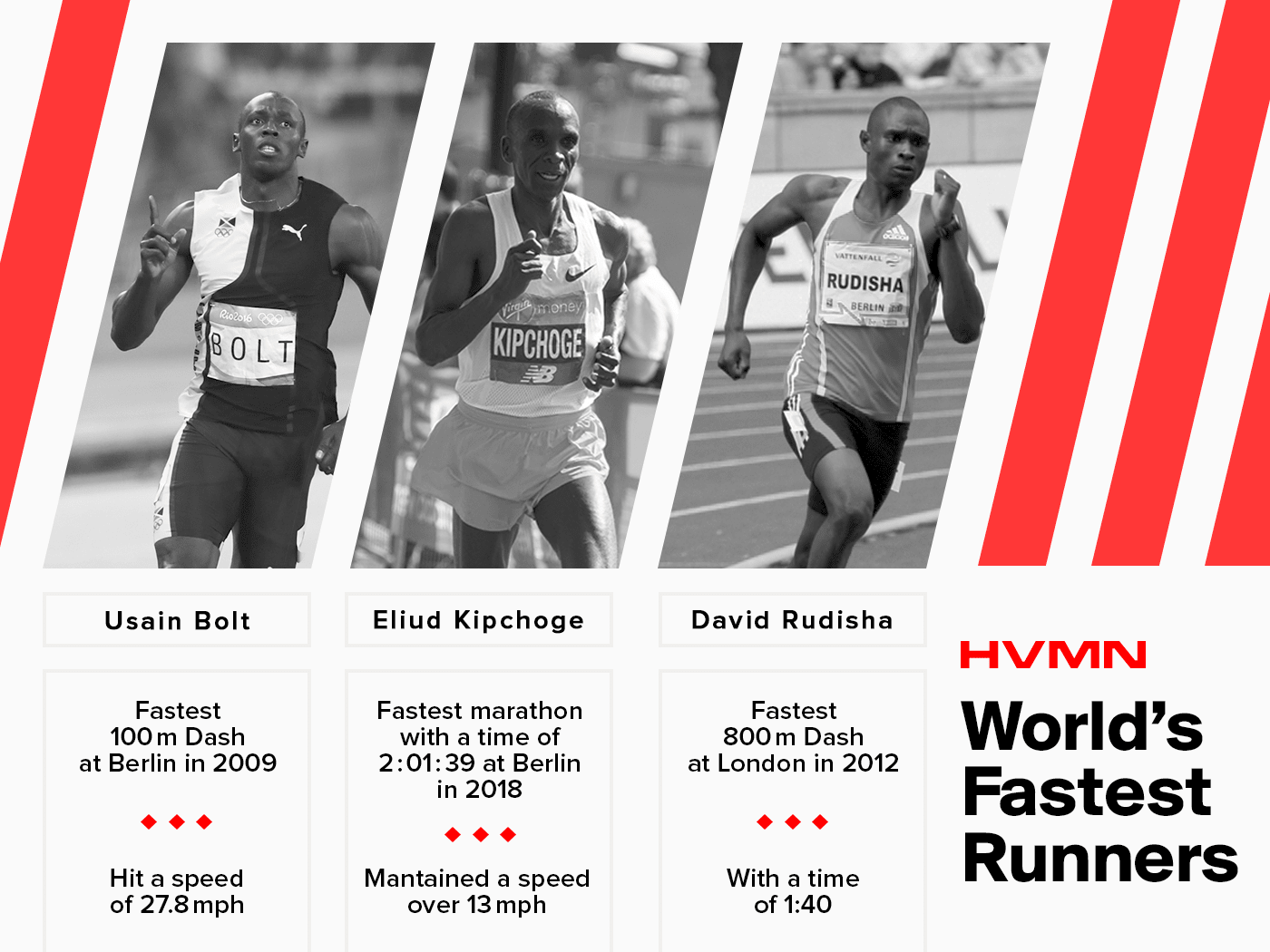
During the 100m dash at the 2009 Berlin World Championships, sprinter Usain Bolt hit 27.8mph. Marathoner Dennis Kimetto ran the 2014 Berlin Marathon in 2:02:57 which was the fastest marathon of all time–until Eliud Kipchoge smashed that record on September 16, 2018 (also at Berlin) with a time of 2:01:39.
These runners exhibit different kinds of speed, each fast in their relative events. While Bolt hit a top speed of nearly 28mph, Kipchoge maintained over 13mph during his world-record setting marathon. The result was an average mile time of 4:38, faster than the max speed of the average treadmill (5 minutes per pace). These are the two extremes: sprints and marathons are almost entirely different sports and ways to exhibit speed.
Between these two efforts, middle distance running (800m, most commonly) provides a unique physiological middle ground.
One study cites the contribution from aerobic and anaerobic variables as allowing a runner to maintain speed during middle distance races. These runners are able to produce velocity without impairment from things like VO2 max (long-distance running), and lactate threshold (sprints).1
The world’s fastest 800m runner is David Rudisha, who holds the world and Olympic record set at London in 2012 with a time of 1:40. That effort broke his own record, set in 2010. Before that? The record was set in 1997 by Wilson Kipketer (who broke his own record several times). And before that? The record was set by Sebastian Coe in 1981. This is interesting when compared to marathon records (broken every few years) and 100m world records (broken even more frequently).
This is all to say that fast doesn’t exist in a vacuum. It depends on things like distance, event, output, and maybe most importantly for the casual runner, personal goal: a number, denoted in time, less than your previous run.
We are not Bolt or Kipchoge. But we share a desire to run faster, whatever that may mean to you as a runner.
Mental Techniques
Running faster is something that must be achieved through physical ability–the body is what propels us forward. But now more than ever, the mental aspect of endurance exercise is being considered a powerful tool to push the body to extreme lengths.
“We’re so fixated on screens. Running is one of the times I can get away from that and be in my own head.” — Sam Robinson
The body and mind are linked; while we’ll explore physical aspects of technique and pacing, we’ll also address mental strategies to employ while on the road or the course.
Welcome the Pain
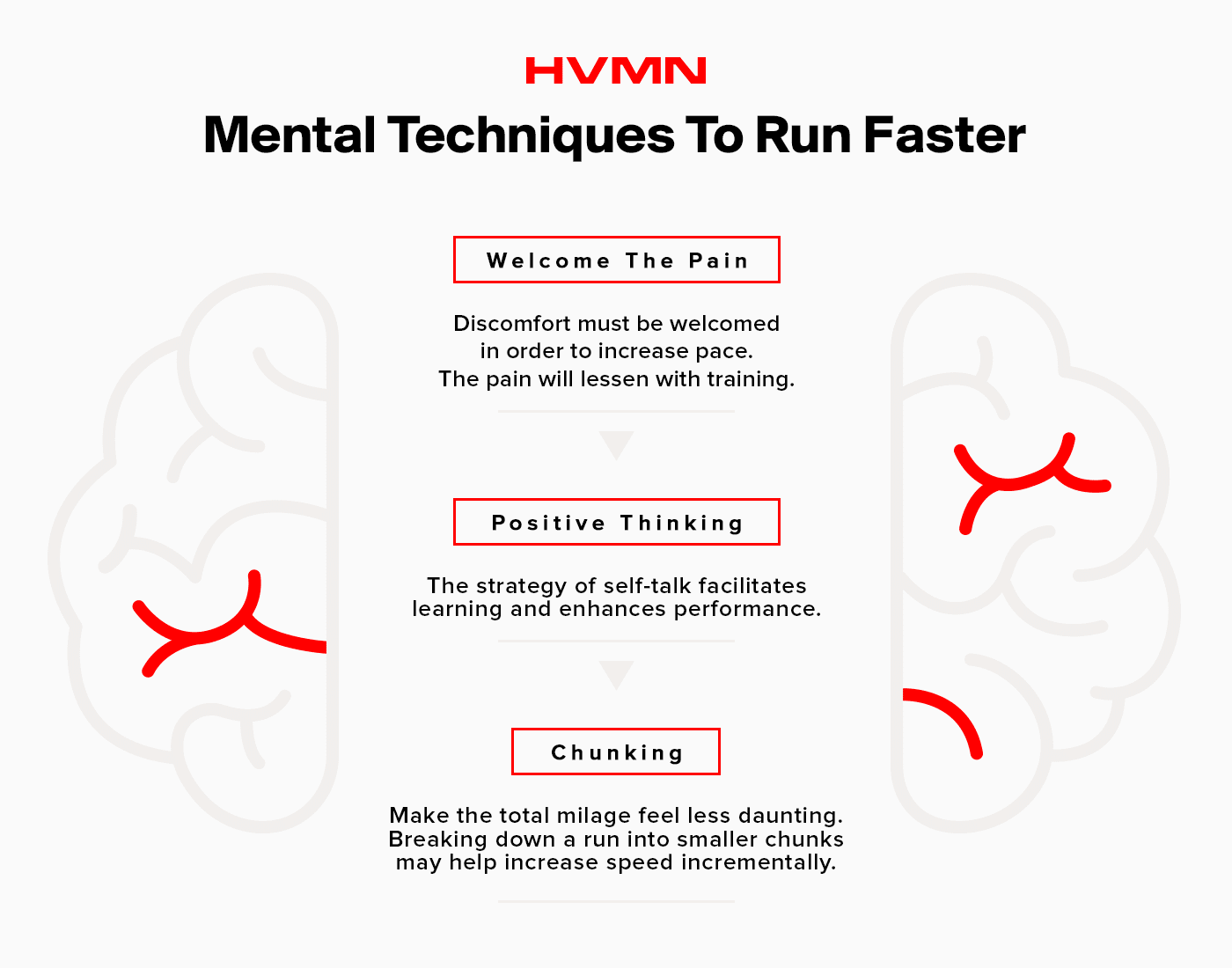
We previously discussed motivational techniques for runners, which points to embracing pain as a way runners can push themselves to log miles every day. The same is true for running faster. There’s an element of discomfort that must be welcomed in order to increase pace.
“Try not to see it as pain, just an intense sensation like spicy food or dark chocolate.” — Michael Brandt, HVMN Co-founder and COO
This is especially difficult for runners who are just starting because they’re not used to the feeling of pain. During workouts like speed training, the pain will come–it’s about being ready for it, anticipating it, and eventually, embracing it.
The pain will lessen with training. Crossing the lactate threshold is the point at which the body cannot recycle the lactic acid accumulated in the blood–it’s then that the body begins sending pain and nausea signals in an effort to make you slow down and thus recycle all that lactic acid. But you can train to increase that lactic threshold and decrease the pain.
With training also comes a knowledge of your body and an understanding of pain, remembering how it feels and at what point in the run it’ll hit.
Positive Thinking
The power of the mind can’t be understated–being aware of your thinking, and how those thoughts make you feel, can have a positive or negative impact on performance outputs. Sometimes telling yourself “you’re great” is the first step to actually making that happen.
One meta-analysis concluded the strategy of self-talk facilitates learning (so it can also help training) and enhance performance.2 Since self-talk has an impact on performance, it’s important to make that self-talk positive.
Cindra Kamphoff has a Ph.D in performance psychology, and she is a performance coach to professional athletes, executives and championships teams from all over the US. She understands the power of the mind and helps athletes harness it. When speaking about the mental aspect of sport, she had this to say: “The negativity is going to come, the disempowering thoughts are going to come because you’re pushing your body. You don’t have to believe them.”
While talking to yourself during a run, it also helps to be mindful. Many runners reach a flowstate of zen or a meditation-like experience. This happens during the run, but its power can be harnessed while off the trail. One study showed that several weeks of mindfulness training could help elite athletes adapt better to stressful situations.3
The ability to harness the connection between body and mind may lead to better results.
Chunking
No, this isn’t adding carbs to your pre-workout.
Breaking a casual run or race into chunks can help–especially for longer runs. This technique can help by making the total mileage feel less daunting. For a marathon distance, a popular way to break it down is into two 10-mile runs and a 10k.
Even on a smaller scale, chunking can be similar to gamifying the run. If you’re running in a city, you might push yourself to the end of the block. During a race, it’s undeniable that seeing the finish line can allow you to tap into a new running gear and push to the end.
Breaking down a run into smaller sections may help increase speed incrementally, which will likely lead to a better overall time.
Training Smart
Training is like juggling. Breathing, form, power–all these things are on your mind with each stride. When one is dropped, the others tend to follow. But it’s during this training process that the best habits are built. And remember, it’s a process.
“Running is about playing the long game. Think of it like a house. A good race or bad race is a single brick in the edifice of your long-term fitness.” — Sam Robinson
Things like intervals and tempo runs can help. It’s also important to track your progress: keep a training log to see how you’ve been able to increase speed after all that hard training.
Intervals
Intervals are great speed workouts for both the aerobic and anaerobic system. They consist of short, high-intensity bursts followed by slow recovery phases which are repeated one after the other. One of the earliest forms of interval training was the Fartlek method (Swedish for “speed play”), and today, many athletes use high-intensity interval training (HIIT). Sometimes, running fast means actually running fast.
Generally, these workouts are ten seconds to several minutes long, run nearly at maximum effort, followed by a rest period of up to four times the length of the effort itself. The shorter the interval, the more of them you’ll likely do.
But the length of intervals (time and distance), power of those intervals, and the rest period, should be optimized for the specific runner. Elite runners can do four intervals of ten minute runs at their 5k pace. Most runners won’t be able to maintain that. An average interval workout is an 8x4: eight repeats of a 400m run done in 90 seconds with a two-minute recovery.
One study in soccer players found that HIIT improved maximal aerobic speed.4 And recreational runners can improve their running economy by replacing aspects of their conventional training with long-interval running.5
Hills
Hill training usually targets power in the legs, meaning higher output. One study found that six weeks of hill workouts increased top speed for runners, while also allowing them to sustain that speed 32% longer.6
Hill repeats are similar to interval training in that they’re usually conducted in short bursts. First, warm up. Then find a hill that’s about 100m long and run hard to the top, with the jog downhill serving as the recovery period. Start with two or four repeats, and work your way up to six or eight.

Tempo Runs
Tempo runs are also known as lactate threshold runs–this is the point at which your body is unable to recycle accumulated lactate in the blood. This is a pace that’s anywhere between ten and 30 seconds slower than a 5k or 10k pace.
The goal of tempo runs is to increase your anaerobic threshold, thus allowing your body to sustain an effort that was previously unsustainable. This training technique tends to benefit longer-distance runners more than sprinters.
Tempo runs should be part of a weekly running routine, and can vary depending on experience level and training needs. One way to incorporate this into training is to start by running 15 - 20 minutes at 75% of maximum heart rate, then build up to 30 - 45 minutes by adding about five minutes to these runs weekly.
Strength Training
While many runners are laser-focused on logging miles, time in the gym can lead to time off your mile splits.7
Two areas of strength training are often employed by runners: leg and core workouts. Weight training can both improve strength and lead to greater running economy (as it did for female runners in this study).8
Exercises like lunges and squats can strengthen those leg muscles used more frequently on runs. And for core workouts, even simple additions like planks and leg raises and weighted sit-ups can positively impact form and posture. Don’t discount yoga and stretching–on days where you’re looking for some active recovery, yoga is perfect for both developing strength in core muscle groups and stretching tight muscles.
Fix Your Form
Essential to running efficiently, improving running form and technique can lead to faster speed. The way you run affects the way force is applied to your muscles and joints. Correcting form can be help injury prevention, as improper execution can cause injury if you’re a beginner;9 if you aren’t running, you aren’t getting faster.
“People assume that running is running is running, but it's not true. Especially when we sit at our desks all day, or aren't used to it.” — Michael Brandt, HVMN Co-founder and COO
Good overall form can feel like a unicorn; it’s best broken down into a few manageable techniques to consider on each run.
Stride Turnover
Changing stride turnover–how my steps taken during one minute of running–may have an impact on speed.10
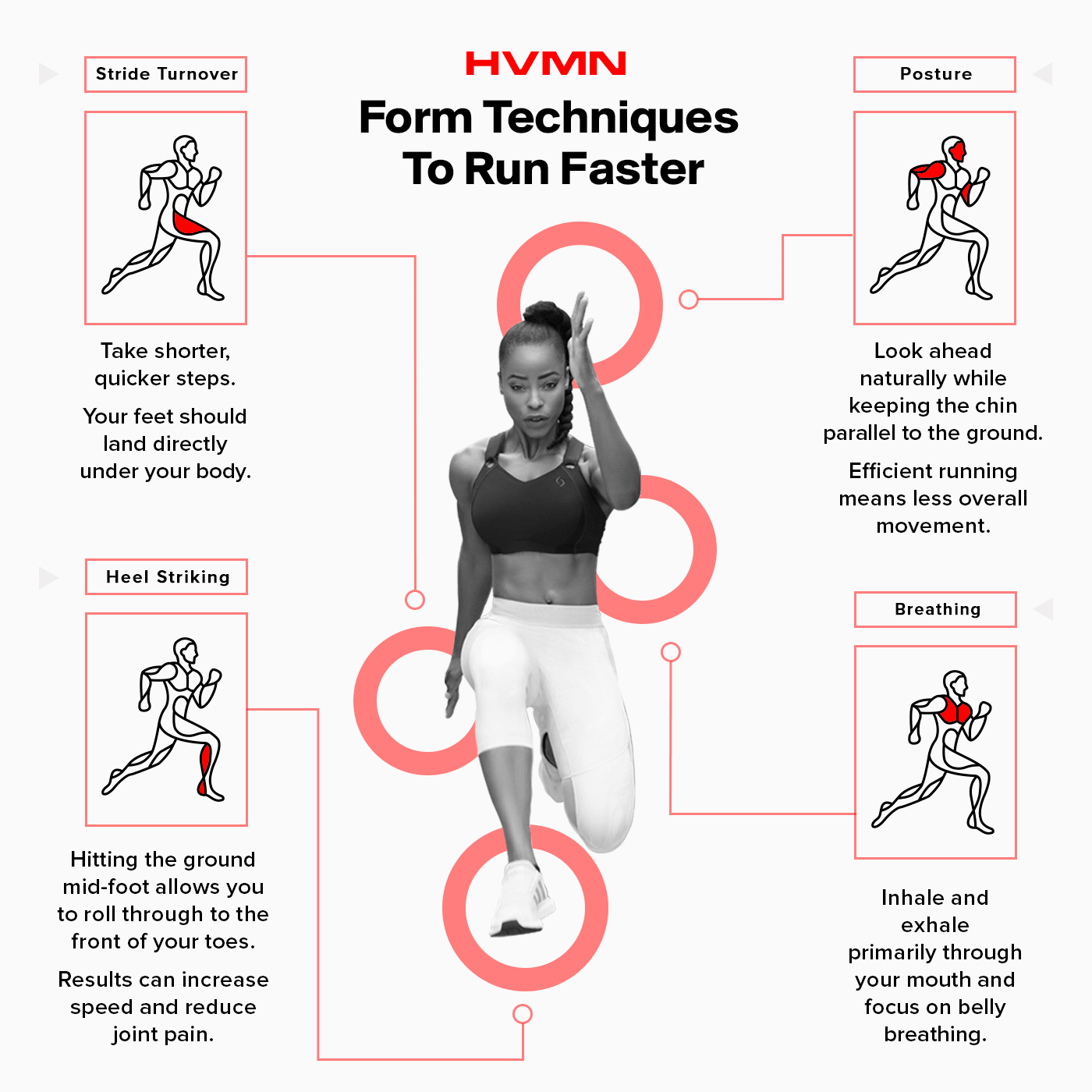
The goal is to have a higher stride turnover, meaning to take shorter, quicker steps; these reduce the impact on your joints because you’ll hit the ground with less force. Longer strides have the opposite effect, and can create more impact because you’re in the air for longer. Sprinters will typically need to lift their knees higher to achieve maximum leg power, but distance runners won’t need as much lift.
Figuring out your stride turnover is easy. Just run for one minute at your 5k pace and count the number of times your right foot hits the ground. To improve stride turnover, jog for one minute to recover, trying to increase your stride count by one. Repeat this several times with the goal of increasing strides each time.
At the proper stride length, your feet should land directly under your body. And when your foot strikes the ground, your knee should be slightly flexed, bending naturally to the impact. Keep in mind that the middle of your foot should be making contact with the ground–not your heel.
Heel Striking
It’s a very common problem for runners.11 Landing on your heel can mean too long of a stride, which wastes energy and may cause running injuries (hello, shin splints).12 Avoid landing on toes too–this can also increase fatigue and wear out your calves.
You want to be a mid-foot striker. Hitting the ground mid-foot allows you to roll through to the front of your toes. Changing your footstrike takes practice, but the results can show up both in speed and in reduced joint pain. One study of runners from habitually barefoot populations showed an increase in speed when mid-foot or front-foot striking.13
Overstriding is usually the culprit–try increasing your number of strides. Your next run, focus on striking on the balls of your feet. Interestingly, that’s where most people strike when running barefoot; try running on grass (or another soft surface) without any shoes on, translating that muscle memory to other runs. Also, running drills can help. Skipping, high knees, side shuffling, butt kicks–with all these, it’s almost impossible to land on the heel.
One last thing. It may seem obvious, but keep those toes pointed in the direction you want to travel. As fatigue sets in, form gets wonky–you may find your toes are turning in or out, which can lead to joint pain.
Relax
It goes from top to bottom and will have an impact on running posture.
Relax your shoulders. Relax your arms. Relax your hands.
Posture
“Running tall” is a repeated mantra meant to encourage good running posture.
It starts with the head: look ahead naturally while keeping the chin parallel to the ground, and avoid looking down at the feet. This should improve posture in your neck, shoulders and back–which, remember, should be relaxed.
Avoid hiking up your shoulders, which can happen naturally with stress. Upon feeling your shoulders close your ears, try giving them a good shake to relax and keep them level.
Efficient running means less overall movement. Arms, at a 90-degree angle, should swing back and forth around the waist, powering the lower body. Think of yourself as two halves: left and right, and keep each arm on that side of the body. Tension in the upper body is controlled by the hands, so relaxed hands are also important. You may notice tension developing throughout the run as it gets more difficult–imagine you’re carrying an egg in each hand and watch that tension disappear.
The torso and back should be naturally straight, as this promotes optimal lung capacity and stride length. Slouching during a run? Try a deep, realigning breath and hold position.
Breathing
We’ve discussed VO2 max, and its impact on the body’s ability to use oxygen efficiently. Since oxygen is feeding those muscles, it’s important to understand how to take in the most air possible.
Inhale and exhale primarily through your mouth–it’s the most effective way to take in oxygen. Your nose can join the party too, but it can be difficult for some to breathe through both simultaneously. Practice makes perfect here; you can try it throughout the day to help get the body adapted to the technique.
And focus on belly breathing, with the force of the inhale extending to the diaphragm with the stomach expanding. These should be deep, slow, rhythmic breaths. Overall, you should see a decrease in cramps and an increased ability to pace yourself.
Sleep & Recovery
The importance of rest cannot be understated–but it’s often forgotten or unaccounted for in a training plan.
“Our culture has a ‘no pain, no gain’ mindset. But that’s not how the body works exactly. You need to recover properly.” — Sam Robinson
Sleep and recovery days are important to give tired muscles a chance to rebuild tissues that have been broken down during exercise.14 That breakdown is meant to cause muscles to adapt and become stronger, thus potentially leading to increased speed. Sleep is also part of this process. It’s important to encourage good sleep: set a sleep schedule and get some screenless time before bed, because screens can negatively impact rest.15 One study found that lack of sleep can lead to muscle degradation.16
Recovery runs are a must. These should be done at a slower, less-strenuous pace that allows the body to recycle lactate as its produced. This pace per mile should be about one minute or 1:30 more than your average pace.
Consuming Your Way to Speed
What you eat, and the supplements you take, can have an impact on how fast you run. A body operating on high-octane fuel will undoubtedly perform better than one with a less-optimized fuel source.
Diet
Diet can have a roundabout effect on speed through a few different avenues.
It directly impacts body composition, which affects speed. It can also determine the body’s fuel source, meaning that a diet low in carbohydrates can lead to fat-adaptation, allowing the body to tap into fat stores. If you aren’t a fat burner, carbs are essential to keep running pace, as glycogen depletion leads to bonking. And after a run, diet can help with recovery, enabling the body to train again faster.
VO2 max is a measure of one’s running fitness; it’s the maximum amount of oxygen that can be delivered to working muscle per unit of body mass. Those with higher VO2 maxes are better runners. And because body weight impacts VO2 max, the lighter the runner means a higher VO2 max which can mean a lighter runner is a better runner.
Many distance runners are employing the ketogenic diet for weight loss. The low-carb, high-fat diet can force a metabolic adaptation allowing the runner to burn fat as fuel (as opposed to carbs). And the restricting of carbohydrates often leads to better body composition.
Counting calories may help you lose weight. While the macronutrient composition of food can be more important than the amount of calories, counting calories while on keto might lead to greater results.

Supplements
We’ve covered supplements for runners extensively, providing you with a toolkit from training to race day to recovery. You’ll want to focus on those for race day, as they’re the supplements that can have a direct correlation to speed.
Many runners drink coffee and consume carbohydrates before a race, giving the body fuel sources to immediately tap into. Buffers are also useful, and may delay the onset of muscle pain associated with the building up lactic acid in the blood (but really it’s the proton associated with lactate)–check out sodium bicarbonate, Beta-alanine and HVMN Ketone.
HVMN Ketone
Ketones are a fundamentally different fuel source from carbohydrates and fats that cells normally use for energy.
Taken before or during exercise, D-BHB (the ketone body in HVMN Ketone) is 28% more efficient than carbohydrates alone, helping your body do more work with the same amount of oxygen.17 In one study, cyclists went ~2% further in a 30-minute time trial.18
When taken with carbs, the glycogen-sparing effect of HVMN Ketone helps many runners–the body will preferentially use the ketones as fuel first, saving glycogen for later in the race, when the need it most.
"By consuming exogenous ketones, athletes give themselves an additional source of fuel that they can burn first, thus preserving glycogen." — Allison Goldstein, Runner’s World
HVMN Athlete and professional cyclists, Vittoria Bussi, recently broke the world record for the women’s Hour: riders see how far they can cycle in a velodrome in one hour. Vittoria used HVMN Ketone before her attempt, citing its effectiveness later in the race.
Read more about Vittoria’s story here.
Running Fast: a Personal Pursuit
With countless ways to measure and track and compare and share statuses, it’s important to remember that on a run, it’s just you and the road. You should want to improve. You should want to get faster. You should expect to work to get there.
Running isn’t about taking shortcuts, if you want to get faster, you have to train. Aspire to some of the world’s best runners, and use that as motivation each time you lace up your shoes to run.
Want to get even faster?
We're currently exploring nutritional techniques to improve performance. Subscribe, and be first to know when our guides are published.
Scientific Citations
1.Brandon LJ. Physiological factors associated with middle distance running performance. Sports Med. 1995 Apr;19(4):268-77.
2.Hatzigeorgiadis A, Zourbanos N, Galanis E, Theodorakis Y. Self-Talk and Sports Performance: A Meta-Analysis. Perspectives on Psychological Science. 2011 July; 6(4): 348-356. https://doi.org/10.1177/1745691611413136
3.Haase L, May AC, Falahpour M, et al. A pilot study investigating changes in neural processing after mindfulness training in elite athletes. Front. Behav. Neurosci., 27 August 2015 | https://doi.org/10.3389/fnbeh.2015.00229
4.Dupont G, Akakpo, K, Berthoin, S. The Effect of In-Season, High-Intensity Interval Training in Soccer Players. Journal of Strength and Conditioning Research: 2004; 18(3): 584–589.
5.Franch J, Madsen K, Djurhuus MS, Pedersen PK. Improved running economy following intensified training correlates with reduced ventilatory demands. Medicine and Science in Sports and Exercise [01 Aug 1998, 30(8):1250-1256].
6.Ferley D, Hopper DT, Vukovich M. Incline Treadmill Interval Training: Short vs. Long Bouts and the Effects on Distance Running Performance. International Journal of Sports Medicine 2016 Aug; 37(12). DOI: 10.1055/s-0042-109539
7.Storen O, Helgerud J, Stoa EM, Hoff J. Maximal Strength Training Improves Running Economy in Distance Runners. Med. Sci. Sports Exerc., Vol. 40, No. 6, pp. 1089–1094, 2008.
8.Johnston RE, Quinn TJ, Kertzer R, Vroman NB. Strength training in female distance runners: Impact on running economy. J. Strength and Cond. Res. 11(4):224-229. 1997
9.Kluitenberg B, van Middelkoop M, Diercks R, van der Worp H. What are the Differences in Injury Proportions Between Different Populations of Runners? A Systematic Review and Meta-Analysis. Sports Med. 2015; 45(8): 1143–1161. doi: 10.1007/s40279-015-0331-x
10.Hogberg, P. Arbeitsphysiologie (1952) 14: 437. https://doi.org/10.1007/BF00934423
11.Larson P, Higgins E, Kaminski J, et al. Foot strike patterns of recreational and sub-elite runners in a long-distance road race, Journal of Sports Sciences. 2011;29:15, 1665-1673, DOI: 10.1080/02640414.2011.610347
12.Daoud, AI, Geissler GJ, Wang F, Saretsky J, Daoud YA, Lieberman DE. Foot Strike and Injury Rates in Endurance Runners: A Retrospective Study. Med. Sci. Sports Exerc., Vol. 44, No. 7, pp. 1325–1334, 2012
13.Hatala KG, Dingwall HL, Wunderlich RE, Richmond BG (2013) Variation in Foot Strike Patterns during Running among Habitually Barefoot Populations. PLoS ONE 8(1): e52548. https://doi.org/10.1371/journal.pone.0052548
14.Parra J, Cadefau J A, Rodas G, Amigo N, Cusso R. The distribution of rest periods affects performance and adaptations of energy metabolism induced by high‐intensity training in human muscle. Acta Physiologica Scandinavica, 169: 157-165.
15.Exelmans L, Van den Bulck J .Bedtime mobile phone use and sleep in adults. Soc Sci Med. 2016 Jan;148:93-101.
16.Dattilo M, Antunes H K M, Medeiros A, Mônico Neto M, Souza H S, Tufika S, de Mello M T. Sleep and muscle recovery: Endocrinological and molecular basis for a new and promising hypothesis. Medical Hypotheses Volume 77, Issue 2, August 2011, Pages 220-222.
17.Sato, K., Kashiw.aya, Y., Keon, C.A., Tsuchiya, N., King, M.T., Radda, G.K., Chance, B., Clarke, K., and Veech, RL. (1995). Insulin, ketone bodies, and mitochondrial energy transduction. FASEB J. 9, 651-658.
18.Cox, P.J., Kirk, T., Ashmore, T., Willerton, K., Evans, R., Smith, A., Murray, Andrew J., Stubbs, B., West, J., McLure, Stewart W., et al. (2016). Nutritional Ketosis Alters Fuel Preference and Thereby Endurance Performance in Athletes. Cell Metabolism 24, 1-13.
Alcohol & Weight Loss
Alcohol & Weight Loss | After Your First Two Drinks
After your first drink, your body starts to get rid of the alcohol quickly using the alcohol dehydrogenase (ADH) pathway.1 In this pathway, ADH converts the alcohol into acetaldehyde, which gets further broken down to acetate. These by-products (acetaldehyde and acetate) are considered to be highly reactive and can increase oxidation throughout the body, but especially in the liver.
Because your body sees these by-products as dangerous, it wants to use them as fuel.This means your body will significantly blunt fat-burning close to 75% after just one and a half drinks.2 And it will stop using carbs for energy. Therefore, although very little alcohol will be stored as fat (less than 5%), the fat and carbs you are eating have an increased risk of being stored as fat.
Your liver can process these toxins through the increased use of certain vitamins, such as the water soluble vitamins B1, B3, B6, folate and C, while also possibly depleting some of the fat-soluble vitamins, A, E and K1. Over-time these decreases in vitamins can play a secondary role in loss of motivation, energy, and well-being.
After your first couple of drinks, your brain also starts to increase its usage of GABA. GABA is an inhibitory neurotransmitter in the brain and is a large reason why alcohol is known as a “depressant.” Over time, the GABA receptors get used to the effects of alcohol, which is a reason why people may need more and more alcohol to feel the effects from alcohol consumption.3 GABA is also the neurotransmitter, principally responsible for allowing you to stay asleep. Therefore when your brain uses more of it before you go to sleep, you have less while you’re actually sleeping, causing a disruption in restful sleep.
Alcohol also affects the higher processing areas of the brain, the cerebral cortex, while leaving the lower areas of the brain somewhat unaffected. This leaves you more emotional than you would normally be. If you’ve ever experienced “drunk logic” while doing or saying things you would never think to do sober, then you’ve experienced the inhibitory effects of having your cerebral cortex taken out of the equation.
While your body has started to use the alcohol as energy, your body releases anti-diuretic hormone (ADH) to help your body rid itself of the alcohol. This basically means that your urine volume increases significantly (about 100 ml per 10 grams of alcohol).4 If you’ve ever “broken the seal,” you know that the more you continue to drink, the more frequently you use the restroom.
Since your kidneys are working over-time, your body releases an increase in certain minerals and electrolytes especially calcium, magnesium, copper, selenium and manganese. All of these play important roles not only in blood volume, but in bone health, blood pressure and the anti-oxidant pathways.
In addition to everything above, a small increase in cortisol typically occurs with moderate drinking while testosterone levels will drop about 6.8% in men (not so much in women).5 Aromatase will also increase. Aromatase is an enzyme that helps to convert testosterone to estrogen and is obviously not something that is welcomed by many guys.
Alcohol & Weight Loss | After Six to Eight Plus Drinks
If you’re drinking a moderate amount of alcohol, those things listed above are the main effects, at least short-term. If you drink heavily and drink often, another system called the Microsomal Ethanol-Oxidizing System (MEOS) system kicks in at the point when the ADH pathway becomes overwhelmed.
This system is interesting because it causes your body to generally burn off more energy as useless heat and probably saves your life from too high of a blood alcohol level. It is primarily controlled by a special enzyme that plays an important role in utilizing certain medications and the metabolism of fatty acids. This increased rate of medication breakdown can decrease their effectiveness, while the incomplete breakdown of fatty acids can cause an increase in oxidation. This increase in oxidation becomes exacerbated as the body’s main anti-oxidant (glutathione) is also impaired, decreasing your ability to fight the oxidation.
As your drinking levels continue to increase, testosterone levels drop from 6.8% with 4 drinks to 23% with 8 drinks.6 This drop, combined with a slowdown in protein synthesis, can cause havoc when trying to recover from a workout.
In addition to that, fluid loss will generally become more significant, causing dehydration that might affect you for days afterwards. Finally, with heavy drinking, the breakdown of alcohol can occur for up to 48 hours after your last drink. This means less glucose is reaching your brain and working muscles, making you both more tired and quicker to fatigue if you do exercise.
If You’re Going to Drink Alcohol, Drink in Moderation and Not Too Often
You would think after listing all that happens in your body after consuming alcohol, the no-brainer suggestion would be to not drink. What is missing though are some of the benefits from consuming moderate amounts of alcohol.
Alcohol is shown to increase insulin sensitivity, which basically means that your body needs less insulin to do its job. In addition to that, research has shown that women who drink a moderate amount will have the same or slightly lower BMI, as those who don’t drink.7 The same effect is not seen in men. Those who moderately drink are also at less risk of dying from heart disease and cancer while decreasing one’s risk of Alzheimer’s8and even slightly improving your immune system.9
In other words, complete abstinence may not be needed while trying to lose fat as long as it’s done in moderation and not very often (think one time per week). If you don’t drink, obviously don’t start, but if you want to have a couple of drinks on the weekend, there is nothing necessarily wrong with having one or two. In future articles, I will list some of the best and worst drinks to have when going out and 5 strategies you can implement to decrease the deleterious effects of having a night of heavy drinking.
Alcohol & Weight Loss | Wrapping It Up
In any fat loss plan, there are three main components that should be priority: Diet, Exercise, and Sleep.
As stated throughout the article, a moderate amount of alcohol can increase total calories, decrease your motivation for exercise, and negatively affect your sleep. Despite this, many people can enjoy a drink or two, without throwing those three components completely out of whack.
On the other hand, drinking heavily can significantly derail energy levels, has a larger influence on dehydration, negatively impacts hormonal levels, and can significantly disrupt your sleep. Therefore, limit your overall levels of alcohol and put yourself in the best position to reap some of the benefits of alcohol consumption, while not derailing your overall progress.