
These articles explore the body, the mind, the environment, and the systems that shape human health. Each piece is written to make complex ideas easier to understand, whether the topic is training, nutrition, sleep, stress, digestion, symptoms, physiology, disease, or the way modern life affects how we feel and function.
Strength, Health, & the Art of Living Well

How to Build Bigger Arms: What an Arm Specialization Phase Actually Requires
Most people treat arm training like an accessory. They train chest, back, or shoulders, then finish the workout with a few curls and pressdowns and assume that, because the arms were trained, they should continue to grow. That can work for a while, particularly when someone is new to lifting. Eventually, though, a muscle that you genuinely want to improve has to become more than something you get to when the important work is finished.
An arm specialization phase changes the way the program is organized around the goal. That doesn’t mean doing an absurd number of curls or adding an extra arm day onto an already crowded week. It means deciding that arm growth is temporarily a priority, then making room for that priority through exercise order, volume allocation, exercise selection, progression, and recovery.
If your arms have looked essentially the same for the last year, the answer may be more training. But before adding more, it’s worth asking whether the training you’re already doing is organized well enough to produce the result you want.
1. Reallocate Volume Before Adding Volume
The easiest response to a lagging muscle is to add more sets. If ten sets haven’t worked, do twelve. If twelve haven’t worked, do fifteen. Eventually the program becomes a collection of everything you were already doing plus an increasing amount of work for the body part you’re trying to bring up.
That ignores the recovery cost of the rest of the program.
Your arms are already involved in much of your upper-body training. The triceps contribute to pressing, while the elbow flexors contribute to most pulling movements. Adding substantial direct arm volume without accounting for that existing work can increase fatigue faster than it improves the stimulus.
A specialization phase should therefore begin by moving training resources, not simply creating more of them. If arms become a higher priority, chest, back, shoulder, or total upper-body volume may temporarily come down. You’re creating room for the arms to receive more high-quality work while preserving your ability to recover from it.
Specialization always involves a tradeoff. You cannot make everything the highest priority at the same time.
2. Put the Priority Muscle First
Exercise order is one of the simplest ways to change the emphasis of a program without changing a single exercise.
Whatever you train first is performed when you’re least fatigued. Your ability to produce force is higher, technique is generally easier to maintain, and the target muscle hasn’t already accumulated fatigue from several other movements. If the arms are always trained after an hour of heavy pressing and pulling, you’re asking them to grow from whatever training quality remains.
That may be fine when arm development is secondary. It makes less sense when it becomes the goal.
During an arm specialization phase, direct arm work can move to the beginning of a session or receive its own dedicated training day. You may even place the muscle you most want to improve first within the arm workout itself. Someone with particularly underdeveloped triceps doesn’t necessarily need to alternate which muscle goes first simply for the sake of fairness. Priorities should determine exercise order.
Your program should reveal what you claim matters.
3. Train the Elbow Flexors, Not Just the Biceps
When people say they’re training biceps, they often use “biceps” as shorthand for everything on the front of the upper arm. Anatomically, elbow flexion involves more than the biceps brachii.
The brachialis contributes strongly to elbow flexion, while the brachioradialis also becomes an important contributor depending on forearm position. Changing your grip changes the contribution of these muscles. A supinated curl places the biceps brachii in a favorable position to contribute. Neutral-grip hammer curls and pronated reverse-curl variations alter that relationship and provide a different challenge to the elbow flexors.
This is why an arm program built entirely around slightly different versions of the same supinated dumbbell curl leaves something on the table.
Exercise variety becomes useful when the exercises are actually different. A supinated curl, hammer curl, and reverse curl represent different forearm positions and slightly different demands on the elbow-flexor group. That gives you a more complete reason for including several exercises than simply choosing three curls because they use different pieces of equipment.
4. Choose Exercises by Where They Load the Range
Two exercises can train the same muscle and still provide meaningfully different stimuli.
What matters is not only which muscle is moving the joint, but where in the range of motion the exercise becomes most difficult. The external resistance created by gravity, a cable, a machine, or another form of loading changes relative to the joints as you move. As a result, one curl may challenge the elbow flexors heavily when they’re relatively lengthened, while another creates more difficulty toward the shortened end of the movement.
That distinction gives exercise selection a purpose.
Instead of asking whether preacher curls are “better” than spider curls or cables are “better” than dumbbells, ask what each exercise contributes to the program. If all three movements become hardest in essentially the same portion of the range, the variety may be more cosmetic than physiological.
A better arm program exposes the muscle to meaningful loading across different portions of its available range. You’re building a collection of complementary exercises rather than collecting exercises for their own sake.
5. Give the Triceps Different Shoulder Positions
The same principle becomes particularly useful when training the triceps because one of the three heads—the long head—crosses both the elbow and shoulder.
That means shoulder position changes the length and mechanical environment of part of the triceps. A pressdown, lying extension, overhead extension, and dip are therefore not interchangeable simply because they all involve elbow extension.
Pressdowns are useful, but an entire triceps program built around the arm staying beside the torso limits the positions through which you train the muscle. Overhead extensions place the shoulder in flexion and lengthen the long head differently. Lying extensions create another loading profile. Dips or pressing variations expose the triceps to still another combination of shoulder and elbow mechanics.
You don’t need every possible angle in every workout. Over the course of a specialization phase, however, using different shoulder positions gives you a more complete triceps stimulus than repeatedly changing attachments on the same pressdown.
6. Pair Biceps and Triceps Strategically
Training biceps and triceps together allows you to use antagonist pairings: perform a biceps exercise, rest briefly, perform a triceps exercise, then return to the biceps after the appropriate recovery period.
This makes arm training unusually well suited to efficient programming. While one muscle group is working, its antagonist is not performing the same task, allowing you to accumulate a considerable amount of direct arm work without turning the workout into a long sequence of isolated straight sets.
The important distinction is between training density and rushing.
Alternating biceps and triceps shouldn’t mean moving so quickly that performance collapses. If the purpose of the set is hypertrophy, you still need enough recovery to produce high-quality repetitions and maintain the intended loading. The pairing simply allows some of that recovery time to be occupied by training the opposing muscle.
Done well, you can fit more productive arm training into the same amount of time without turning every set into conditioning.
7. Specialization Can Justify More Exercise Variety
Most muscles don’t require an enormous exercise menu in a normal training program. If a body part is receiving only a moderate amount of weekly volume, two well-chosen exercises may provide everything you need.
Specialization changes the problem.
Once you deliberately increase direct work for a muscle, relying on one or two movements for all of that volume can become limiting. Repeating the same joint angles, loading profiles, grips, and positions across a large number of sets may make the additional volume increasingly redundant.
That’s where three or four complementary exercises can make sense.
The word complementary is doing most of the work. Four exercises should give you more than four names in your training log. You might combine different forearm positions for the elbow flexors, different shoulder positions for the triceps, and exercises that emphasize different portions of the resistance curve.
Variety has value when it expands the stimulus. Novelty for its own sake simply makes progression harder to track.
8. Use Intensifiers for a Reason
Drop sets, tri-sets, and mechanical-advantage sets can all make an arm workout considerably harder. That alone doesn’t make them better.
Their value is that they allow you to extend productive work under circumstances where a conventional straight set has reached its limit.
A mechanical-advantage set is a good example. You begin with a variation in which your leverage is relatively poor, take that movement close to or to its prescribed endpoint, then shift into a mechanically stronger version that allows you to continue working the same general musculature. The load doesn’t necessarily have to change because your position changes your ability to continue producing force.
That is different from randomly adding intensity techniques because you want the workout to hurt more.
Intensifiers should have a job. They can increase training density, extend a set, increase the amount of work performed with a given load, or expose the muscle to a different fatigue environment. Used selectively, they can be very useful during specialization. Used everywhere, they mostly make fatigue harder to manage.
9. Progress Arms in Smaller Increments
Progressive overload becomes awkward with smaller exercises because the equipment often increases in increments that are disproportionately large.
Going from a 30-pound dumbbell to a 35-pound dumbbell is a 16.7% increase in load. Nobody would expect someone squatting 300 pounds to casually add 50 pounds the next week simply because that happens to be the next weight available.
Yet that is effectively what we sometimes ask people to do with curls.
Microplates, adjustable dumbbells, cable stacks with smaller increments, and fractional loading can make progression much more realistic. When smaller load increases aren’t available, progression can also occur through repetitions, improved range of motion, more consistent execution, or eventually additional sets.
The important part is that the progression is measurable.
If you curled 30 pounds for ten technically consistent repetitions and several weeks later you can perform twelve with the same execution, something improved. If you immediately jump to 35 pounds and turn the movement into a combination of lumbar extension, shoulder flexion, and hope, the number on the dumbbell increased while the training stimulus became harder to evaluate.
10. Change the Prescription After You’ve Adapted to It
Consistency is necessary for progression because you need enough repeated exposure to an exercise and training method to become proficient and determine whether it’s working. Changing exercises every workout prevents you from establishing that baseline.
But consistency doesn’t mean keeping the same program indefinitely.
Eventually, progress slows. Repetitions stop increasing. Loads stop moving. An exercise that once produced a very strong local stimulus may begin producing more joint discomfort or systemic fatigue than useful progression. A training method that worked well for several weeks may simply have given you most of what it currently has to offer.
That is when variation becomes useful.
You might change the rep range, loading method, resistance profile, exercise, or way movements are paired. The change should answer something you observed in the previous phase. If the program is still working, there’s very little reason to abandon it. If progress has clearly flattened despite adequate recovery and execution, changing part of the prescription gives you a new problem to adapt to.
The goal is neither endless novelty nor stubborn consistency. It is to keep a useful stimulus progressing.
Build the Program Around the Priority
Bigger arms don’t require secret exercises. They require the same thing every other stubborn training goal eventually requires: better organization.
If arm development is genuinely important to you, give it a period in which the rest of your training reflects that decision. Move volume away from lower-priority work. Train the arms before they’re exhausted. Understand the muscles you’re trying to develop. Choose exercises because they contribute different loading conditions. Progress them with increments that make sense. Use advanced methods when they solve an actual programming problem, and change the prescription when you have evidence that the current one has stopped moving forward.
An arm specialization phase should look different from simply adding an arm workout.
Otherwise, you haven’t specialized. You’ve just added more training.
Your Lower Back May Be Limiting More Than You Think
The lower back tends to enter the conversation only when it hurts. Until then, most people treat it as something that should stay out of the way while the “real” muscles do the work. You train your legs with squats, your hamstrings with Romanian deadlifts, your back with rows, and your shoulders with presses. The lower back is simply assumed to be along for the ride.
But that’s not really how those movements work.
Your lower back is one of the structures responsible for maintaining the position that allows force to move through the rest of the body. In a squat, your legs and hips may be producing most of the force needed to move the weight, but that force still has to pass through a trunk capable of holding its position. In an RDL, your hamstrings and glutes may be strong enough to keep working, but if your spinal erectors can no longer maintain the position of your torso, the set is effectively finished. The same thing can happen in a bent-over row, a loaded carry, a deadlift, or even a standing press.
This is where the lower back becomes more than a support structure. It becomes part of the system that determines how much of your strength you can actually use.
A person can have strong legs and still struggle to express that strength in a squat because the torso loses position under load. The hamstrings can have more to give during an RDL while the lower back is already exhausted. The upper back can still be capable of producing force in a row, but that capacity becomes irrelevant once you can no longer hold the position required to perform the exercise well. In each case, the muscle you’re trying to train may not be the thing ending the set.
That distinction is important because it changes how you think about weak links. A weak link isn’t necessarily the muscle producing the least force. Sometimes it’s the structure that can no longer maintain the conditions that allow everyone else to keep producing force.
Working Hard Doesn’t Mean It’s Fully Trained
This is also where the usual response of “I already squat and deadlift, so my lower back gets plenty of work” becomes a little too simple.
Of course it gets work. The spinal erectors are involved heavily in those exercises. But involvement and complete development aren’t the same thing.
A muscle can accumulate a lot of fatigue while performing a supporting role without necessarily being trained in the way that would best improve its strength or endurance. During a squat, for example, the lower back may be working very hard to resist the tendency of the torso to collapse forward. That can make it tired. It doesn’t automatically mean the squat is the best exercise for improving every quality of lower-back strength.
This is one of the reasons direct training can make sense even for someone who already performs plenty of compound lifts. It allows you to isolate the problem more deliberately. You can choose the position you want to strengthen, control the amount of load and fatigue, and build capacity without relying on the lower back to improve as a side effect of something else.
That doesn’t mean everyone needs to start hammering heavy good mornings three times a week. The lower back already participates in a lot of training, so direct work has to account for everything else you’re asking it to do. If you’re squatting, deadlifting, doing unsupported rows, and performing heavy hinges during the same week, piling more heavy hinge work on top may create more fatigue than progress. The point of direct training is to address a limitation, not to create another one.
Different Exercises Challenge the Lower Back Differently
It also helps to stop thinking of every posterior-chain exercise as interchangeable. An RDL, good morning, 45-degree back extension, horizontal back extension, and reverse hyper can all involve the lower back, but the mechanical demands aren’t identical.
One useful way to organize them is by looking at where in the movement they tend to become most demanding.
Romanian deadlifts and good mornings place a large demand on the lower portion of the hinge. As the torso travels farther away from upright, the weight gains more leverage against you. The muscles responsible for extending the hips and maintaining the position of the spine have to produce more force to resist that leverage. This makes RDLs, standing good mornings, and seated good mornings useful when you want to become stronger while the torso is farther forward.
A 45-degree back extension changes that profile. It generally moves the challenge more toward the middle and upper portion of the movement, although this is where it becomes important not to pretend these categories are exact. Bench angle, range of motion, body proportions, technique, and where you hold the weight can all change the exercise considerably. Holding a plate against your chest creates a different resistance profile than holding it at arm’s length. Increasing the range changes the problem again. The 45-degree extension is better thought of as a flexible tool that can be manipulated than as an exercise that belongs permanently to one exact point on a strength curve.
Horizontal back extensions and reverse hypers shift the problem again. As the torso approaches horizontal during a back extension, or as the legs rise toward horizontal during a reverse hyper, the external demand increases. These movements can therefore be useful for strengthening the upper portion of the range.
The reverse hyper also deserves to be considered separately from a conventional back extension because the body is organized differently. In a back extension, the lower body is relatively fixed while the torso moves. In a reverse hyper, the torso is supported while the legs move. Both involve the posterior chain, but they ask the system to solve the movement in different ways.
None of this means the lower back is neatly divided into three separate sections that can be isolated with the correct exercise. That would be taking the strength-curve idea too literally. These classifications are useful because they help us think about where an exercise tends to create the greatest external demand, but the exact profile will always depend on how the exercise is performed.
What This Means for Your Training
You don’t need every lower-back exercise in the same program. In most cases, that would simply be redundant.
A better approach is to look at what your current training already provides and where you appear to lose capacity. If you already perform heavy squats and RDLs, you’re getting a considerable amount of work while the torso is inclined forward. Adding another heavy good morning may give you more of the same thing when what you actually need is additional work with a different resistance profile. A 45-degree back extension or reverse hyper might make more sense.
If your position consistently breaks down near the bottom of an RDL or good morning, strengthening that deeper hinge position may deserve more attention. If you’re strong there but lose control or force as you approach extension, another exercise may be more useful. The exercise should solve a problem you actually have.
The same principle applies to strength and endurance. The lower back needs enough strength to tolerate heavy loads, but it also needs enough endurance to maintain position as a set continues and fatigue builds. A person can be reasonably strong for a few heavy repetitions and still have the lower back become the limiting factor during longer sets. On the other end, someone can perform endless light back extensions and still lack the strength required to hold position when the loading becomes meaningful.
Good programming develops both qualities while accounting for the work the lower back is already doing elsewhere.
That’s really the larger point. The lower back shouldn’t be treated as a fragile area that you hope survives your training, nor should it be buried under endless extra work simply because “a strong back is important.” It’s trainable musculature with a specific role in the system. When it can maintain position under greater loads and for longer periods of time, the muscles above and below it have a more stable structure through which to express their strength.
Sometimes the reason a lift stops improving isn’t that the obvious muscle needs to become stronger. Sometimes the rest of the system is already capable of more, and the structure connecting it all together simply hasn’t caught up.
Can an Algorithm Really Tell You How Much Weight to Lift?
There is an understandable appeal to removing the guesswork from training. If an app knows what you lifted last week, how many reps you completed, and what the program asks you to do next, it seems reasonable that it should be able to tell you exactly what weight to put on the bar. That is especially attractive when progressive overload is commonly explained as some version of doing more over time.
One common way to turn that idea into a program is to increase the training weight by a fixed percentage from week to week. The 2.5% figure is not a law of human performance. It is simply a practical example of a small, manageable progression: if you lifted 100 lbs this week, the program might prescribe 102.5 lbs next week, then approximately 105 lbs after that, continuing upward as long as the increases remain achievable. The number is small enough to seem realistic, while still creating a clear progression rule.
There is nothing inherently wrong with using a progression rule like that. For some people, particularly newer lifters, it may work quite well for a while. The problem begins when a simple progression rule is presented as though it is an individualized prediction of what someone should be capable of lifting. Increasing everyone's training weight by 2.5% because another week has passed isn't really an individualized model. It is a predetermined progression applied to individuals.
The difficulty is that strength doesn't progress at a uniform rate, either between people or within the same person over time. Someone who has been lifting for three months can improve incredibly quickly, while someone who has trained seriously for ten years may spend months trying to add a few pounds to the same exercise. Even that distinction is incomplete because training age doesn't tell us how experienced someone is with a particular movement. An experienced lifter who has never performed a front squat may improve rapidly for several weeks simply because they are learning how to perform the exercise better.
That improvement is still real in the sense that they can now lift more weight, but it doesn't necessarily mean that their muscles became 15% stronger over that period. Early improvements can come from better intermuscular and intramuscular coordination, improved technique, greater comfort under load, better understanding of effort, and a growing willingness to actually push the set. A beginner may add 10 or 20% to an exercise over a relatively short period without experiencing anything close to a corresponding increase in muscle mass.
This immediately creates a problem for any algorithm that assumes everyone's performance should move according to the same percentage.
It becomes even more complicated when we consider how differently people approach training. Two people can have the same training age, perform the same exercise, and possess roughly similar strength, yet require very different loading decisions. One person may consistently underestimate what they are capable of and stop sets with 4 or 5 reps left in the tank. Another may routinely push every set to the edge of failure regardless of what was prescribed. Someone else may be technically excellent and unusually consistent from session to session, while another person's execution changes enough that the same number on the bar doesn't always represent the same exercise.
A coach learns these things about an athlete over time. You learn that someone's reported 2 reps in reserve is usually closer to 4. You learn that another athlete will attempt almost anything you put in front of them, so the coaching problem is occasionally holding them back rather than convincing them to work harder. You learn who responds well to larger jumps in weight, who needs smaller increases, whose performance varies considerably from day to day, and who is remarkably predictable.
None of this means that algorithms are useless. It means that predicting training load is a much more complicated problem than multiplying last week's weight by 1.025.
What Are We Actually Trying to Predict?
The first thing to clarify is the algorithm's prediction target.
A useful question is:
Given what this person has demonstrated recently on this exercise, what load gives them the best chance of completing today's prescribed reps at approximately the intended level of effort?
A person's 1RM can still provide useful context, but the practical training decision concerns the load most likely to produce the intended reps and effort in today's session.
If the workout calls for three sets of 8 reps with approximately 2 RIR, the algorithm is trying to predict the weight most likely to create that outcome.
That is a different problem from simply estimating maximal strength.
A person's recent training already provides useful information. If they performed 185 lbs for 8 reps with approximately 2 reps remaining, that set tells us something about their current capacity. If they later perform 190 for the same reps and effort, or perform more reps with 185, we have evidence that their usable strength on that exercise has improved.
This gives us a better foundation than predetermined weekly increases because the progression now follows demonstrated performance.
A simple estimate could begin with:
Estimated reps to failure = completed reps + reps in reserve
If someone performs 8 reps with 2 left, we can treat that set approximately like a ten-rep maximum for estimation purposes.
An established rep-max equation can then turn that performance into an estimated current strength value. The exact equation will never be perfect, but that is acceptable because the purpose is not to discover someone's true physiological maximum to the pound. We are trying to create a useful estimate that can be updated continually as more information becomes available.
The important change is that every training session becomes another observation.
The Athlete's History Should Become More Important Over Time
Initially, an algorithm knows almost nothing about someone. It has to rely on general assumptions about relationships between reps, load, effort, and strength. That is unavoidable.
But the longer someone uses the system, the less those generic assumptions should matter.
Imagine a general equation predicts that someone should be able to perform 8 reps with 2 RIR at roughly 80% of their estimated max. After several months, however, the athlete's training history consistently shows that they perform that prescription better around 75%.
At that point, continuing to insist that they should use 80% because a generalized equation says so would defeat the purpose of having individual data.
The model should gradually learn the athlete's own relationship between load, reps, and effort for each exercise.
This distinction also needs to exist between exercises. Someone's bench press, back squat, split squat, and dumbbell row do not necessarily follow the same rep-to-load relationship. The more data an athlete accumulates on an exercise, the more that exercise should develop its own prediction model.
Training history can therefore become increasingly specific:
This person, on this exercise, in this rep range, at approximately this effort, has historically performed best around this percentage of their estimated capacity.
That is much closer to meaningful individualization.
Training Age Plays a Role
Training age should probably influence the model. Not by assigning everyone with the same experience the same progression rate but in determining how stable we expect someone's performance to be.
A new lifter can change dramatically from week to week because they are learning how to lift. Their technique and coordination improves, their perception of effort changes, and they become more comfortable producing force. Their predicted load may therefore need to move rapidly.
An experienced athlete is usually different. If someone with ten years of serious training suddenly appears to have increased their strength by 15% in a week, that observation deserves more skepticism. It could be real, but it could also reflect an unusually good session, a different technique, inaccurate RIR reporting, changes in equipment, simple measurement noise, or anabolics.
So rather than using training age to determine the predicted weight itself, I would use it initially to influence the amount of expected variation around the prediction.
An athlete with less than a year of experience might reasonably have a much wider prediction range than an advanced athlete whose performance has been stable for years.
For example, if the model predicts a working weight of 200 lbs, the novice prediction might initially be something like:
200 lbs, with substantial expected variation
while the experienced athlete might receive:
200 lbs, with a much narrower expected range.
Those ranges should eventually stop being determined primarily by training age. Once enough individual data exist, the athlete's actual historical variability should take over.
Someone with eight years of training may still have highly variable performance. Someone with two years may be incredibly consistent. Their own history is better evidence than the category we initially placed them in.
Effort Creates Another Layer of Uncertainty
The model also has to account for the fact that reps in reserve are subjective.
If a workout calls for 8 reps with 2 remaining, the system may assume that someone reporting 2 RIR could have completed approximately 10 reps. But that assumption only works if their perception of effort is reasonably accurate.
Some people become quite good at estimating proximity to failure. Others are consistently wrong.
This is another area where a coach develops context that is difficult to capture from a single number. Over time, however, an algorithm could begin learning from the discrepancy between predicted and demonstrated capacity.
If someone routinely reports 2 RIR but occasionally performs a calibrated set close to failure and demonstrates that they actually had 5 reps available, the model now has evidence that this person's RIR reporting is systematically conservative.
It could begin adjusting future predictions accordingly.
Again, the system becomes more useful when it learns from behavior rather than assuming that every person's "2 RIR" means the same thing.
Then Life Happens
Even after accounting for training age, exercise history, effort, and previous performance, we still have the problem that human performance fluctuates.
Sleep, nutrition, carbohydrate availability, stress, soreness, recent training, illness, travel, and motivation can all influence performance, but none of these variables behaves like a simple switch.
Sleeping poorly doesn't mean that you will necessarily perform poorly the following day. Someone can sleep 4 hours and still hit a PR. Another athlete can sleep 9 hours, eat perfectly, report low stress, and have a terrible session because his mind is somewhere else.
That makes lifestyle information useful, but dangerous if it's interpreted too literally.
An algorithm that says:
"You slept poorly, therefore reduce today's load by 7%."
may be just as misleading as one that completely ignores sleep.
A better interpretation is that lifestyle variables change the uncertainty of today's prediction.
If someone's recent training suggests that 200 lbs is appropriate, poor sleep and unusually high stress might make us less confident that 200 will behave normally today. They don't necessarily tell us whether the correct weight is 190, 200, or 205.
The prediction could therefore remain centered around 200 while the expected range becomes wider.
This is probably one of the most important distinctions in the entire model.
Lifestyle data should generally influence confidence in the prediction before the athlete trains, while actual performance during the session should quickly become the stronger source of information.
If the athlete slept badly but their warm-ups are fast, their technique looks good, and their first working set is considerably easier than expected, the system should respond to what is happening in front of it.
A coach naturally does this.
They may walk into the session expecting the athlete to be flat because they know the athlete was up all night. But if the athlete starts moving extremely well, the coach changes the plan.
The sleep data provided context rather than becoming a command.
The First Working Set May Be the Best Readiness Test
This leads to what may ultimately be the most useful feature of the entire model.
Instead of expecting an algorithm to perfectly predict someone's capacity before they touch a weight, we can use the algorithm to choose the best starting load and then use the athlete's actual performance to update the session.
Suppose the model recommends:
200 lbs for 8 reps at 2 RIR.
The athlete performs the first set and reports:
200 × 8 @ 4 RIR.
We now have better information than we had 10 minutes earlier. Whatever the sleep score, stress score, calorie intake, or training-age model predicted, today's actual performance suggests that the initial recommendation was conservative.
If instead the athlete performs:
200 × 7 @ 0 RIR,
we also learned something. Today's capacity is probably lower than expected.
At that point, the actual set should outweigh most of the softer readiness information.
This creates a hierarchy that resembles how good coaching already works:
What is the athlete demonstrating right now?
Then:
What have they demonstrated recently?
Then:
What does their longer-term history tell us?
Then:
What contextual factors might affect today's performance?
And finally:
What do population-level assumptions suggest when individual information is unavailable?
The farther down that hierarchy we go, the less confidently the information should dictate the training decision.
What the Algorithm Could Actually Look Like
If we were going to build a more defensible training-load algorithm, I would structure it around a series of estimates rather than one progression percentage.
The first layer would estimate current exercise-specific capacity from recent working sets:
Load + Reps + Reps in reserve
Each set provides an estimated strength value.
Several recent observations are then combined, with more recent and more informative sets receiving greater weight. A hard set performed last week should probably tell us more about current capacity than an easy set performed three months ago.
That produces an estimate of current capacity for the specific exercise.
The program's target is then introduced:
Target reps + target RIR
If the workout asks for 8 reps with 2 remaining, the system estimates what percentage of the athlete's current capacity has historically produced approximately that outcome.
Initially, it may use generalized rep equations. As individual data accumulate, the person's own exercise-specific history should increasingly replace those general assumptions.
Training age can initially influence the expected variance around the prediction, with less experienced athletes receiving wider ranges because their performance is likely to change more quickly.
Exercise experience should modify that further. A ten-year lifter performing an unfamiliar exercise should be treated differently from a ten-year lifter performing a movement they have trained weekly for five years.
The individual's actual history of prediction errors should eventually replace much of this categorical information. If the model repeatedly predicts 200 lbs and the athlete reliably performs best at 190, the algorithm should learn that rather than repeatedly making the same mistake.
Lifestyle information can then widen or narrow the confidence range around the day's recommendation without automatically forcing the load upward or downward.
Finally, the first meaningful working set becomes the strongest available information and allows the system to adjust subsequent sets if necessary.
The result is less like:
Last week's weight + 2.5% = today's weight
and more like:
Based on your recent performance, exercise history, training experience, individual response to previous load increases, reported effort, and today's uncertainty, this is the most likely useful starting load. We will update that estimate based on what you actually do.
That is a fundamentally different way of thinking about the problem.
Where the Coach Still Has an Advantage
Even this more sophisticated model remains imperfect because it is attempting to turn a large number of interacting human variables into measurable inputs.
A coach does something similar, but not entirely through arithmetic.
They see how the athlete walks into the room. They see whether the warm-up looks normal. They notice if someone is protecting a knee without realizing it. They know that an athlete is usually conservative when choosing weight, or that another one becomes reckless when they feel good. They can tell when technique changed enough that last week's numbers are no longer directly comparable to today's. They can recognize when someone needs to be pushed and when the same person needs to be restrained.
More importantly, a coach can ask why, while an algorithm only sees that performance dropped 8%.
A coach might learn that the athlete broke up with their girlfriend, slept three hours, skipped breakfast, has an exam in two hours, and still wants to train hard because training is the only part of their day that currently feels normal.
None of those things automatically determines what weight should go on the bar, but together they change how the coach interprets what happens next.
That doesn't mean coaches are infallible. Coaches guess too. Good coaching isn't the absence of uncertainty. Much of coaching is making increasingly educated decisions from incomplete information and then adjusting as reality gives you better information.
An algorithm can do some of that as well, particularly when it has enough longitudinal data. However, the difference is that we should be careful about presenting mathematical precision as physiological certainty.
A recommendation of 187.5 lbs looks incredibly precise. The human being lifting it may not be.
A Better Approach?
There is value in using technology to remove unnecessary guesswork from training. Most people don't have an experienced coach watching every set, and an adaptive recommendation based on actual training history could be considerably more useful than asking someone to randomly choose a weight.
The system should make the best available prediction, communicate how uncertain that prediction is, and improve its recommendations as the athlete provides more information.
It should become less dependent on generic rules the longer someone uses it. Training age may help establish an initial expectation. Exercise history makes that expectation more specific. Previous performance begins shaping the athlete's individual model. Effort calibration tells us how much confidence to place in subjective feedback. Lifestyle factors modify our uncertainty about the day. Actual performance then tells us whether the prediction survived contact with reality.
That is a much harder problem than adding 2.5% every week. It's also much closer to what coaching actually is.
What the Algorithm Could Actually Look Like
All of this still leaves us needing to put a number on the bar. If I were trying to build the algorithm, I would use everything above to solve three separate problems: estimate the athlete's current capacity, calculate the load most likely to satisfy today's prescription, and then establish how much uncertainty should exist around that prediction.
The starting point would be recent exercise-specific performance. If we know the load, completed reps, and estimated reps in reserve, we can approximate how many total reps the athlete was capable of:
Estimated reps to failure = completed reps + RIR
A set of 185 lbs for 8 reps at approximately 2 RIR therefore behaves roughly like a 10RM. That performance can then be converted into an estimated current capacity using an established rep-max equation. Using the O'Connor equation as an example:
Estimated 1RM = Load × [1 + 0.025 × estimated reps to failure]
For 185 lbs and approximately 10 available reps:
185 × [1 + (0.025 × 10)] = approximately 231 lbs
I wouldn't use that one set as the answer. The model could combine the most recent several exposures, giving greater weight to more recent performances. As an initial structure, the last five useful exposures might receive weights of 40%, 25%, 15%, 12%, and 8%. That produces a rolling estimate of the athlete's current capacity on that specific exercise.
Suppose that estimate is 250 lbs and today's program calls for 8 reps at 2 RIR. We again treat the prescription as approximately 10 available reps and reverse the equation:
Predicted load = estimated current capacity ÷ [1 + 0.025 × target available reps]
In this case:
250 ÷ 1.25 = 200 lbs
So 200 lbs becomes the initial prediction.
The next step is where the model begins becoming genuinely individual. If the equation repeatedly predicts 200 lbs, but this athlete consistently achieves the intended reps and RIR closer to 190, the system should learn from that discrepancy. We could calculate an individual correction factor:
Individual correction = actual successful load ÷ predicted load
If 190 consistently works when 200 was predicted:
190 ÷ 200 = 0.95
Future comparable predictions would then be multiplied by approximately 0.95. This correction should be specific to the exercise and, where enough data exist, the rep range. The more the athlete trains, the less the model depends on generalized rep equations and the more it depends on that athlete's own history.
The final pre-workout calculation would therefore look roughly like:
Personalized predicted load = estimated load from current capacity × individual correction factor
That gives us the number we think the athlete should use. It doesn’t tell us how certain we should be.
Initially, training age and exercise familiarity can establish the expected range around that prediction. A reasonable starting assumption might look something like:
Less than 1 year training: ±10%
1-2 years: ±7.5%
2-4 years: ±5%
4+ years: ±3%
These numbers are starting assumptions rather than established physiological thresholds. An unfamiliar exercise would widen the range further because performance can change rapidly while the athlete learns the movement. Once enough individual data exist, however, the system should stop relying primarily on training age and instead calculate how far this particular person's actual loads normally deviate from its predictions.
Lifestyle information can then widen that range when today's performance is unusually difficult to predict. Poor sleep, unusually high stress, low calorie intake, soreness, travel, or illness would not automatically subtract weight from the recommendation; they would reduce our confidence that the athlete will perform exactly as expected.
The output might therefore look like:
Predicted starting load: 200 lbs
Expected range today: 190-210 lbs
Then the athlete actually lifts.
At that point, today's performance should begin replacing prediction with observation. If the prescription was 200 × 8 at 2 RIR and the athlete performs 200 × 8 at 4 RIR, the starting prediction was conservative. If they perform 200 × 8 at 0 RIR, it was aggressive. If they only complete 6 of the prescribed 8 reps, that objective failure should carry even more weight than the subjective RIR estimate.
A simple first version could adjust the next set approximately 2% for each RIR the prediction missed by, while missed reps could carry a larger adjustment, perhaps around 3% per rep. Those coefficients would need to be tested against real training data rather than treated as established truths.
The complete system therefore becomes fairly simple despite the number of variables behind it:
1. Use recent performance to estimate current exercise-specific capacity.
2. Use today's reps and RIR target to calculate the most likely starting load.
3. Correct that prediction using what the system has learned about the individual.
4. Attach a range reflecting how uncertain the prediction is.
5. Let today's actual performance update the recommendation once the athlete begins training.
The precise coefficients would almost certainly change as real data accumulated. That is partly the point. A genuinely individualized algorithm should become less dependent on the assumptions it was built with as it learns how the individual actually performs.
Understanding the Stretch-Shortening Cycle: Muscle, Tendon, Stiffness, and Explosive Movement
The stretch-shortening cycle is easy to recognize but much harder to explain clearly. We see it whenever an eccentric action immediately precedes a concentric one, such as dipping before a vertical jump, absorbing force before pushing off during a sprint, or rapidly loading the arm before a throw. The eccentric phase improves the performance of the concentric phase that follows, allowing greater force, impulse, velocity, or movement than would be possible from a concentric-only action. The difficulty comes from explaining why this happens, because the stretch-shortening cycle is not driven by one mechanism. The stretch reflex contributes, but so do pre-activation, residual force enhancement, tendon elastic energy storage, and the interaction between muscle and tendon. In fast athletic movements such as sprinting and jumping, the behavior of the muscle-tendon system becomes especially important.
To understand that interaction, it helps to separate the muscle fibers from the tendon even though they function as one connected system. Muscle fibers actively generate force, while the tendon transmits that force to the skeleton and can temporarily store and return mechanical energy. Because the muscle and tendon sit in series, a change in the total length of the muscle-tendon unit does not require the muscle fibers and tendon to change length by the same amount. Depending on the task, more of the movement can occur through the muscle fibers, more can occur through the tendon, or the contribution can be shared between the two. This is where much of the confusion around the stretch-shortening cycle begins, because joint movement is often assumed to reflect what the muscle fibers themselves are doing.
During high-speed movement, the tendon can undergo substantial length change while the muscle fibers remain relatively stable. In sprinting, for example, the plantar-flexor muscles are already active before the foot contacts the ground. Ground contact then creates an external force that drives the ankle toward dorsiflexion and lengthens the calf–Achilles muscle-tendon unit. At the same time, the calf musculature is contracting strongly and resisting that lengthening. The force created between the external loading of the limb and the active muscle causes the Achilles tendon to elongate while the muscle fibers themselves may change length relatively little. When the direction of movement reverses into push-off, the tendon recoils and contributes to rapid plantar flexion while the muscle remains active.
This is the context in which the term quasi-isometric becomes useful. The muscle fibers are not perfectly motionless, but their change in length can be small compared with the speed and range of movement occurring at the joint. That allows the muscle to continue producing substantial force without having to shorten at the same extreme velocity as the limb. The force-velocity relationship tells us that muscle fibers are capable of producing more force when they shorten slowly than when they shorten very quickly. Tendon deformation therefore provides a mechanical advantage: the body can move rapidly while the muscle fibers remain in a slower, more favorable force-producing condition. The tendon is not creating force independently. The muscle remains the active source of force, while the tendon changes how that force is transmitted and how the movement is distributed across the muscle-tendon system.
This is also where tendon stiffness becomes easy to misunderstand. Tendon stiffness describes how resistant a tendon is to elongation under load. A stiffer tendon changes length less for a given increase in force, while a more compliant tendon changes length more. That property can be useful in different ways depending on the movement. In slow, high-force actions such as heavy strength training, large amounts of tendon deformation are not especially useful because the task does not rely heavily on rapid stretch and recoil. A relatively stiff tendon can transmit force efficiently while allowing the muscle fibers to operate under favorable conditions during a slow, force-dominant movement. This helps explain why tendon stiffness can be beneficial in strength-oriented contexts.
Fast stretch-shortening actions create a different mechanical problem because tendon deformation itself becomes useful. When the tendon elongates during the eccentric phase, it can temporarily store elastic energy and return some of that energy as it recoils during the concentric phase. The same tendon movement also allows the muscle fibers to avoid having to perform all of the rapid length change themselves. Both effects can improve the performance of the movement. The tendon therefore needs to deform enough to participate meaningfully in the stretch-recoil process, which is why simply trying to maximize tendon stiffness can become counterproductive when the goal is high-velocity stretch-shortening performance.
The elastic-energy equation helps explain why this becomes more complicated than saying that a stiffer tendon is automatically a better spring. Elastic energy is often represented as E = ½kx², where k represents stiffness and x represents displacement. If two tendons were stretched the same distance, the stiffer tendon could store more energy. The problem is that greater stiffness also makes the tendon harder to stretch that distance in the first place. Because displacement is squared in the equation, the amount the tendon actually moves becomes extremely important. A tendon with a high stiffness value that barely deforms during the brief loading phase of a sprint or jump may not provide the same functional benefit as a tendon that undergoes greater useful displacement under the forces produced by the athlete.
This is why the relationship between eccentric muscle strength and tendon stiffness is more useful than thinking about stiffness by itself. The muscle has to produce enough eccentric force during the loading phase to deform the tendon. Two athletes could have tendons with similar mechanical stiffness but behave very differently if one athlete can generate substantially more eccentric force. The stronger athlete may be able to stretch the tendon farther during the same brief loading period, allowing more energy storage and a greater contribution from tendon recoil. In that situation, the tendon behaves more compliantly during the movement even though its underlying structural stiffness has not necessarily decreased.
This distinction also explains an apparent contradiction in plyometric training. Tendon stiffness can increase during successful plyometric training while stretch-shortening performance improves at the same time. The reason is that eccentric muscle strength may increase faster than tendon stiffness. The tendon becomes slightly stiffer, but the muscle becomes even more capable of deforming it. The athlete therefore produces a more useful stretch-recoil interaction even though the tendon itself has not become structurally softer. The meaningful change occurs in the relationship between the force-producing capacity of the muscle and the resistance of the tendon to deformation.
The misunderstanding in training often comes from reducing the entire system to one tissue property. Tendons are commonly described as springs, which leads to the assumption that a stiffer spring must create a more explosive athlete. That idea overlooks the fact that a spring only stores meaningful energy if it can actually be loaded and deformed. It also ignores the role of the muscle in creating the force that loads the tendon and the role of the tendon in allowing the muscle fibers to remain relatively slow while the joint moves rapidly. As a result, training methods that increase tendon stiffness can be mistakenly treated as direct stretch-shortening-cycle training even when they are primarily improving a different quality.
Isometric training is a good example. Heavy or long-duration isometrics can increase tendon stiffness and may be useful for improving force production or other strength-related adaptations. Brief maximal isometrics can also improve motor-unit recruitment. Those adaptations may still be valuable for an athlete, but they should not automatically be treated as equivalent to improving the high-velocity stretch-shortening cycle. If the goal is to improve the rapid eccentric-to-concentric interaction that occurs during sprinting, jumping, or throwing, the athlete still needs exposure to fast stretch-shortening actions in which the muscle and tendon are forced to coordinate under those conditions.
Plyometric training is useful because it exposes the athlete directly to that interaction. The muscle must produce eccentric force rapidly, the tendon must accept and store part of the resulting load, and the entire system must transition immediately into a high-velocity concentric action. The value of plyometrics therefore goes beyond making a tendon stiffer or more compliant. They train the relationship between eccentric force production, tendon deformation, elastic energy storage and return, muscle-fiber behavior, coordination, and subsequent movement velocity. That is why low-volume, high-quality plyometric work can be highly effective even when the total number of repetitions is small.
It is also useful to separate the stretch-shortening-cycle adaptation from the speed benefit that can occur during the concentric phase of a plyometric. If the specific goal is to improve eccentric muscle strength relative to tendon stiffness, the concentric phase is not what creates that adaptation. The concentric phase can still provide an additional benefit because the preceding stretch-shortening action can allow the athlete to reach a higher movement velocity than they would from a concentric-only start. That higher velocity may then provide a separate speed-related stimulus. In practice, the same exercise can therefore train more than one quality, but those benefits should not be treated as though they come from the same physiological mechanism.
This also helps explain why plyometric volume does not need to be especially high. The desired adaptation is not dependent on accumulating fatigue or completing a large number of contacts. A small number of maximal-quality repetitions can provide the required exposure, while continuing to add repetitions after movement quality begins to fall may increase tissue loading without adding the same quality of stimulus. The goal is therefore to preserve the speed, eccentric force, and coordination of the movement rather than chase volume for its own sake.
The tendon’s contribution to movement also becomes easier to understand once energy storage is separated from energy generation. The tendon is not an active motor. It does not create energy on its own. Energy enters the system through muscular force and external loading, and some of that energy can temporarily be stored as elastic strain within the tendon. When the tendon recoils, that stored energy is returned quickly and contributes to the movement. The muscle is still producing force throughout the process, but the tendon allows some of the mechanical work to be stored and released in a way that would be difficult for muscle fibers to reproduce through rapid shortening alone.
A useful mental model is to think of the muscle as an active motor connected to an elastic spring, with the spring connected to a lever. In a slow strength movement, the motor performs most of the active work and the spring behaves primarily as a force-transmitting structure. During a fast stretch-shortening action, an external force rapidly loads the lever while the motor is already active. The active motor resists the imposed movement, which loads the spring. The spring stretches, the direction of movement reverses, and the spring recoils while the motor continues producing force. Because the spring changes length rapidly, the motor does not have to shorten at the same velocity as the lever. This allows the system to combine high external movement speed with relatively favorable force production from the muscle fibers.
The change in stretch-shortening-cycle performance can also be monitored without sophisticated equipment. One practical option is to compare a concentric-only jump, such as a squat jump, with a jump that includes a rapid eccentric loading phase, such as a drop jump performed for maximum height. The difference between those performances provides a rough indication of the additional contribution being gained from the stretch-shortening cycle. Both jump heights may improve at the same time, but if the drop jump improves faster than the squat jump, the stretch-shortening-cycle contribution has increased. If the relationship stops improving and begins to plateau, that may indicate that the current emphasis has already produced most of the available change.
The practical goal of stretch-shortening-cycle training is therefore to improve the ability of the entire muscle-tendon system to accept rapid eccentric loading and convert it efficiently into subsequent concentric performance. That requires enough eccentric muscle force to load the tendon effectively, tendon properties that allow useful deformation and recoil, favorable muscle-fiber behavior, and coordination that preserves the rapid transition between loading and propulsion. Heavy strength work, isometrics, eccentric training, and plyometrics can all contribute useful adaptations, but they contribute in different ways and should be programmed according to the specific adaptation they are intended to develop.
That does not necessarily mean stretch-shortening-cycle performance should be maximized throughout the entire training year. Greater tendon movement may support high-velocity performance, but a tendon that repeatedly undergoes larger excursions is also being exposed to greater mechanical loading. This creates a programming trade-off between maximizing performance and managing tissue stress. During periods farther from competition, greater emphasis on strength and carefully dosed isometric work can allow the athlete to develop force-producing and recruitment adaptations without continually maximizing tendon deformation. Plyometric emphasis can then increase when high-velocity stretch-shortening performance becomes more important. The basic exercises do not necessarily need to change completely between off-season and in-season training; the amount, frequency, and emphasis can change according to the demands placed on the athlete.
The most useful way to think about tendon stiffness is therefore in relation to the task rather than as an isolated quality to maximize. In slow, high-force actions, relatively greater stiffness can support efficient force transmission. In fast stretch-shortening actions, tendon deformation becomes valuable because it allows elastic energy storage and helps the muscle fibers operate at slower shortening velocities while the body moves rapidly. High-velocity stretch-shortening performance therefore depends less on whether a tendon can simply be described as “stiff” or “compliant” and more on whether the muscle can generate enough eccentric force relative to that stiffness to deform the tendon effectively. Plyometric training can improve this relationship by increasing eccentric muscle strength faster than tendon stiffness, allowing greater useful tendon deformation, elastic energy storage and return, and slower muscle-fiber shortening while the joint itself moves rapidly. The training objective is to develop a muscle-tendon system whose force-producing capacity and tendon behavior are appropriately matched to the velocity demands of the movement, rather than attempting to maximize either stiffness or compliance in isolation.
Proximal-to-Distal Sequencing: How Force and Velocity Should Shape Athletic Training
Proximal-to-distal sequencing describes the way many athletic movements transfer kinetic energy through the body. In actions such as jumping, sprinting, throwing, kicking, or striking, the joints closer to the center of the body begin accelerating and reach peak angular velocity before the joints farther away. In the lower body, the hip reaches its peak angular velocity before the knee, and the knee before the ankle. As energy is transferred down the chain, the more distal segments reach progressively higher movement velocities.
This has an important implication for training because the different joints are operating in different parts of the force–velocity spectrum. The proximal segments move more slowly and are therefore more force-dominant, while the distal segments move progressively faster and become more velocity-dominant. In practical terms, this means the hip can often benefit substantially from heavy strength training because it plays a major role in generating the kinetic energy that is later transferred through the rest of the movement. The knee may require a more balanced mixture of force- and velocity-oriented work, while the ankle and calf, particularly in very fast movements, may benefit more from high-velocity and plyometric work than from large amounts of heavy strength training.
This also changes how exercise selection should be approached. Rather than treating an athlete as globally “force-dominant” or “velocity-dominant,” it can be more useful to examine where each joint sits within the movement sequence. An athlete may already produce plenty of force overall and still benefit from additional heavy hip training because the hip remains the slower, more force-oriented part of the sequence. Conversely, adding excessive strength work or muscle mass farther down the limb may offer little benefit when those distal segments are already operating at very high velocities. In cyclical movements such as sprinting, additional distal mass can also increase the cost of accelerating and decelerating the limb.
The same framework applies to the upper body. Throwing, punching, and striking rely heavily on force and energy generated through the hips and torso before that energy is passed into the arm. When an implement such as a bat, racket, or golf club is added, it effectively extends the sequence and makes more of the body relatively proximal, which can increase the usefulness of heavy strength training in areas that would otherwise sit closer to the velocity end of the chain. This is also why rotational strength deserves more attention: the torso is a highly proximal segment in many sporting actions, yet rotational training is often performed only with light, fast movements rather than stable, high-force exercises.
Fatigue is another important consideration because it can disrupt the sequence itself. When an athlete becomes fatigued, the normal timing between proximal and distal joints can deteriorate, with the joints beginning to accelerate and decelerate more simultaneously rather than passing energy efficiently from one segment to the next. This reduces performance and also changes the coordination pattern being practiced. If the goal is to improve the skill or speed of a movement, accumulating repetitions after the sequence has begun to deteriorate may no longer provide the same training effect.
A practical way to program around this for an athlete trying to improve jump performance would be to organize the session from the speed end back toward the force end while preserving the role each joint plays in the sequence. The athlete might begin with a small number of maximal countermovement jumps or calf hops while completely fresh, using the distal end of the chain at high velocity. That could be followed by a loaded jump variation to provide a more balanced knee-dominant stimulus, then heavier hip-dominant strength work such as hip thrusts and stiff-leg deadlifts to develop force production through the glutes and hamstrings. If the sport also requires resisting force through the torso, as in grappling, a good morning could be added to train hip extension while maintaining torso rigidity. The overall session would stay relatively low in volume so that the fast work remains fast and the heavier work does not create unnecessary fatigue that compromises later exposures.
The most useful takeaway is that athletic exercise selection should reflect where a joint sits in the kinetic sequence. Train the more proximal segments primarily for force, allow the middle of the chain to use a blend of force and velocity work, and bias the most distal segments toward high-velocity training when the sport demands very fast movement. At the same time, keep the athlete fresh enough during skill and speed work to preserve the proximal-to-distal sequence you are actually trying to improve.
How Often Should You Change Exercises?
Most training programs are built around fairly arbitrary blocks of time. You choose a group of exercises, perform them for four to six weeks, and then when the next phase begins, most or all of those exercises get replaced. There is nothing inherently wrong with organizing training into phases, and having some structure around when changes are made is certainly better than changing exercises whenever you feel like doing something different. The problem is that this approach assumes every exercise has roughly the same useful lifespan, when in practice some movements can continue producing progress for months while others seem to lose their return much sooner.
This is where exercise selection becomes a programming decision rather than simply a matter of choosing good movements. An exercise should remain in the program for as long as it continues doing what you need it to do. If performance is improving, execution remains consistent, the intended muscles are receiving the majority of the stress, and the exercise is not creating unnecessary joint or recovery problems, there is usually no compelling reason to remove it simply because you have reached the end of a predetermined training block. At the same time, an exercise does not need to become completely ineffective before another variation becomes the better choice. The goal of the next phase may change, a weak point may become more obvious, fatigue may begin accumulating in a particular joint or movement pattern, or another exercise may simply give you a better way to direct the training stress where you now want it.
The useful lifespan of an exercise is therefore individual to the movement, the person performing it, and the purpose it serves within the program. Time is part of that equation, but time alone tells us very little.
Upper-Body and Lower-Body Exercises Often Have Different Lifespans
One of the more useful distinctions when thinking about exercise rotation is that upper-body exercises generally benefit from more frequent variation than the major movements used for the lower body. This does not mean the upper body requires constant novelty or that lower-body exercises should remain unchanged indefinitely. It reflects the fact that the two areas give us different programming opportunities.
Consider how many meaningful ways an upper-body movement can be altered. A pressing exercise can change through bench angle, grip, implement, stability, range of motion, resistance profile, elbow position, or the path through which the arm moves. Rows, pulldowns, curls, extensions, and raises give us many of the same options. Relatively small changes can alter joint position, change the contribution of surrounding muscles, modify where the movement becomes difficult, or allow the target muscle to work through a slightly different range or line of pull.
For someone trying to develop a complete physique, those differences are useful. You can continue training the chest, shoulders, back, or arms while periodically changing how the load is distributed through those tissues. A low-incline dumbbell press, a converging machine press, and a barbell bench press all train many of the same structures, but they do not present the exact same mechanical problem. Rotating between them can allow you to continue developing the same general musculature while shifting emphasis toward whatever the current phase of training requires.
Lower-body training tends to be organized around fewer fundamental patterns. Most productive programs will contain some combination of squatting, hinging, lunging, stepping, knee flexion, and knee extension, and the major compound movements within those categories are capable of tolerating a considerable amount of progressive loading. A squat or Romanian deadlift can often remain useful for a long time because there is still plenty of room to improve force production, technical efficiency, load tolerance, and overall execution without needing to continually alter the exercise itself.
There are also fewer small positional changes that completely redirect the training effect. Foot position, stance width, bar placement, implement choice, and range of motion certainly influence lower-body exercises, and those changes can be valuable, but lower-body progression is often driven to a greater extent by becoming stronger and more competent within the same large movement pattern. If someone is still adding load or repetitions to a Romanian deadlift while maintaining excellent execution and continuing to load the hamstrings effectively, there may be very little gained by replacing it simply because six weeks have passed.
Lower-body variations become especially useful when there is a reason for them. A front squat may be selected to place greater demand on the knee extensors or reduce the absolute loading required compared with a back squat. A different deadlift variation may be introduced to address a weakness, manage fatigue, change the range through which force must be produced, or better match the objective of the next training phase. The movement changes because the problem we are trying to solve has changed.
Exercise Variety Is Only One Way to Change the Training Stimulus
Exercise rotation is often treated as though it is the primary way to prevent training from becoming repetitive, but the exercise itself is only one variable inside a much larger program. You can keep the same movement in place while meaningfully changing the demand through load, repetitions, volume, tempo, rest periods, frequency, proximity to failure, or the way the exercise is paired with other movements.
A squat performed for sets of ten with moderate loads creates a different training experience from the same squat performed several weeks later for sets of four or five with considerably more weight. The motor pattern remains familiar, which allows the lifter to continue benefiting from the technical skill they have developed, while the physiological and mechanical demands of the program move in a different direction. This is one reason lower-body exercises can often remain in a program longer without the training stimulus becoming completely stagnant.
The distinction is important because people frequently change the exercise when what actually needed to change was the way the exercise was being programmed. If a movement is still mechanically appropriate, well tolerated, and capable of being progressed, modifying the loading parameters may give you everything you need from the next phase without sacrificing the technical development that has already taken place.
There will eventually be a point where changing the exercise itself becomes useful, but that decision should come from what the program is trying to accomplish rather than from an assumption that novelty automatically produces better adaptation.
Exercise Changes Should Have a Reason Behind Them
When looking through a program, you should be able to explain why each exercise is there and why it replaced whatever came before it. Sometimes the explanation is straightforward: performance on the previous exercise has stopped progressing despite appropriate recovery and effort. Other times the change is made because a joint is becoming irritated, because another muscle consistently becomes the limiting factor before the target tissue has received enough work, or because a different movement provides a better mechanical fit for the next objective.
Weak-point training is a good example. If a lifter's squat is being limited by quadriceps strength, choosing a squat variation that increases the demand on the quadriceps may help address the bottleneck that is limiting the larger movement. The same logic applies to hypertrophy. If someone wants to develop their chest but a particular press consistently becomes limited by the triceps or anterior deltoid, changing the angle, implement, stability requirements, or resistance profile may allow the chest to become the limiting tissue again.
This is a very different use of variety from simply cycling through exercises to keep training interesting. Variety becomes productive when it gives the body a reason to adapt in a direction that supports the larger goal of the program.
Training Experience Changes How Frequently Variation Is Useful
Training age also has to be considered because a beginner and an advanced lifter are not responding to the same training problem. Someone who has only been lifting for a short period is still learning how to perform the exercises, coordinate force through the movement, recognize what productive effort feels like, and develop the basic strength required to make the movement worth loading aggressively. Repeated exposure is extremely valuable during this stage because every session is giving them an opportunity to become better at performing the exercise itself.
Constantly changing movements can interfere with that process. If a beginner performs a different squat variation every two weeks, it becomes difficult to separate actual physical improvement from changes in familiarity with each exercise. Keeping the basic movements relatively stable for six to eight weeks, and sometimes considerably longer, gives them enough exposure to learn the movement and demonstrate whether they are actually becoming stronger.
As training experience increases, the situation gradually changes. An advanced lifter has already accumulated years of exposure to many of the same movement patterns, their technique is more established, and familiar exercises no longer provide the same degree of novelty they once did. Certain movements may therefore only need to remain in the program for two to four weeks before another variation offers a more useful stimulus, while other exercises may continue producing for much longer.
Those timeframes should be treated as general guidelines rather than rules. Training intensity, total volume, recovery ability, exercise complexity, joint tolerance, technical proficiency, and individual response all influence how long a particular exercise remains useful. Someone aggressively loading an exercise several times per week may exhaust its productive window sooner than someone using the same movement at a lower frequency and with more conservative loading.
The more experienced the lifter becomes, the more this judgment becomes part of programming. There is less value in blindly following a predetermined exercise calendar and more value in understanding what each movement is currently contributing.
Managing the Rate of Change
The body adapts to repeated exposure, and that adaptation is exactly what we are trying to create through training. During the early stages of using an exercise, repeated exposure improves coordination, strength, technical efficiency, and the ability to tolerate greater levels of work. Over time, however, the return from presenting the exact same problem begins to diminish, particularly when the loading conditions surrounding the movement remain unchanged.
Programming requires managing that process without rushing it.
Changing exercises too quickly removes the opportunity to accumulate meaningful practice and progression. You never become sufficiently skilled at the movement, and you may spend most of your training repeatedly adapting to new exercises rather than becoming stronger within them. Keeping everything unchanged for too long creates the opposite problem, where training continues to repeat a demand that may no longer provide enough of a reason for further adaptation.
There is no universal number of weeks that resolves this problem. Upper-body and lower-body movements frequently deserve different rates of change, beginners and advanced lifters require different amounts of repetition, and the same exercise can have very different productive lifespans depending on how it is being programmed.
Learning to recognize those differences is one of the skills that separates following a workout from understanding how training is actually organized. A movement deserves to stay in the program while it continues contributing to the adaptation you are trying to create. When its return begins to diminish, or when another exercise gives you a better way to address the next problem, the program should move with it.
Speed: What Actually Makes Someone Faster
Speed is produced by several underlying adaptations, and each requires a different type of stimulus.
Coordination is one of the most specific. To improve the coordination of a fast movement, that movement has to be practiced quickly. Slow practice does not fully develop the motor program required at maximal velocity. This is why sprinting, jumping, throwing, or other high-speed tasks need to be performed at or near the speed the athlete is trying to improve.
The quality of each repetition matters. Once fatigue causes the athlete to slow down, the training stimulus changes. High-velocity work therefore does not need to follow traditional high-volume set-and-rep structures. A small number of maximal-quality repetitions may be more useful than continuing after velocity has fallen.
Motor-unit recruitment is different because it is primarily muscle-specific rather than movement-specific. Heavy strength training and brief maximal isometrics can improve recruitment and contribute to faster performance even though those exercises are not performed at maximal velocity.
Other adaptations, however, require actual fast movement. Increased motor-unit firing rates and increased muscle-fiber shortening velocity do not appear to develop from heavy strength training alone. They require genuinely high movement speeds. Maximal intent with a slowly moving heavy load is therefore not a substitute for fast training.
Strength work can also interfere with speed when poorly managed. Excessive fatigue can promote shifts toward slower muscle-fiber characteristics, and unnecessary hypertrophy can add mass that the athlete then has to accelerate and decelerate. This is especially relevant when muscle is added distally rather than around the hips.
Actionable takeaway: Train speed through three main targets: practice the actual fast movement for coordination, use heavy work or brief isometrics to improve transferable recruitment, and include genuinely maximal-velocity work to improve firing rate and shortening velocity. Stop the work when speed begins to fall.
Maximum Strength: What Actually Makes Someone Stronger
Maximum strength can improve through several different adaptations, and those adaptations do not all transfer equally to other movements.
Coordination is one contributor. Repeated practice can make an exercise more efficient, allowing someone to lift more weight without necessarily increasing the force-producing capacity of the muscle itself. This type of improvement is highly specific to the movement and even to the load being used. Becoming more skilled at a heavy squat is therefore very useful for a powerlifter, but that coordination does not automatically transfer to sprinting or jumping.
Motor-unit recruitment is much more transferable. Improving the nervous system’s ability to activate more of a muscle increases the force that muscle can produce across different movements that use it. High recruitment can be trained through heavy lifting, brief maximal isometrics, and other high-effort contractions, provided fatigue and discomfort are kept low enough to allow high central motor command.
Hypertrophy contributes by increasing the amount of contractile tissue available to produce force. For athletes, however, the location of that muscle matters. Adding muscle where it contributes to the demands of the sport can be useful, while adding mass indiscriminately may not be.
Other adaptations can also contribute. Reduced antagonist co-activation can increase net force around a joint. Lateral force transmission can improve how efficiently muscle-fiber force reaches the tendon. Increased tendon stiffness can improve force production in slow, high-force actions by changing how quickly the muscle fibers themselves have to shorten.
The important point is that the same improvement in a strength test can come from very different mechanisms.
Actionable takeaway: Do not treat “getting stronger” as one process. Identify whether the goal is movement skill, greater muscle activation, more muscle, or another force-producing adaptation, and program specifically for that need.
Strength, Speed, and Power: Understanding the Relationship
Strength, speed, and power are performance outcomes. They are things we measure, not single adaptations that the body develops directly.
An increase in strength might come from greater muscle size, improved motor-unit recruitment, better coordination, changes in tendon behavior, or other adaptations. Speed works the same way. A faster sprint, jump, or throw tells us performance improved, but the useful question is what changed underneath that performance.
Power sits one level higher because it is the product of force and velocity. That means transferable power is improved by increasing force capability, velocity capability, or both. This is important because the load that produces the highest measured power in a gym exercise is not necessarily the load that best develops either quality. Heavy loading is better suited to high-force adaptations, while very light or unloaded movements performed at genuinely high speeds are better suited to high-velocity adaptations.
Strength also does not automatically become speed. The force a muscle can produce decreases as shortening velocity increases, so an athlete can be very strong at slow speeds while still lacking the ability to produce force at high velocities. Likewise, intending to move a heavy load quickly is not the same as actually moving quickly. Speed-specific adaptations require exposure to genuinely fast movement.
Fatigue therefore matters because it can reduce the athlete’s ability to reach the velocities required for speed development. High-velocity work should be performed while the athlete is fresh enough to actually express speed.
Actionable takeaway: Decide whether you, or the athlete, primarily needs more force, more speed, or both. Train those qualities directly and protect the quality of the stimulus by limiting unnecessary fatigue.

Cardio and Lifting: How to Do Both Without Killing Your Progress
There is an old idea in strength training that cardio kills your gains. Like most absolutes in fitness, it takes something that can happen under certain conditions and turns it into a rule that supposedly applies to everyone. Cardio does not automatically prevent you from getting stronger or building muscle, and for most people there is no reason they cannot improve their cardiovascular fitness while continuing to make progress in the weight room. The problem begins when the cardio you are doing creates enough fatigue, muscular stress, or recovery demand that it starts compromising the lifting responsible for the result you actually care about.
This is why the first question should not be whether cardio is good or bad for muscle growth. The better question is why you are doing cardio in the first place. Someone walking to increase energy expenditure during a fat-loss phase, someone doing moderate aerobic work for cardiovascular health, and someone preparing for a marathon are all technically “doing cardio,” but they are solving completely different problems. The purpose of the cardio should determine the modality, frequency, intensity, and amount you use, as well as how much of your recovery you are willing to dedicate to it.
Why Are You Doing Cardio?
For someone primarily focused on body composition, cardio is usually a tool for increasing activity and energy expenditure. In that situation, there is very little reason to immediately choose the hardest form available. Daily walking, incline treadmill work, easy cycling, or other low-intensity activity can increase expenditure while creating relatively little additional fatigue. For some people, simply increasing daily steps will accomplish what they need. If more activity is necessary, adding 20–30 minutes of low-intensity cardio after lifting sessions is a reasonable place to start and can be increased only when the goal actually requires it.
Cardio for general health serves a different purpose. Here the objective is to improve cardiovascular fitness and aerobic capacity rather than simply burn additional calories. Regular moderate aerobic work that can be repeated and recovered from makes sense, and something in the range of 20–40 minutes two or three times per week can be a practical starting point. This work does not need to become another maximal training session. HIIT can have a place, but harder work is not automatically more useful when the desired adaptation can be achieved with a lower recovery cost.
Endurance performance changes the conversation again because specificity now matters. If you want to become a better runner, you eventually have to run enough to improve at running. If you are preparing for a marathon, the volume, frequency, and specificity of the endurance work have to become large enough to drive those adaptations. At that point, cardio is no longer simply supporting your lifting program; it has become one of the primary goals of the training phase. Some reduction in the rate of hypertrophy may come with that shift, but that is not necessarily a programming mistake. It is the predictable cost of prioritizing a different quality.
Where the Interference Actually Comes From
Combining resistance training and endurance work is commonly referred to as concurrent training, and the potential reduction in strength or hypertrophy adaptations is usually called the interference effect. This has often been interpreted to mean that cardio somehow burns muscle or shuts down muscle growth, but that is an overly dramatic way to describe what is usually a much simpler problem. Concurrent training generally does not appear to produce a large reduction in whole-muscle hypertrophy under normal conditions, although some forms of aerobic work seem to create more interference than others. The practical issue is usually the total amount of stress being accumulated and whether the person can continue recovering well enough to train productively.
Three variables are especially useful when thinking about that stress: frequency, intensity, and modality. The more often you perform cardio, the harder those sessions are, and the more muscular damage or impact the modality creates, the more likely it is to compete with the resistance training you are trying to prioritize. There is no universal number of sessions where cardio suddenly becomes excessive because recovery capacity differs from person to person. Someone sleeping well, eating enough, and performing relatively low-fatigue aerobic work may tolerate a considerable amount. Someone dieting aggressively, training legs hard several times per week, sleeping poorly, and adding frequent running sessions may reach their limit much sooner.
Intensity changes the cost of the work considerably. Walking, incline treadmill work, and easy cycling generally create relatively little fatigue, which is why they can usually be performed more frequently. Hard intervals and sprint work are different. They may be more time-efficient, but they also create a larger recovery demand and overlap more heavily with the high-intensity muscular work already being performed in the weight room. If the purpose of cardio is simply to increase energy expenditure during a body-composition phase, turning every session into HIIT often creates more fatigue than the goal requires.
Modality matters for the same reason. Walking and cycling generally create less impact and eccentric muscular stress than running. Running is not inherently bad for hypertrophy, but it tends to be more expensive from a recovery standpoint, particularly as volume and intensity rise. If someone is preparing for a race, that cost is necessary because running is the adaptation being pursued. If someone is simply trying to burn a few extra calories while maximizing lower-body hypertrophy, choosing a lower-cost modality is usually the more sensible option. The principle is simple: use the least costly tool that still accomplishes the job.
The Mechanism Is Probably Less Complicated Than It Sounds
A great deal of discussion around concurrent training has focused on molecular signaling. One of the better-known explanations was that endurance exercise activates AMPK and other signaling pathways associated with aerobic adaptation, which could suppress mTOR signaling and interfere with the muscle-building response to resistance training. That explanation is interesting, but the evidence has not supported such a clean relationship. Aerobic and resistance exercise can be performed in relatively close proximity without necessarily producing the kind of suppression of anabolic signaling that the original hypothesis predicted.
There are other molecular explanations that remain possible, but from a coaching standpoint there is a much simpler explanation that matters more: fatigue reduces what you are able to do in the gym. Resistance training needs to provide enough tension and effort to stimulate the muscle fibers you are trying to grow. If hard cardio leaves you fatigued before your next lifting session, you may use less weight, perform fewer reps, produce less force, or struggle to recruit the same high-threshold motor units you otherwise could. An isolated bad workout does not matter much, but if cardio repeatedly reduces the quality of the resistance-training stimulus, the accumulated result can be less hypertrophy than you would have achieved otherwise.
That is the useful way to think about the interference effect. Cardio does not have to directly destroy muscle to interfere with muscle growth. It simply has to make the training responsible for building that muscle consistently worse.
If Muscle Is the Goal, Protect the Lifting
Once the priority is clear, the order of training becomes fairly straightforward. If size and strength are the primary goals, lifting should receive the best of your energy and recovery. That generally means resistance training comes first when lifting and cardio need to happen on the same day. Low-intensity work can often be performed immediately afterward because it creates relatively little additional fatigue. If the cardio session is harder, separating the two sessions by several hours can be useful so there is time to eat, hydrate, and regain some performance capacity before training again.
The exact number of hours is not magical. Something around three to six hours is a reasonable practical guideline when the second session is more demanding, but the larger principle is simply to avoid asking the body to perform two difficult sessions back-to-back when there is no need to do so. If the goal is hypertrophy, the resistance-training session is the one you want to protect.
There is also a difference between separating training sessions and separating training days. Coaches sometimes alternate lifting and cardio throughout the week because it appears to create more recovery between each type of training. In reality, this can leave the same muscles working almost every day. A lower-body session on Monday, running on Tuesday, another leg workout Wednesday, and more conditioning Thursday technically separates the modalities while providing very little actual recovery for the legs.
In many cases, it makes more sense to consolidate the stressors. Place cardio on the same days as lifting when appropriate, perform the lifting first, and then leave complete recovery days afterward. This concentrates the workload into fewer days and gives the muscles and nervous system longer uninterrupted periods to recover. For someone whose main goal is hypertrophy, that can be a much cleaner way to organize concurrent training than spreading some form of lower-body stress across the entire week.
How Much Cardio Should You Actually Do?
There is no single cardio prescription because the amount should come from the goal rather than from the belief that more exercise is automatically better. If body composition is the priority, start with daily movement and use steps as the first lever. If additional expenditure is needed, add 20–30 minutes of low-intensity work after lifting sessions and assess what happens before doing more. If fat loss is already progressing at the desired rate, adding more cardio simply because it is available does not accomplish anything useful.
For general health, the goal is to establish a consistent aerobic base that complements resistance training. Moderate aerobic sessions a few times per week are enough to provide meaningful cardiovascular work for many people without turning the entire program into conditioning. Higher-intensity intervals can be added if there is a reason for them, but they should not automatically replace lower-intensity work simply because they feel more difficult.
For endurance performance, the required amount becomes much more specific to the event. More running, cycling, intervals, or longer sessions may be necessary, and eventually that increased workload has to be reflected elsewhere in the program. Resistance-training volume may need to come down, lower-body training may need to be reorganized, and expectations for hypertrophy may need to change during that phase. Training resources are finite, so increasing the priority of one quality inevitably changes how much can be invested in another.
You Can Improve Both, but One Has to Take Priority
This is ultimately the part of concurrent training that people tend to avoid. You can improve multiple qualities at the same time, but you cannot assume that every quality can be maximized simultaneously. If bodybuilding is the goal, lifting should drive the program and cardio should support body composition, health, or conditioning without consistently compromising resistance-training performance. If you decide to prepare for a marathon, endurance training becomes the primary focus and hypertrophy takes a secondary role for that period.
Neither choice is better. They simply require different programs. The problem begins when someone says muscle growth is the priority while training like an endurance athlete, or says endurance performance is the priority while refusing to give it enough training volume because they are afraid of sacrificing any hypertrophy. The goal has to determine what receives the majority of your time, effort, and recovery.
The simplest way to know whether you have found the right balance is to watch the thing you are trying to protect. If your loads, repetitions, execution, and recovery continue improving while cardio is in the program, there is little reason to assume the cardio is meaningfully interfering. If your legs are constantly fatigued, performance begins to fall, soreness never resolves, or progression stalls after cardio volume increases, the dose has probably exceeded what you can currently recover from. At that point, reduce the frequency, lower the intensity, choose a less demanding modality, reorganize the week, or improve the recovery supporting the training.
Cardio and lifting are not natural enemies. The problem is usually trying to do more work than the goal requires or more work than the athlete can recover from. Determine why the cardio is there, choose the modality that accomplishes that goal with the lowest necessary recovery cost, give the priority training the best of your performance, and adjust the total dose according to what your body is actually showing you. You can improve both cardiovascular fitness and muscle mass. You simply have to be clear about which one leads when the demands begin to compete.
The Apparent Confusion About Progressive Overload
Apparently, there is a growing disagreement online about progressive overload. Most of it comes from confusing cause and effect, while different people use the same term to mean slightly different things.
Brosef’s explanation from the bench next to you usually goes like this: you get stronger by continually adding more weight to the bar. Since strength and load rise together, it must be the added weight that produced the improvement.
This explanation makes intuitive sense and works reasonably well for beginners, who often improve fast enough to add weight almost every workout. However, it puts the plates before the muscle by mistaking the visible result of progress for the process that made it possible.
The process of building strength starts when you expose the body to a challenging training stimulus. In response, the body may improve neural coordination, become more efficient at the movement, and increase its ability to produce force. Once those adaptations occur, the same weight becomes easier relative to your new capacity. At that point, you can adjust the training demand by adding weight, reps, or changing another variable to keep the stimulus productive.
This creates a repeating cycle:
Training stimulus → Adaptation → Improved performance → Adjusted stimulus
Or, more simply:
You perform a set of five reps → You get stronger → That same set becomes easier → You add some weight to keep it challenging.
Increasing the load can help drive further adaptation, but the increase works best when supported by the capacity you have already developed. When someone forces more weight before their performance has improved, range of motion often shortens, technique breaks down, and control suffers. The number on the bar went up, but the ability being trained likely did not.
Another point of disagreement is how broadly progressive overload should be defined. Some people use it almost exclusively to mean adding weight. Others include more reps, better execution, increased range of motion, or more total work. These can all change the training demand, but they do not demonstrate the same kind of progress.
Adding a rep with the same load, range of motion, and technique provides clear evidence of improved performance. Adding another set increases total training volume, which may be useful for hypertrophy, but it represents a programming adjustment rather than direct evidence that performance on a given exercise has improved. Better execution or greater range of motion may also represent meaningful improvement, although changing the conditions of the movement makes comparison less direct.
Progression works best when it responds to meaningful improvements in capacity rather than forcing the numbers upward at all costs. You apply an appropriate stimulus, recover, monitor performance, and increase the demand when your performance supports the adjustment.
This brings us back to the original confusion between cause and effect. Because the weight on the bar usually increases as you become stronger, it's easy to assume that adding weight is what created the strength. The process works as a cycle: the existing training stimulus produces adaptation, that adaptation improves performance, and improved performance allows you to increase the demand. The heavier load then becomes part of the next stimulus and may contribute to further adaptation.
Progressive overload is therefore the ongoing adjustment of training demands as the body adapts. The controversy becomes much easier to understand once you recognize that progression can be both the result of the adaptation that came before it and part of the stimulus that produces what comes next.
Strength and Training Tolerance Are Different Capacities
The ability to lift a weight and the ability to recover from lifting it are not the same thing.
A workout is usually judged by what someone can complete. If they can move the weight, maintain decent technique, and finish the set, it's assumed the training was appropriate. But completing the work only proves that they were capable of producing enough force in that moment. It doesn’t tell us how much the workout cost them or whether their body can turn that stress into progress.
Two people can perform the same exercise with the same weight and have completely different responses. One may recover quickly and return stronger. The other may experience a large drop in performance, remain sore for several days, and struggle through their next workout. They completed the same task, but the biological cost wasn’t the same.
To understand why, we have to look beyond whether the weight moved and consider what the muscle had to do to move it.
Muscle growth begins when the fibers inside a muscle experience enough mechanical tension to signal that they need to become better prepared for similar demands in the future. Heavy weights can create this tension immediately because the muscle has to produce a lot of force to move them. Lighter weights can also create it, but usually only after fatigue builds and the final repetitions become difficult.
This is why hard sets performed close to failure can stimulate growth. As the set becomes more demanding, the repetitions slow down, the body recruits more muscle fibers, and those fibers are forced to produce more tension.
However, the same set that creates the growth signal also creates fatigue and disruption. The body must restore energy, regulate calcium inside the muscle, repair damaged tissue, and return the muscle to normal before it can fully adapt.
A workout provides the reason to grow, but recovery is where that growth is actually built. The body can increase muscle protein synthesis for two different reasons. It may be using new protein to build the muscle larger, or it may simply be repairing tissue that was damaged during training.
Those processes can happen at the same time, but they don't produce the same outcome.
Imagine you're renovating a house. Some of your budget can be used to add a new room, but if you damage the roof first, much of that money has to be spent repairing what was damaged in the process.
Training works in a similar way. When a workout creates enough tension with manageable damage, more of the recovery process can be directed toward building additional muscle. When it causes excessive damage, the body has to spend more time and resources repairing what was already there.
This is why soreness isn't proof that a workout was productive. A little soreness is normal, especially after unfamiliar exercises, but feeling destroyed doesn't mean the muscle received a better growth stimulus.
The same principle applies to exhaustion. Training close to failure can be useful because the final and most challenging repetitions often create the greatest amount of tension in the muscle fibers. But that doesn't mean every set needs to continue until the weight physically stops moving.
Once the target muscle is working hard and the repetitions have slowed down, much of the useful growth stimulus may already be present. Continuing beyond that point can add more fatigue and muscle damage without adding the same amount of benefit.
The goal is to get close enough to failure that the set becomes challenging, while stopping before the cost begins to rise faster than the reward. For most exercises, leaving 1-3 good reps in reserve is enough to create a strong stimulus while making recovery easier.
This becomes especially important because strength can improve faster than training tolerance.
Someone can become capable of lifting heavier weights before their body is ready to handle much more total training. Their technique improves. Their confidence grows. Their nervous system becomes better at recruiting muscle. These changes can increase performance quickly.
However, the structures and systems that support repeated training may take longer to adapt. Muscles, tendons, connective tissue, energy systems, and recovery capacity all need time to become more tolerant of heavier loads and greater volume.
This creates a common mistake. A lifter adds weight and sets simply because they are capable of completing them. Their strength may be improving, but the amount of stress they can recover from hasn't increased at the same rate.
Good training therefore requires more than asking, “Could I finish the workout?” A better question is, "Could I complete the workout, recover from it, and return ready to perform at a greater capacity next time?"
Signs that the training dose is appropriate include stable or improving strength, manageable soreness, consistent technique, and the ability to repeat the workload without a continued decline in performance. Over time, that same workload should become easier to tolerate, or the lifter should be able to perform slightly more without creating a disproportionate increase in fatigue.
If you can survive the session but spend the rest of the week trying to recover from it, the workout may be creating more disruption than your body can productively adapt to. Being strong enough to complete the work is only part of the equation. Strength is the ability to produce force, while training tolerance is the ability to handle that force repeatedly, recover from the stress it creates, and return better prepared for the next session.
Why the New Resistance Training Guidelines Feel Both Important and Underwhelming
The American College of Sports Medicine (ACSM) recently released an updated position stand on resistance training for healthy adults. A position stand is essentially an official summary of the current evidence that organizations use to guide recommendations for practitioners, coaches, and the general public. This update revisits and expands on ACSM's 2009 guidance by synthesizing a large body of research on how different training variables affect outcomes like strength, muscle growth, power, and physical function.
When I first saw people discussing the update, I expected the conclusions to feel more surprising. Instead, a lot of them sounded like things many evidence-informed coaches already accept. You do not need to train to failure every set. Muscle can grow across a wide range of loads. Frequency is mostly a way to distribute weekly volume. Machines and free weights can both be useful. Periodization is not automatically superior for every lifter in every situation.
My first reaction was not disagreement as much as confusion. Why was this being treated like big news?
The answer, I think, is that the update is less revolutionary as an advanced coaching document and more important as an institutional correction. It moves resistance-training guidance away from rigid prescriptions and toward a more flexible understanding of what actually drives adaptation.
In other words, the big shift is not that the old methods stopped working. It is that many of the old rules should no longer be treated as universal requirements.
What the Paper Actually Did
The American College of Sports Medicine released an updated position stand on resistance-training prescription for healthy adults. This paper updates their 2009 position by summarizing a large body of research on how different resistance-training variables affect strength, hypertrophy, power, muscular endurance, and physical function.
This was not one new training study. It was an overview of reviews, meaning the authors looked at existing systematic reviews and meta-analyses to determine what the broader literature says about resistance training.
That distinction matters because the paper is not trying to answer the same question a coach might ask when writing a program for an advanced lifter or athlete.
The paper is asking a broad question:
What resistance-training variables consistently improve outcomes across healthy adults?
A coach is often asking a more specific question:
What does this individual need, at this stage of development, with this goal, this recovery capacity, this training history, and this timeline?
Both questions are useful, but they are not the same question. That is part of why the conclusions can feel both important and underwhelming at the same time.
The Big Shift: From Rules to Ranges
Resistance training has traditionally been taught through very specific rules.
Train each muscle two or three times per week. Use a certain repetition range. Rest a certain amount of time. Progressively overload the movement. Periodize the program. Use enough volume. Train through a full range of motion. Choose the right exercises. Follow the right structure.
None of those recommendations are inherently bad. In many cases, they are useful. The problem is that useful recommendations often become universal laws.
The new position stand seems to challenge that way of thinking.
It does not say that programming variables are meaningless. It says that many resistance-training approaches can improve muscle, strength, and function when compared with doing nothing. Once training is hard enough, consistent enough, and organized around the goal, fewer variables appear to have one universally superior setting.
That is the difference between saying:
“This is a useful way to train.”
And saying:
“This is the only correct way to train.”
The first statement may be true. The second is much harder to defend.
Effective Is Not the Same as Optimal
One of the most important distinctions in the paper is the difference between training that is effective and training that is optimal for a specific outcome.
For general health and function, many forms of resistance training work. Free weights, machines, elastic bands, bodyweight exercises, circuit training, home-based training, and other approaches can all produce meaningful improvements if they are performed consistently and with enough effort.
That does not mean every program is equally good for every goal.
If the goal is maximal strength, heavier loading becomes more important because strength is highly specific to producing force against heavy loads. If the goal is hypertrophy, weekly volume and sufficient effort appear more important than forcing one exact repetition range or training frequency. If the goal is power, the program needs to include faster, more explosive intent rather than only slow, grinding repetitions.
This is where the paper can be misread.
It is not saying the details do not matter. It is saying the details matter most when they are attached to a specific outcome.
A beginner trying to become healthier and stronger does not need the same level of programming precision as an advanced lifter trying to peak a competition lift, bring up a weak muscle group, or manage fatigue across a long training cycle.
The Traditional Rules That Became Tools
The most useful way to understand the update is this:
A lot of traditional resistance-training rules should now be viewed as tools.
Frequency is not magic. It is a tool for distributing weekly volume and managing session quality.
Failure is not mandatory. It is a tool for measuring and applying effort.
Tempo is not a secret hypertrophy mechanism. It is a tool for controlling execution, reducing momentum, and keeping tension where you want it.
Exercise selection is not about choosing universally superior movements. It is a tool for directing stress toward the tissues and skills you are trying to improve.
Rest periods are not inherently anabolic or non-anabolic. They are a tool for controlling performance, fatigue, density, and training quality.
Machines and free weights are not moral categories. They are tools that load the body differently and should be chosen based on the goal, the person, and the context.
Periodization is not a magic ingredient. It is a tool for organizing training stress over time.
This does not make the variables unimportant. It makes them conditional.
The question is not, “What is the rule?”
The better question is, “What problem is this variable solving?”
Why the Periodization Finding Feels Strange
The periodization conclusion is probably one of the easiest parts of the paper to misunderstand.
At first glance, it can sound like the authors are saying periodization does not matter. That can feel wrong to anyone who has trained or coached beyond the beginner stage.
But the better interpretation is more specific.
The paper does not show that planning training over time is useless. It shows that formal periodized programs have not consistently outperformed nonperiodized programs for broad strength and hypertrophy outcomes across the available reviews.
That makes more sense when you consider who is often included in resistance-training research.
Many studies involve untrained or minimally trained participants. For those people, almost any sensible resistance-training program can work. A novice can gain strength from improved coordination, better movement skill, increased confidence, and simply being exposed to loading for the first time. Their threshold for adaptation is low.
In that context, a basic program can produce similar short-term progress to a more formally periodized program.
But that does not mean periodization has no value for people with a higher training age or athletic aspirations.
As someone becomes more advanced, the training problem changes. The issue is no longer just getting exposed to resistance training. The issue becomes continuing to create a stimulus while managing fatigue, joint stress, performance demands, skill practice, recovery, and long-term progression.
That is where periodization still matters.
It can help organize volume, intensity, exercise selection, specificity, variation, and recovery across time. It can help an athlete shift from general preparation to more specific performance. It can help someone emphasize hypertrophy in one phase, strength in another, and peaking in another. It can help manage competing qualities that cannot all be maximally trained at once.
So the takeaway should not be:
“You do not need periodization.”
The better takeaway is:
“Not everyone needs formal periodization to make progress, especially beginners. But advanced lifters and athletes often need some form of organized training structure because their problems are more complex.”
Periodization may not be a direct driver of adaptation by itself. It is a way of organizing the variables that drive adaptation.
Why This Feels Underwhelming
If you already follow modern hypertrophy and strength research, a lot of the paper may feel familiar.
It is already fairly well accepted that hypertrophy can occur across a wide range of loads if sets are taken close enough to failure. It is already common to say that failure is not required on every set. It is already known that frequency is often a way to distribute volume rather than an independent growth trigger. It is already accepted by many coaches that machines can be excellent tools, especially for hypertrophy. It is already reasonable to say that beginners do not need complex periodized programs.
So why does the update matter?
It matters because official guidelines tend to lag behind what experienced coaches and researchers are already discussing. The position stand is not necessarily introducing a brand-new way to train. It is updating the official language around training.
That is still important.
Many people still believe resistance training must follow a narrow template to count. They think they need the perfect split, the perfect rep range, the perfect exercise selection, the perfect progression model, or the perfect periodized plan before they can start.
This paper pushes back against that.
For the general population, the most important message is that resistance training is more flexible than many people think. You do not need to train like a bodybuilder, powerlifter, or athlete to receive meaningful benefits. You need a sustainable way to challenge your muscles consistently.
That is not underwhelming for the person who has been intimidated by the weight room for years.
What This Means for Beginners
For beginners, the message is simple.
Start.
Do not wait until you understand every training variable. Do not wait until you know the perfect split. Do not obsess over whether you should use machines or free weights. Do not worry about whether your program is formally periodized.
Train the major muscle groups. Use exercises you can perform safely and consistently. Work hard enough that the sets are challenging. Add weight, repetitions, sets, or control over time when appropriate. Recover well enough to repeat the process.
For a beginner, consistency matters more than complexity.
A simple program done consistently will outperform a sophisticated program that someone cannot understand, recover from, or maintain.
What This Means for More Advanced Lifters
For advanced lifters, the message is different.
This paper should not be used as an excuse to abandon structure. The fact that many variables do not show universal superiority across broad research does not mean they are irrelevant in advanced training.
As training age increases, the margin for progress becomes smaller. The workload required to create adaptation often becomes higher, while the cost of that workload also increases. Fatigue becomes more meaningful. Exercise selection becomes more specific. Recovery becomes more limiting. Weak points become harder to address. Performance goals become more precise.
At that point, programming variables matter because they solve specific problems.
Frequency may be adjusted to distribute volume more effectively.
Exercise selection may be used to bias a lagging muscle or reduce joint stress.
Failure may be used sparingly to increase stimulus without overwhelming recovery.
Volume may be cycled to manage fatigue.
Intensity may be emphasized when strength expression becomes the priority.
Periodization may be used to organize all of those variables across time.
For advanced trainees, the lesson is not that programming matters less. It is that programming should be justified by the goal rather than inherited as dogma.
What This Means for Coaches
For coaches, the update is a reminder to be more precise with language.
There is a difference between saying:
“I like this approach.”
“This approach works well for this person.”
“This is useful for this goal.”
And:
“Everyone needs to train this way.”
A lot of coaching errors come from turning useful tools into universal rules.
A coach should be able to explain why a variable is being used. Why this frequency? Why this exercise? Why this rep range? Why this rest period? Why this phase? Why this progression model?
If the only answer is, “Because that is what a good program is supposed to include,” the reasoning probably needs to be sharpened.
The value of coaching is not just knowing the variables. It is knowing when each variable matters, when it does not, and how to apply it to the person in front of you.
The Real Takeaway
The new ACSM position stand does not mean programming no longer matters.
It means the field is becoming more careful about which programming rules are truly universal and which are context-dependent.
For the general population, the most important message is that resistance training works across a wide range of approaches. You do not need a perfect program to begin. You need a repeatable one.
For beginners, that should be freeing.
For coaches, it should be humbling.
For advanced lifters and athletes, it should not be misread as a dismissal of structure. The more specific the goal and the more trained the person, the more important it becomes to organize training intelligently.
The real update is not that resistance training has changed.
The update is that the rules have become less rigid.
Many of the things we once treated as requirements are better understood as tools. Their value depends on who is training, what they are training for, and what problem the program is trying to solve.
Why High-Glycemic Post-Workout Meals May Work Against Muscle Growth
Glycemic load is a term used to describe the effect a food has on blood sugar. The higher the glycemic load, the more that food raises blood sugar and insulin.
Over the years, there has been growing public awareness around glycemic load and how it affects health. More people understand that certain foods spike blood sugar more aggressively than others, and that repeated blood sugar and insulin spikes can affect metabolism over time.
However, this topic is still widely misunderstood, especially in sports nutrition.
One of the most common assumptions is that high-glycemic protein meals promote muscle gain. Many commercial protein products are packed with sugar and marketed around the idea that deliberately spiking insulin after training will help drive more nutrients into muscle and produce better growth.
The logic sounds simple. Insulin is an anabolic hormone, so if you spike insulin after training, it should increase protein deposition in the muscle and improve muscle gain.
That is the idea.
But that is not necessarily what happens in real life.
In real life, high-glycemic protein meals may be counterproductive for muscle. There are two main reasons why.
First, exercise causes a temporary disruption in glucose utilization in the muscle. This is related to muscle microtrauma, or the wear and tear that occurs in muscle tissue during training. Immediately after exercise, the muscle may not tolerate a high-glycemic meal as well as people assume.
The post-workout window is often described as a time when the body can handle anything because the muscles are “primed” for nutrients. But that idea may be too simplistic. Training creates demand, but it also creates stress. The body still needs to manage inflammation, tissue damage, glucose handling, and recovery.
Second, high-glycemic meals can impair insulin function, disrupt muscle mTOR signaling, and interfere with muscle protein synthesis. mTOR is one of the key biological mechanisms involved in building muscle. If insulin sensitivity is impaired, mTOR cannot be fully activated in the way people want.
This is where the insulin-spike theory starts to fall apart.
Insulin matters, but more insulin is not always better. The goal should not be to constantly force the largest possible insulin response. The goal should be to maintain insulin sensitivity so the body can respond properly to the insulin it produces.
There is a major difference between using insulin effectively and chronically overspiking it.
Chronic intake of high-glycemic meals has been shown to cause hyperinsulinemia, a condition where insulin is repeatedly or chronically elevated. Hyperinsulinemia has been linked to uncontrollable fat gain, damage to insulin receptors, and harm to the muscular system.
That matters because muscle growth does not happen in isolation. It depends on the health of the entire metabolic system. If the diet repeatedly drives excessive insulin responses and worsens insulin sensitivity, the body may become less efficient at using nutrients properly.
In that environment, the same meal that was supposed to help build muscle may contribute to fat gain and metabolic dysfunction instead.
This does not mean carbohydrates are bad. It does not mean insulin is bad. It does not mean post-workout nutrition does not matter. The issue is the assumption that a high-sugar, high-glycemic protein meal is automatically the best way to support muscle growth.
Muscle growth requires training stimulus, adequate protein, enough total calories, recovery, and proper nutrient timing. But none of that requires turning every post-workout meal into a blood sugar spike.
A better approach is to support recovery without overwhelming the body. That means prioritizing high-quality protein, choosing carbohydrates based on the person’s training, goals, and insulin sensitivity, and avoiding the belief that more sugar automatically means more muscle.
The body builds muscle through coordinated signaling, not through brute-force insulin spikes.
High-glycemic post-workout meals may sound effective because they appear to match a simple anabolic story: spike insulin, drive nutrients, build muscle. But the body is more complex than that. If insulin sensitivity is impaired, glucose handling is disrupted, and mTOR signaling is compromised, the strategy can work against the very outcome it is supposed to support.
The goal after training is not simply to raise insulin as high as possible.
The goal is to create the internal conditions that allow the body to recover, repair, and build muscle efficiently.
Exercise Keeps You Younger at the Cellular Level
Most people think about exercise in terms of how it changes the body on the outside. They think about weight loss, muscle, strength, endurance, or how they look in the mirror.
But exercise also changes the body on the inside.
Research shows that adults who regularly engage in intense exercise have significantly longer telomeres. Telomeres are the protective caps on the ends of chromosomes. They help protect genetic material as cells divide, and they are often discussed as one marker connected to biological aging.
That matters because telomere length gives us a way to think about aging beyond the number of birthdays someone has had. Two people can be the same chronological age, but their bodies may not be aging at the same rate internally.
In a 2017 study using NHANES data, researcher Larry A. Tucker found that adults who engaged in high levels of physical activity had significantly longer telomeres than those who were less active. According to the research, people who exercised regularly appeared to be a full decade younger than their peers at the cellular level.
That is a powerful idea.
Exercise is not just about burning calories. It is not just about looking better, building muscle, or improving performance. It is one of the most important signals we can send the body if we want to preserve function, resilience, and biological youth.
The body adapts to what we ask of it. When we regularly engage in intense exercise, we are giving the body a reason to maintain itself. We are asking it to preserve muscle, improve cardiovascular function, regulate blood sugar, support mitochondrial health, and keep tissues responsive.
Telomeres are one way to see that the benefits of exercise may reach deep into the biology of aging.
This does not mean exercise makes someone immortal. It does not mean training can stop every part of the aging process. But it does suggest that regular intense physical activity is associated with measurable differences in cellular aging.
That should change how we think about exercise.
Exercise is often treated like an optional lifestyle habit, something people try to fit in when they have time. But if regular intense exercise is connected to longer telomeres and a younger cellular profile, then movement belongs in the same conversation as longevity, prevention, and long-term health.
The goal is not simply to live longer. The goal is to live longer with a body that still works.
Strength, endurance, mobility, and metabolic health all matter because they determine what kind of life a person can physically participate in as they age. Longer life has less value if the body loses the capacity to move, lift, walk, recover, and engage with the world.
Exercise helps protect that capacity.
The larger point is simple: movement is not only something we do for fitness. It is something we do to preserve the body’s ability to keep functioning well over time.
If you want to age better, exercise cannot be an afterthought. It has to become part of the way you live.
Reference
Tucker, Larry A. “Physical Activity and Telomere Length in U.S. Men and Women: An NHANES Investigation.” Preventive Medicine 100, July 2017, 145-151. https://doi.org/10.1016/j.ypmed.2017.04.027
A Case for the Hyperextension
In many gyms, the hyperextension has a bit of a therapeutic image. If you do this exercise, it is because your physical therapist has advised you to. But real members of the iron tribe who do not need a physiotherapist, of course, do not do the hyperextension. They are going to deadlift. Yes right? Thought wrong, Norwegian sports scientists discovered.
Why you should include the hyperextension in your workouts
In many gyms, the hyperextension has a bit of a therapeutic image. If you do this exercise, it is because your physical therapist has advised you to. But real members of the iron tribe who do not need a physiotherapist, of course, do not do the hyperextension. They are going to deadlift. Yes right? Thought wrong, Norwegian sports scientists discovered.

Study
Vidar Andersen, of the Western Norway University of Applied Sciences, in the Journal of Sports Science and Medicine, compared the effects of the hyperextension [using the term Roman chair extension] with those of the Romanian deadlift and the machine back extension.
Andersen had the exercises performed by 15 female students, who had been training with weights for quite some time, with a load with which 6 reps were possible. He stuck electrodes on the subjects' bodies so that he could see how hard muscles such as the erector spinae, the biceps femoris or the gluteus maximus had to work during the upper and lower part of the movement.

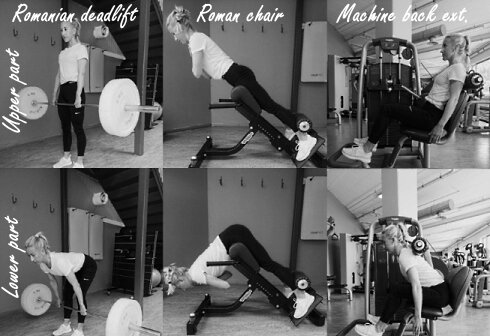
Results
The figure below shows the activation of the muscle groups. Of these three exercises, the hyperextension appears to provide the best stimuli for the muscle groups. The Romanian deadlift comes in second.

Practical application
"For athletes and recreationally active people aiming to optimize the neuromuscular activation of the glutes and hamstring, we would particularly recommend the Roman chair exercise", writes Andersen.
"This exercise was in general more effective in activating these muscles, likely due to the biomechanical properties of the exercise creating a consistently large torque throughout the whole range of motion, and particularly in the upper part. It is also easier to perform with proper technique than the Romanian deadlift."
"Machine back extension was clearly inferior to the other two exercises."
Honor the deadlift
That's not to say Andersen thinks serious athletes should forget about the Romanian deadlift. The exercise certainly has its qualities.
"The Romanian deadlift maximizes its torque in a flexed hip position", Andersen continues. "As the hip is extended, the torque continuously decreases, allowing for increased velocity. These biomechanics would simulate running, and especially the top speed phase, where the hip torque is greatest in the late swing phase where the hip is flexed."
"Therefore, we recommend athletes and recreational trained to consider the purpose of the exercises before choosing which one to include in their weekly resistance-training program."
Strength Training works better than Cardio for fat loss
Men who do strength training keep their fat percentage lower in the long term than men who run, cycle or do other aerobic exercise. Epidemiologists at the University of Harvard came to this conclusion after following 10,500 men for 12 years.
Strength training fights belly fat better than aerobic training
Men who do strength training keep their fat percentage lower in the long term than men who run, cycle or do other aerobic exercise. Epidemiologists at the University of Harvard came to this conclusion after following 10,500 men for 12 years.
Strength training and body fat
At first glance you'd think that aerobic forms of exercise such as running, cycling and rowing would offer better protection against building up excess fat than strength sports do. A weights workout burns a couple of hundred kilocalories at most, while an hour of intensive aerobic training will easily help you burn eight hundred kilocalories.
On the other hand though: after the age of thirty you lose a little bit of muscle mass each year. Because every kilogram of muscle mass you lose also lowers your daily calorie burning by a couple of dozen kilocalories, the older you are, the more easily you put on weight. You can stop this process by doing strength training. If you train really hard and eat enough protein, you can even build up more muscle mass as you age. Aerobic forms of exercise contribute little to building up more muscle mass.
Study
The researchers used data on over 10,000 healthy men that had been gathered between 1996 and 2008 in the Health Professionals Follow-Up Study, including information on how the waist measurement of the participants had changed over the study period. When the study began in 1986, the participants were aged between 40-75.
"Because aging is associated with the loss of skeletal muscle mass, relying on body weight is insufficient for the study of healthy aging", explained Rania Mekary, the first author of the study, in a press release. [harvard.edu December 22, 2014] "Measuring waist circumference is a better indicator of healthy body composition among older adults."
The researchers divided the men up according to the amount of exercise they got. First the researchers looked at the amount of moderate to vigorous aerobic activity [MVAA] the men got daily. The norm is at least half an hour a day of this type of exercise.
Then the researchers looked at the number of minutes a day the men devoted to strength training.
Results
Strength training offered more protection against a growing waist circumference than moderate to vigorous aerobic activity did, according to the figure below.

During the period that the researchers monitored the men, their waist measurement increased by an average of 6.6 cm. Strength training reduces this increase by 3 cm. According to this study, that happens regardless of whether you adhere to the norm for moderate to vigorous aerobic activity or not.
The researchers even calculated that if the participants had done 20 minutes of strength training daily during the 12 years of the study instead of 30 minutes of aerobic activity, they would have lost another 0.34 cm from their waist measurement. It would have been even better if they had done 20 minutes strength training a day instead of of watching TV for 30 minutes: that would have resulted in a reduction of 0.76 cm on the waist measurement.

Conclusion
The leader of the project, Frank Hu, emphasised in a press release [harvard.edu December 22, 2014] that the study does not show that aerobic forms of exercise are therefore no longer necessary. Aerobic exercise has positive effects on the cardiovascular system that strength training does not have.
"This study underscores the importance of weight training in reducing abdominal obesity, especially among the elderly", said Hu. "To maintain a healthy weight and waistline, it is critical to incorporate weight training with aerobic exercise."
Intense Workouts 2xWeek Reduce Burnout from Office Work
Employees, freelance workers and entrepreneurs are less likely to succumb to a burnout if they do an intensive training session twice a week. Psychologists at the University of New England in Australia discovered that both strength training and cardio training reduce the chances of having a burnout.
Resistance training and cardio training offer protection against burnout
Employees, freelance workers and entrepreneurs are less likely to succumb to a burnout if they do an intensive training session twice a week. Psychologists at the University of New England in Australia discovered that both strength training and cardio training reduce the chances of having a burnout.
Burnout
The term burnout was coined in 1975 by the American psychologist Christina Maslach. According to Maslach a burnout has three components.
The most obvious of these is emotional exhaustion, followed by depersonalisation. Depersonalisation is when someone develops a negative and often cynical attitude towards their colleagues, the organisation where they work and the work itself. The third component in a burnout is that someone's sense of personal accomplishment decreases.
Study
The Australian researchers wanted to find out whether doing sports would reduce the likelihood of developing a burnout, so they got 29 subjects, aged between 19 and 68, to train three times a week for a period of four weeks. Each session lasted at least half an hour. Twenty subjects did cardio training and 9 did weight training. A control group of 20 people did no sports at all.
Results
At the beginning and end of the four weeks the researchers got the subjects to fill in a questionnaire designed in the 1980s by Maslach to measure burnout. The figures below show that cardio training reduced emotional exhaustion and that resistance training boosted the subjects' personal accomplishment.
In addition, resistance training and cardio training both increased the feeling of psychological wellbeing and reduced the amount of stress that the subjects reported.
Conclusion
"This research provides a valuable supplement that attests to the significant benefit of exercise to both individuals and organisations in increasing well-being, reducing perceived stress, and reducing burnout", the researchers wrote.
"The positive effect of resistance training on personal accomplishment and the psychological distress reducing effects of cardiovascular exercise are exciting extensions of the current literature which, if replicated, can support health and fitness professionals in developing exercise programs for optimal physical and psychological health."
Reference: PeerJ. 2015 Apr 9;3:e891.
Hack your Endurance with Rhodiola & Ginkgo
Rhodiola and ginkgo combination boosts endurance (no training required)
Supplementation with extracts of Ginkgo biloba and Rhodiola crenulata increases the stamina of young men. This is shown in a human study published in 2009 in the Chinese Journal of Integrative Medicine.
Study
The researchers, at the University of Hong Kong, divided 67 young men into 2 groups. For 7 weeks, they gave the men in one group placebo capsules and the men in the other group capsules containing extracts of Ginkgo biloba and Rhodiola crenulata in a ratio of 1: 9.
The men took 4 capsules each day, each containing 270 milligrams of extract mixture. They took 2 capsules with breakfast and 2 capsules with dinner.
Results
The supplement increased the men's stamina. The subjects in the experimental group managed to cycle longer, and that may have been due to the increase in their bodies' ability to absorb oxygen. [VO2max]


Supplementation did not affect the test subjects' testosterone levels, but it did prevent cortisol levels from rising after exercise. That may mean that the men recovered faster.
Conclusion
"The present findings have provided evidence supporting the use of Rhodiola crenulata and Ginkgo biloba combined supplement for improving the endurance performance by increasing oxygen consumption and protecting against fatigue", summarize the researchers.
According to Russian animal study, extracts from both plants improve endurance, albeit in different ways. [Bull Exp Biol Med. 2003 Dec;136(6):585-7.]
Women and Men respond similarly to strength trianing
Women's upper body muscles respond to strength training just as well as men's
The extent to which women can strengthen the muscles in their upper body through strength training is the same as the extent to which men can do this. However, this does not imply that women can easily reach the strength level of men who work out.
Study
In 2016, Brazilian sports scientist Paulo Gentil published a study in which he got 44 male and 47 female students to do a full-body workout twice a week for 10 weeks.
The workout consisted of basic exercises such as leg press, leg curl, chest press and lat pulldown. The subjects did 3 sets of each exercise with a weight that allowed for 8-12 repetitions. The subjects rested for 2 minutes between sets.
Before and after the training period, the researchers determined the torque that the test subjects could develop during a biceps curl. 'Torque' is what athletes in the gym often refer to as 'force'.
Results
In absolute terms, the men gained more strength than the women [left in the figure below]. But in relative terms, in terms of progression over the strength already present before the training program began, the progression of the men was similar to that of the women [bottom right].

Conclusion
"Despite the physiological and hormonal differences between sexes, women demonstrated the same relative strength gains compared to men [...]", writes Gentil.
"It appears there is presently no evidence of a need to design different resistance training protocols to men and women. [...] One should not expect to find limitations in upper body strength development in women."
Reference: PeerJ. 2016 Feb 11;4:e1627.