
These articles explore the body, the mind, the environment, and the systems that shape human health. Each piece is written to make complex ideas easier to understand, whether the topic is training, nutrition, sleep, stress, digestion, symptoms, physiology, disease, or the way modern life affects how we feel and function.
Strength, Health, & the Art of Living Well

How to Build Bigger Arms: What an Arm Specialization Phase Actually Requires
Most people treat arm training like an accessory. They train chest, back, or shoulders, then finish the workout with a few curls and pressdowns and assume that, because the arms were trained, they should continue to grow. That can work for a while, particularly when someone is new to lifting. Eventually, though, a muscle that you genuinely want to improve has to become more than something you get to when the important work is finished.
An arm specialization phase changes the way the program is organized around the goal. That doesn’t mean doing an absurd number of curls or adding an extra arm day onto an already crowded week. It means deciding that arm growth is temporarily a priority, then making room for that priority through exercise order, volume allocation, exercise selection, progression, and recovery.
If your arms have looked essentially the same for the last year, the answer may be more training. But before adding more, it’s worth asking whether the training you’re already doing is organized well enough to produce the result you want.
1. Reallocate Volume Before Adding Volume
The easiest response to a lagging muscle is to add more sets. If ten sets haven’t worked, do twelve. If twelve haven’t worked, do fifteen. Eventually the program becomes a collection of everything you were already doing plus an increasing amount of work for the body part you’re trying to bring up.
That ignores the recovery cost of the rest of the program.
Your arms are already involved in much of your upper-body training. The triceps contribute to pressing, while the elbow flexors contribute to most pulling movements. Adding substantial direct arm volume without accounting for that existing work can increase fatigue faster than it improves the stimulus.
A specialization phase should therefore begin by moving training resources, not simply creating more of them. If arms become a higher priority, chest, back, shoulder, or total upper-body volume may temporarily come down. You’re creating room for the arms to receive more high-quality work while preserving your ability to recover from it.
Specialization always involves a tradeoff. You cannot make everything the highest priority at the same time.
2. Put the Priority Muscle First
Exercise order is one of the simplest ways to change the emphasis of a program without changing a single exercise.
Whatever you train first is performed when you’re least fatigued. Your ability to produce force is higher, technique is generally easier to maintain, and the target muscle hasn’t already accumulated fatigue from several other movements. If the arms are always trained after an hour of heavy pressing and pulling, you’re asking them to grow from whatever training quality remains.
That may be fine when arm development is secondary. It makes less sense when it becomes the goal.
During an arm specialization phase, direct arm work can move to the beginning of a session or receive its own dedicated training day. You may even place the muscle you most want to improve first within the arm workout itself. Someone with particularly underdeveloped triceps doesn’t necessarily need to alternate which muscle goes first simply for the sake of fairness. Priorities should determine exercise order.
Your program should reveal what you claim matters.
3. Train the Elbow Flexors, Not Just the Biceps
When people say they’re training biceps, they often use “biceps” as shorthand for everything on the front of the upper arm. Anatomically, elbow flexion involves more than the biceps brachii.
The brachialis contributes strongly to elbow flexion, while the brachioradialis also becomes an important contributor depending on forearm position. Changing your grip changes the contribution of these muscles. A supinated curl places the biceps brachii in a favorable position to contribute. Neutral-grip hammer curls and pronated reverse-curl variations alter that relationship and provide a different challenge to the elbow flexors.
This is why an arm program built entirely around slightly different versions of the same supinated dumbbell curl leaves something on the table.
Exercise variety becomes useful when the exercises are actually different. A supinated curl, hammer curl, and reverse curl represent different forearm positions and slightly different demands on the elbow-flexor group. That gives you a more complete reason for including several exercises than simply choosing three curls because they use different pieces of equipment.
4. Choose Exercises by Where They Load the Range
Two exercises can train the same muscle and still provide meaningfully different stimuli.
What matters is not only which muscle is moving the joint, but where in the range of motion the exercise becomes most difficult. The external resistance created by gravity, a cable, a machine, or another form of loading changes relative to the joints as you move. As a result, one curl may challenge the elbow flexors heavily when they’re relatively lengthened, while another creates more difficulty toward the shortened end of the movement.
That distinction gives exercise selection a purpose.
Instead of asking whether preacher curls are “better” than spider curls or cables are “better” than dumbbells, ask what each exercise contributes to the program. If all three movements become hardest in essentially the same portion of the range, the variety may be more cosmetic than physiological.
A better arm program exposes the muscle to meaningful loading across different portions of its available range. You’re building a collection of complementary exercises rather than collecting exercises for their own sake.
5. Give the Triceps Different Shoulder Positions
The same principle becomes particularly useful when training the triceps because one of the three heads—the long head—crosses both the elbow and shoulder.
That means shoulder position changes the length and mechanical environment of part of the triceps. A pressdown, lying extension, overhead extension, and dip are therefore not interchangeable simply because they all involve elbow extension.
Pressdowns are useful, but an entire triceps program built around the arm staying beside the torso limits the positions through which you train the muscle. Overhead extensions place the shoulder in flexion and lengthen the long head differently. Lying extensions create another loading profile. Dips or pressing variations expose the triceps to still another combination of shoulder and elbow mechanics.
You don’t need every possible angle in every workout. Over the course of a specialization phase, however, using different shoulder positions gives you a more complete triceps stimulus than repeatedly changing attachments on the same pressdown.
6. Pair Biceps and Triceps Strategically
Training biceps and triceps together allows you to use antagonist pairings: perform a biceps exercise, rest briefly, perform a triceps exercise, then return to the biceps after the appropriate recovery period.
This makes arm training unusually well suited to efficient programming. While one muscle group is working, its antagonist is not performing the same task, allowing you to accumulate a considerable amount of direct arm work without turning the workout into a long sequence of isolated straight sets.
The important distinction is between training density and rushing.
Alternating biceps and triceps shouldn’t mean moving so quickly that performance collapses. If the purpose of the set is hypertrophy, you still need enough recovery to produce high-quality repetitions and maintain the intended loading. The pairing simply allows some of that recovery time to be occupied by training the opposing muscle.
Done well, you can fit more productive arm training into the same amount of time without turning every set into conditioning.
7. Specialization Can Justify More Exercise Variety
Most muscles don’t require an enormous exercise menu in a normal training program. If a body part is receiving only a moderate amount of weekly volume, two well-chosen exercises may provide everything you need.
Specialization changes the problem.
Once you deliberately increase direct work for a muscle, relying on one or two movements for all of that volume can become limiting. Repeating the same joint angles, loading profiles, grips, and positions across a large number of sets may make the additional volume increasingly redundant.
That’s where three or four complementary exercises can make sense.
The word complementary is doing most of the work. Four exercises should give you more than four names in your training log. You might combine different forearm positions for the elbow flexors, different shoulder positions for the triceps, and exercises that emphasize different portions of the resistance curve.
Variety has value when it expands the stimulus. Novelty for its own sake simply makes progression harder to track.
8. Use Intensifiers for a Reason
Drop sets, tri-sets, and mechanical-advantage sets can all make an arm workout considerably harder. That alone doesn’t make them better.
Their value is that they allow you to extend productive work under circumstances where a conventional straight set has reached its limit.
A mechanical-advantage set is a good example. You begin with a variation in which your leverage is relatively poor, take that movement close to or to its prescribed endpoint, then shift into a mechanically stronger version that allows you to continue working the same general musculature. The load doesn’t necessarily have to change because your position changes your ability to continue producing force.
That is different from randomly adding intensity techniques because you want the workout to hurt more.
Intensifiers should have a job. They can increase training density, extend a set, increase the amount of work performed with a given load, or expose the muscle to a different fatigue environment. Used selectively, they can be very useful during specialization. Used everywhere, they mostly make fatigue harder to manage.
9. Progress Arms in Smaller Increments
Progressive overload becomes awkward with smaller exercises because the equipment often increases in increments that are disproportionately large.
Going from a 30-pound dumbbell to a 35-pound dumbbell is a 16.7% increase in load. Nobody would expect someone squatting 300 pounds to casually add 50 pounds the next week simply because that happens to be the next weight available.
Yet that is effectively what we sometimes ask people to do with curls.
Microplates, adjustable dumbbells, cable stacks with smaller increments, and fractional loading can make progression much more realistic. When smaller load increases aren’t available, progression can also occur through repetitions, improved range of motion, more consistent execution, or eventually additional sets.
The important part is that the progression is measurable.
If you curled 30 pounds for ten technically consistent repetitions and several weeks later you can perform twelve with the same execution, something improved. If you immediately jump to 35 pounds and turn the movement into a combination of lumbar extension, shoulder flexion, and hope, the number on the dumbbell increased while the training stimulus became harder to evaluate.
10. Change the Prescription After You’ve Adapted to It
Consistency is necessary for progression because you need enough repeated exposure to an exercise and training method to become proficient and determine whether it’s working. Changing exercises every workout prevents you from establishing that baseline.
But consistency doesn’t mean keeping the same program indefinitely.
Eventually, progress slows. Repetitions stop increasing. Loads stop moving. An exercise that once produced a very strong local stimulus may begin producing more joint discomfort or systemic fatigue than useful progression. A training method that worked well for several weeks may simply have given you most of what it currently has to offer.
That is when variation becomes useful.
You might change the rep range, loading method, resistance profile, exercise, or way movements are paired. The change should answer something you observed in the previous phase. If the program is still working, there’s very little reason to abandon it. If progress has clearly flattened despite adequate recovery and execution, changing part of the prescription gives you a new problem to adapt to.
The goal is neither endless novelty nor stubborn consistency. It is to keep a useful stimulus progressing.
Build the Program Around the Priority
Bigger arms don’t require secret exercises. They require the same thing every other stubborn training goal eventually requires: better organization.
If arm development is genuinely important to you, give it a period in which the rest of your training reflects that decision. Move volume away from lower-priority work. Train the arms before they’re exhausted. Understand the muscles you’re trying to develop. Choose exercises because they contribute different loading conditions. Progress them with increments that make sense. Use advanced methods when they solve an actual programming problem, and change the prescription when you have evidence that the current one has stopped moving forward.
An arm specialization phase should look different from simply adding an arm workout.
Otherwise, you haven’t specialized. You’ve just added more training.
The Apparent Confusion About Progressive Overload
Apparently, there is a growing disagreement online about progressive overload. Most of it comes from confusing cause and effect, while different people use the same term to mean slightly different things.
Brosef’s explanation from the bench next to you usually goes like this: you get stronger by continually adding more weight to the bar. Since strength and load rise together, it must be the added weight that produced the improvement.
This explanation makes intuitive sense and works reasonably well for beginners, who often improve fast enough to add weight almost every workout. However, it puts the plates before the muscle by mistaking the visible result of progress for the process that made it possible.
The process of building strength starts when you expose the body to a challenging training stimulus. In response, the body may improve neural coordination, become more efficient at the movement, and increase its ability to produce force. Once those adaptations occur, the same weight becomes easier relative to your new capacity. At that point, you can adjust the training demand by adding weight, reps, or changing another variable to keep the stimulus productive.
This creates a repeating cycle:
Training stimulus → Adaptation → Improved performance → Adjusted stimulus
Or, more simply:
You perform a set of five reps → You get stronger → That same set becomes easier → You add some weight to keep it challenging.
Increasing the load can help drive further adaptation, but the increase works best when supported by the capacity you have already developed. When someone forces more weight before their performance has improved, range of motion often shortens, technique breaks down, and control suffers. The number on the bar went up, but the ability being trained likely did not.
Another point of disagreement is how broadly progressive overload should be defined. Some people use it almost exclusively to mean adding weight. Others include more reps, better execution, increased range of motion, or more total work. These can all change the training demand, but they do not demonstrate the same kind of progress.
Adding a rep with the same load, range of motion, and technique provides clear evidence of improved performance. Adding another set increases total training volume, which may be useful for hypertrophy, but it represents a programming adjustment rather than direct evidence that performance on a given exercise has improved. Better execution or greater range of motion may also represent meaningful improvement, although changing the conditions of the movement makes comparison less direct.
Progression works best when it responds to meaningful improvements in capacity rather than forcing the numbers upward at all costs. You apply an appropriate stimulus, recover, monitor performance, and increase the demand when your performance supports the adjustment.
This brings us back to the original confusion between cause and effect. Because the weight on the bar usually increases as you become stronger, it's easy to assume that adding weight is what created the strength. The process works as a cycle: the existing training stimulus produces adaptation, that adaptation improves performance, and improved performance allows you to increase the demand. The heavier load then becomes part of the next stimulus and may contribute to further adaptation.
Progressive overload is therefore the ongoing adjustment of training demands as the body adapts. The controversy becomes much easier to understand once you recognize that progression can be both the result of the adaptation that came before it and part of the stimulus that produces what comes next.
Strength and Training Tolerance Are Different Capacities
The ability to lift a weight and the ability to recover from lifting it are not the same thing.
A workout is usually judged by what someone can complete. If they can move the weight, maintain decent technique, and finish the set, it's assumed the training was appropriate. But completing the work only proves that they were capable of producing enough force in that moment. It doesn’t tell us how much the workout cost them or whether their body can turn that stress into progress.
Two people can perform the same exercise with the same weight and have completely different responses. One may recover quickly and return stronger. The other may experience a large drop in performance, remain sore for several days, and struggle through their next workout. They completed the same task, but the biological cost wasn’t the same.
To understand why, we have to look beyond whether the weight moved and consider what the muscle had to do to move it.
Muscle growth begins when the fibers inside a muscle experience enough mechanical tension to signal that they need to become better prepared for similar demands in the future. Heavy weights can create this tension immediately because the muscle has to produce a lot of force to move them. Lighter weights can also create it, but usually only after fatigue builds and the final repetitions become difficult.
This is why hard sets performed close to failure can stimulate growth. As the set becomes more demanding, the repetitions slow down, the body recruits more muscle fibers, and those fibers are forced to produce more tension.
However, the same set that creates the growth signal also creates fatigue and disruption. The body must restore energy, regulate calcium inside the muscle, repair damaged tissue, and return the muscle to normal before it can fully adapt.
A workout provides the reason to grow, but recovery is where that growth is actually built. The body can increase muscle protein synthesis for two different reasons. It may be using new protein to build the muscle larger, or it may simply be repairing tissue that was damaged during training.
Those processes can happen at the same time, but they don't produce the same outcome.
Imagine you're renovating a house. Some of your budget can be used to add a new room, but if you damage the roof first, much of that money has to be spent repairing what was damaged in the process.
Training works in a similar way. When a workout creates enough tension with manageable damage, more of the recovery process can be directed toward building additional muscle. When it causes excessive damage, the body has to spend more time and resources repairing what was already there.
This is why soreness isn't proof that a workout was productive. A little soreness is normal, especially after unfamiliar exercises, but feeling destroyed doesn't mean the muscle received a better growth stimulus.
The same principle applies to exhaustion. Training close to failure can be useful because the final and most challenging repetitions often create the greatest amount of tension in the muscle fibers. But that doesn't mean every set needs to continue until the weight physically stops moving.
Once the target muscle is working hard and the repetitions have slowed down, much of the useful growth stimulus may already be present. Continuing beyond that point can add more fatigue and muscle damage without adding the same amount of benefit.
The goal is to get close enough to failure that the set becomes challenging, while stopping before the cost begins to rise faster than the reward. For most exercises, leaving 1-3 good reps in reserve is enough to create a strong stimulus while making recovery easier.
This becomes especially important because strength can improve faster than training tolerance.
Someone can become capable of lifting heavier weights before their body is ready to handle much more total training. Their technique improves. Their confidence grows. Their nervous system becomes better at recruiting muscle. These changes can increase performance quickly.
However, the structures and systems that support repeated training may take longer to adapt. Muscles, tendons, connective tissue, energy systems, and recovery capacity all need time to become more tolerant of heavier loads and greater volume.
This creates a common mistake. A lifter adds weight and sets simply because they are capable of completing them. Their strength may be improving, but the amount of stress they can recover from hasn't increased at the same rate.
Good training therefore requires more than asking, “Could I finish the workout?” A better question is, "Could I complete the workout, recover from it, and return ready to perform at a greater capacity next time?"
Signs that the training dose is appropriate include stable or improving strength, manageable soreness, consistent technique, and the ability to repeat the workload without a continued decline in performance. Over time, that same workload should become easier to tolerate, or the lifter should be able to perform slightly more without creating a disproportionate increase in fatigue.
If you can survive the session but spend the rest of the week trying to recover from it, the workout may be creating more disruption than your body can productively adapt to. Being strong enough to complete the work is only part of the equation. Strength is the ability to produce force, while training tolerance is the ability to handle that force repeatedly, recover from the stress it creates, and return better prepared for the next session.
Take-a-ways from the past week
1. Essential Amino Acid’s (EAA’s) are better than Branched Chain Amino Acid’s (BCAA’s).
When it comes to making gains you want the full amino acid profile because it has been found that loading up on Leucine, Isoleucine and Valine can have a negative effect on neurotransmitter balance effecting drive and recovery. BCAA’s lack essential amino acids like L-Tryptophan and L-Tyrosine (precursors to dopamine and serotonin) which can throw off neurotransmitter balance over time. Also, net protein utilization are profoundly affected by the limitations of the complete amino acid profile, therefore it is important to have all essential amino acids present to make optimal gains.
2. Essential Amino Acid’s (EAA’s) combined with a Carbohydrate source are best for making strength and hypertrophy gains.
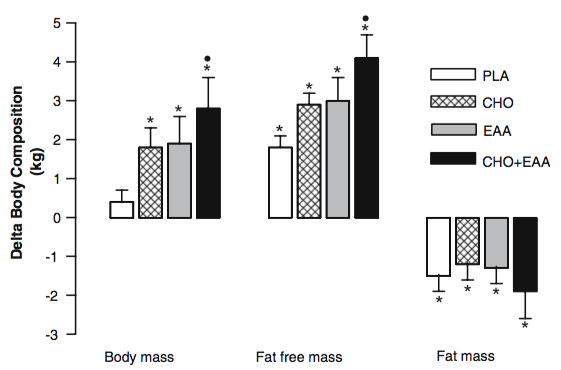
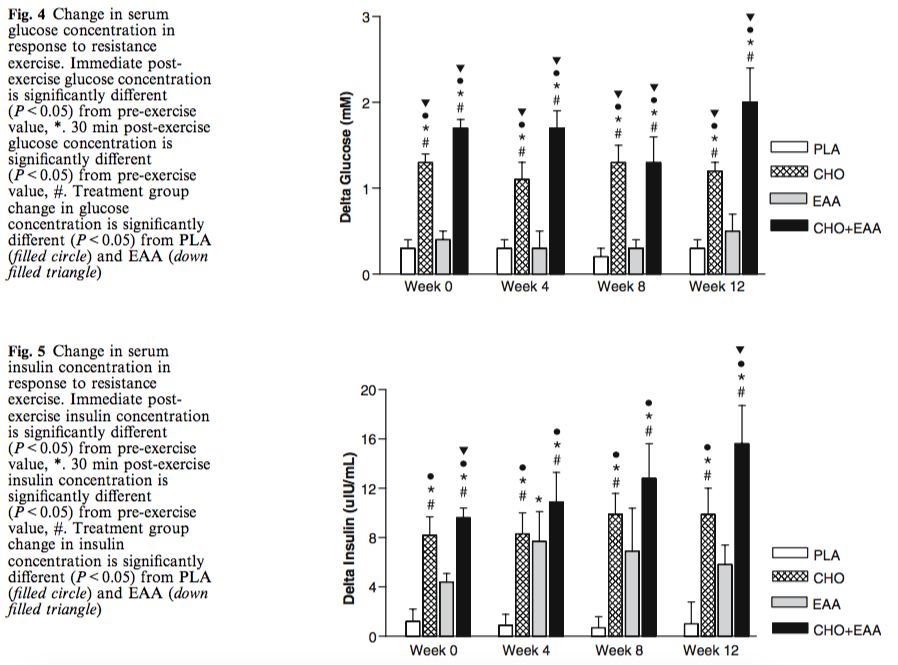
A 2006 study called “Independent and Combined Effects of Liquid Carbohydrate/Essential Amino Acid Ingestion on Hormonal and Muscular Adaptations following Resistance Training in Untrained Men” showed surprising results in that Carbohydrates alone outperformed EAA’s in almost all categories including, Muscle Fiber (Type I, Type IIa and Type IIb) improvements; Post-Workout Glucose Uptake, Insulin response and favorable reduction in Cortisol response. Yet, when EAA’s were combined with Carbohydrates for intra-workout nutrition, the positive effects on all categories were greater than either EAA’s or Carbohydrates alone. The best results for Body Composition were also seen in the EAA/Carb group. Moral of the story, to optimize your workout use EAA’s and Carbohydrates together.


3. The more carbohydrate sources you take in before/during/after your workout the better the absorption rate.
Your body can absorb 1g of carbohydrates from a single source from dextrose, maltodextrin, fructose, cluster dextrine, etc. per minute. However, if you combine sources you can increase carbohydrate uptake into the muscle by a factor of 5. Products like PentaCarb are formulated for this specific purpose and as the name implies, it has five different carbohydrate sources.
4. Improve insulin sensitivity for optimal hypertrophy.
The easiest way to recognize that you are not insulin sensitive is that you do not feel the “pump” when you are working out. The more insulin sensitive you are the better able you are to increase glucose and amino acid uptake into the muscle cells, thereby suppressing cortisol and reducing muscle breakdown. Plus, if you are insulin sensitive, when you eat carbohydrates the are better able to be used for fueling your muscles rather than storing them as fat.
5. Don’t have a bolus dose of Antioxidants around your workout.
This can turn off your insulin sensitivity and reduce the amount of hormetic stress placed on your mitochondrial which are both drivers of growth.
6. Fasting is beneficial, even for those seeking hypertrophy.
Due to the amount of calories one must consume to put on size, the gut can take quite a beating. Fasting allows the gastrointestinal tract to relax and have time to heal so that when the fast is over, nutrients can be better absorbed. A 24 hour fast once a week can offer improvements. Also, intermittent fasting for 3 days a week has the same benefits as intermittent fasting for 7 days a week.
7. Over 90% of athletes are deficient in Iodine.
This fundamental nutrient is often lost through sweat and can cause hydrochloric acid (stomach acid) deficiencies, migraines, insomnia or brain fog if not repleted through supplemental or dietary means.
8. When it comes to nutrition, the 80/20 Rule is Bullshit.
You have to take into account the inflammatory affects of food and the cumulative effect it can have on your body. A study recently produced a study that said 100% of people who consume gluten have intestinal inflammation within 30 minutes!
9. The first step towards success is taken when you refuse to be a captive of the environment in which you first found yourself.
This is the basis of all change, and fundamental to my 7 Pillars of Health. Realizing that the environment that surrounds you makes you who you are; the people, the food, the job, the situation all have an effect, whether good or bad. To make a change, start by changing your environment.
10. The things that are done to you or for you are rarely as effective as the things you do for yourself.
Read that over a few times.