
These articles explore the body, the mind, the environment, and the systems that shape human health. Each piece is written to make complex ideas easier to understand, whether the topic is training, nutrition, sleep, stress, digestion, symptoms, physiology, disease, or the way modern life affects how we feel and function.
Strength, Health, & the Art of Living Well
Viruses Are Just Information
Imagine a situation where the human community is confronted with a new toxin.
This toxin can only be neutralized by an enzyme that human beings do not usually make. But one member of the community has a randomly generated mutation that allows her, and only her, to make the toxin-neutralizing enzyme. She does well, while others become sick and some die because this mutation gives her an adaptive advantage.
According to the theory of genetic mutation and natural selection, her genes would slowly spread throughout the population. Over time, the adaptive mutation would become more common because it helps people survive.
But what happens if she is a sixty-year-old postmenopausal woman? What if she is a man who does not have children? In that case, the helpful gene dies out.
If we are lucky, maybe the carrier of the gene is a thirty-year-old man about to get married. He and his wife have six children, and three of them carry the autosomal dominant mutation. One of those three dies in a car crash. Another becomes sterile. The third passes the adaptive gene on to her two children.
In ten thousand years, that adaptive gene may have spread throughout the population through natural selection. Unfortunately, by then, the toxin has either killed everyone off or is long gone, making the mutation useless.
This creates an important question.
Can the theory of natural selection following random mutations fully explain how humans and animals adapt to new situations quickly enough for those mutations to be useful?
If adaptation only happens through random mutation and reproduction across generations, the process may be too slow to explain real-time biological response to rapidly changing environments. Life often has to respond faster than that.
So how do organisms adapt in real time?
One proposed way to think about this is through exosomes. When cells are threatened, they can produce exosomes containing DNA and RNA. These tiny packages of genetic material are involved in communication between cells. They carry information from one part of the body to another and may help coordinate biological responses to changing conditions.
From this perspective, what we call “viruses” may be understood differently. Rather than thinking of viruses only as hostile invaders, this view suggests they may function as physical-resonance forms of genetic material that code for changes happening in the environment.
In that interpretation, viruses are not simply enemies. They are carriers of biological information.
They may represent a system of real-time genetic adaptation. Instead of waiting thousands of years for a useful mutation to spread through reproduction, genetic information could move more quickly between cells, organisms, or populations. This would create a much faster way for life to respond to environmental pressure.
That is the larger idea behind the claim that viruses are information.
Unlike bacteria, which can be grown in a petri dish and are clearly living organisms, viruses are not alive in the same way. They do not independently metabolize. They do not reproduce on their own. They are pieces of genetic material packaged in a protein coat, dependent on cells to replicate.
In simple terms, viruses can be thought of as packets of information.
They carry instructions. They interact with the genome. They may influence which biological switches are turned on or off. In this view, viruses are not merely agents of disease. They are genetic messengers that may participate in how organisms respond to environmental change.
This way of thinking also changes how we interpret sickness.
If someone becomes overtly sick, one possibility is that the body could not handle the “download” of information. Another possibility is that the new biological instructions did not match the person’s internal health, lifestyle, or external environment. In other words, the issue may not only be exposure. It may also be the condition of the terrain receiving the signal.
This does not mean illness is imaginary. It does not mean viruses are harmless. It means there may be more to the story than the idea that viruses are only hostile forces trying to attack us.
The conventional model often treats viruses as dangerous invaders that must be fought. But if viruses also function as carriers of environmental information, then a total war on viruses may reflect a misunderstanding of their role in nature.
A virus may not be alive in the way bacteria are alive. It may be closer to information. A signal. A message. A set of instructions.
The role of viruses in nature, from this perspective, is to help recode genetic material in response to changes happening in the environment. They may provide a mechanism for real-time genetic adaptation.
That is a very different way to understand biology.
Instead of seeing life as a battlefield where organisms defend themselves against endless microbial enemies, this view sees life as a communication system. Cells communicate. Organisms communicate. Genetic information moves. The environment changes, and biology responds.
Viruses may be part of that communication.
The question is whether we are willing to look at them through a wider lens.
If we assume viruses are only hostile and dangerous, then our only response is fear, suppression, and war. But if viruses are also information, then we may need to rethink the relationship between illness, adaptation, genetic expression, environment, and evolution.
Maybe the body is not simply being attacked.
Maybe it is receiving information.
Maybe sickness is sometimes the cost of a system trying to adapt to instructions it is not currently healthy enough to process smoothly.
This idea may sound strange because it challenges the standard story. But the standard story does not always explain how quickly life adapts, how genetic information moves, or why the same exposure can affect different people in different ways.
Viruses may not be the enemy in the way we have been taught to imagine them.
They may be part of the language life uses to communicate with itself.
Questioning Immunology
Most people are introduced to the immune system through a very simple metaphor: the body is a battlefield, germs are the enemies, and the immune system is an army of soldiers fighting off invaders.
That image is easy to understand, which is probably why it has become so common. The problem is that it may also be too simple to explain what is actually happening inside the body.
The immune system is not just a defensive military force. It is an intelligent, adaptive, highly responsive communication system. It reacts to the internal and external environment. It responds to stressors. It coordinates inflammation, repair, tolerance, elimination, and adaptation. It is deeply connected to the gut, the microbiome, the nervous system, the endocrine system, and the condition of the body as a whole.
When immunology is reduced to “soldiers fighting germs,” we risk missing the complexity of the system we are trying to understand.
A major part of modern immunology is also tied to vaccinology, which shapes how many people understand immunity. Vaccines are often discussed through the production of antibodies, and antibodies are frequently treated as synonymous with protection. In the laboratory setting, antibody production is often used as a surrogate marker to suggest that a vaccine “works.”
That raises an important question: does the presence of antibodies always equal true protection?
It is worth asking whether antibodies produced after vaccination consistently bind to and inactivate disease-causing agents in the way the public is often led to believe. It is also worth asking whether antibodies may, in some cases, be part of the body’s broader response to the ingredients or stressors introduced through vaccination, including compounds such as polysorbate 80 or formaldehyde.
These questions are not small. They challenge the way many people have been taught to think about immunity, protection, and disease.
The same kind of questioning can be applied to contagion.
The conventional view says germs travel from one person to another, infect them, and produce disease. That model is treated as obvious, but germs as pathogens is a more complex question than the simple battlefield metaphor allows. Over the past few decades, science has produced an enormous amount of literature on microbes, pathogens, host response, the microbiome, and immune regulation.
The discovery of the microbiome should have changed the way we talk about microbes. Our inner ecology reveals that we do not simply live in opposition to microorganisms. We depend on them. The very microbes that have often been demonized are also involved in digestion, immune regulation, metabolism, barrier function, and overall health.
This does not make every microbe harmless. It does mean the relationship between microbes and the body is more complex than enemy versus defender.
The conversation becomes even more interesting when we consider the virome. Research into human biology suggests that a meaningful percentage of what we call human DNA may be viral in origin. Some estimates place this around 8 percent. This raises deeper questions about how we define viruses, how genetic information moves between living systems, and whether some of the agents we have assigned purely causal roles may also be part of a more complicated biological exchange.
A virus is generally described as nucleic acids in a protein coat that require cells to replicate. In that sense, viruses are often called nonliving agents of genetic information transfer. As we learn more about how genetic information is passed between living entities, we may need to think more carefully about the roles we assign to these vectors.
This also invites a larger question: has every assumption in conventional infectious disease theory been proven as completely as people assume, or are some claims still inferred through models, indirect evidence, and interpretation?
Transmission of effects can take many forms when we step outside the narrowest version of conventional medicine. A yawn can spread through a room without being a pathogen. Fear can spread through a group and create physical symptoms. There are studies in which people became sick after believing they had been exposed to contaminated air, especially after seeing others appear sick from it, even when there was nothing wrong with the air.¹
There are also examples of people developing cold-like symptoms when they already believe themselves to be unwell or vulnerable. These situations raise questions about the relationship between belief, perception, nervous system state, environment, and physical symptoms.
That does not mean pathogens are irrelevant. It means physical pathogens alone may not explain the full picture of illness, susceptibility, symptom expression, and recovery.
Symptoms themselves may also deserve a different interpretation.
Vomiting, diarrhea, sweating, coughing, sneezing, and runny noses all have something in common. They are exudative. They move material out of the body. From this perspective, the symptoms of infection may be evidence that the body knows how to eliminate what it no longer wants to hold.
This way of thinking changes the meaning of symptoms. A symptom is no longer just an inconvenience to suppress. It becomes a message, a process, and possibly a form of elimination.
This may also help explain why some people seem to move through repeated patterns of illness during or after major changes in their health, lifestyle, medication use, or internal toxic burden. One possibility is that the immune system is finally able to mobilize and eliminate stored stressors or toxicants. In that context, symptoms may reflect the body’s attempt to restore order rather than simply evidence of an outside enemy taking control.
This is where curiosity matters.
What other assumptions have we made that remain unproven, incomplete, or open to reinterpretation? What have we accepted because it is familiar rather than because it fully explains what we see? Science can be a beautiful tool for discovery, but only when it is allowed to acknowledge that a more complete picture may be emerging.
Charles Eisenstein wrote in The Ascent of Humanity:
“When we see germs as predators who seek to steal ‘resources’ from us for their own biological interest (survival and reproduction), then a rational response is to deny them those resources, to hide from the predators or fight them off — the fight-or-flight response… If I believe, on the contrary, that there is some reason specific to my own body why the flu has infected me and not you, then the program of control doesn’t make sense anymore.”
That quote points to a very different relationship with the body.
When illness is viewed only as invasion, the response becomes control. Fight harder. Suppress faster. Kill the invader. But when illness is viewed as an interaction between the body, the environment, the immune system, the microbiome, perception, stress, terrain, and resilience, a different set of questions becomes possible.
Why did this person become sick at this time?
Why did another person exposed to the same environment remain well?
What was happening in the body before symptoms appeared?
What does the body need in order to move through this process?
How can the immune system be supported rather than overridden?
This is the deeper question behind symptomology, immunology, and the way we understand disease. The body is not passive. It is not stupid. It is not simply waiting to be attacked by the outside world. It is constantly responding, adapting, communicating, regulating, eliminating, and trying to restore balance.
Sometimes all it takes is a reminder that the body is not the enemy.
When we are aligned with the body, and when we truly make a truce with it, we may access a much greater capacity for healing than we have been taught to believe. That is the reclamation worth paying attention to.
Once we understand that symptoms and illness can have meaning, that they may be sending us a message, and that the body has a capacity to move through them when properly supported, our relationship with health begins to change.
We become less interested in fear and control.
We become more interested in listening, supporting, questioning, and understanding.
That shift alone is revolutionary in a society that has taught people to distrust their bodies, silence their symptoms, and hand over their intuition to systems that may not always see the whole picture.
Glutathione Info and Supplementation Tips
Glutathione is critical in the management of your voltage. When an electron donor gives up its electrons, the donor can become a stealer. Glutathione readily supplies the electrons to restore your electron donor to its donor status so it can help again.
Glutathione is not significantly absorbed from the gut, so taking it doesn’t help. However, it is made in every cell in the body by assembling the amino acids cysteine, glycine, and glutamine. Thus the key is for you to be sure to consume those amino acids.
Glutathione has multiple functions:
It is the major antioxidant produced by the cells, participating directly in the neutralization of free radicals and reactive oxygen compounds, as well as maintaining exogenous antioxidants such as vitamins C and E in their reduced (electron donor) forms.
It detoxifies many foreign compounds and carcinogens, both organic and inorganic.
It is essential for the immune system to exert its full potential, e.g.:
Modulating antigen presentation to lymphocytes, thereby influencing cytokine production and type of response (cellular or humoral) that develops
Enhancing proliferation of lymphocytes thereby increasing magnitude of response
Enhancing killing activity of cytotoxic T cells and NK cells
Regulating apoptosis, thereby maintaining control of the immune response
It plays a fundamental role in numerous metabolic and biochemical reactions such as DNA synthesis and repair, protein synthesis, prostaglandin synthesis, amino acid transport, and enzyme activation. Thus every system in the body can be affected by the state of the glutathione system, especially the immune system, the nervous system, the gastrointestinal system, and the lungs.
It is necessary for converting T4 to T3 (thyroid hormones). It is also necessary to transfer electrons from the cell membrane to the mitochondria.
Supplementing has been difficult, as research suggests that glutathione taken orally is not well absorbed across the gastrointestinal tract. In a study of acute oral administration of a very large dose (3 grams) of oral glutathione, Witschi and coworkers found that “it is not possible to increase circulating glutathione to a clinically beneficial extent by the oral administration of a single dose of 3g of glutathione.”
However, plasma and liver glutathione concentrations can be raised by oral administration of S-adenosylmethionine (SAMe), glutathione precursors rich in cysteine include N-acetylcysteine (NAC) and whey protein, and these supplements have been shown to increase glutathione content within the cell.
N-acetylcysteine is available both as a drug and as a generic supplement. Alpha lipoic acid has also been shown to restore intracellular glutathione. Melatonin has been shown to stimulate a related enzyme, glutathione peroxidase, and silymarin, an extract of the seeds of the milk thistle plant (Silybum marianum) has also demonstrated an ability to replenish glutathione levels.

Quarantine & Chill
With social-distancing in full swing, it may seem like options for improving your health are down to Quarantine and Chill, or participating in the scourge of bodyweight workouts that are woefully ineffective at promoting long-term results. Instead let's look at some options that can be completed within the isolation of your own home!

With social-distancing in full swing, it may seem like options for improving your health are down to Quarantine and Chill, or participating in the scourge of bodyweight workouts that are woefully ineffective at promoting long-term results. Instead let's look at some options that can be completed within the isolation of your own home!
NUTRITION
- When stocking your pandemic pantry you should select foods that consist of the greatest nutrient density, with the lowest impact on blood sugar, have the ability to be stored for a relatively extended period. Selecting foods that are highly satiating will be your best option in these times. Look for high in protein (such as meat, dairy, eggs, or protein powder), high in fat (coconut cream, olives, olive oil, nuts or nut butters), and lower starch/fructose containing fruits and veggies (such as all colors of sweet potatoes and carrots, or frozen berries). For more info check out the Fundamentals of Food.
- If you are having trouble piecing together an easy meal use this SUPER SIMPLE MEAL PLANNER.
Combine: 1 Fat + 1 Protein + 1 Veggie + 1 Spice = Delicious and healthy meal!

Combine: 1 Fat + 1 Protein + 1 Veggie + 1 Spice = Delicious and healthy meal!
- Now would be a great time to start a practice of Intermittent Fasting (IF), or choosing a feeding window that is shorter than you're used to. This will not only allow you to conserve on food but also give your body a break from digesting food. Because the body is never dormant it will use the extra time to complete a process called autophagy, which clears out senescent or old defective cells that could cause health problems. Additionally, IF promotes the clearance of pathogens and infectious bacteria, protect against the negative effects of stress and provides time for our gut lining to rest and repair.

- Incorporating a practice of IF is as simple as selecting a window of time you'd like to eat within whether 6,8,10, or 12 hours. Whichever time you pick, you have that long to get all your calories in and then you're done! Example, if you have an 8-hour window and you eat your first bite of food at 6AM, you'll have to get all your calories in by 2PM.

- Supplementation that will help with boosting Immunity are:
- NAC
- Vitamin C
- Zinc
- Glycine
- Glutamine
- Multi Vitamin/Mineral
- Protein
- Immune Support (probably the best choice overall)
To save 5% on the purchase of any or all of these go here: NutriDyn
MOVEMENT
- During this quarantine it looks like we have to be sequestered to sitting on the couch, however I have a better idea. We can make time to focus on improving movement in our daily lives and how we interact with the environment we consistent find ourselves in. WHY WE SHOULD SIT ON THE FLOOR is an article I wrote about how incorporating sitting in different archetypal postures can improve mobility with very little effort. Here is an excerpt:
"Achieving better tune, thus less pain and freer movement, is as easy as adopting a floor based lifestyle, just like those used by our ancestors. Instead of sitting on a chair or couch while watching television, transition to sitting on the floor. Floor sitting encourages normal movement patterns across the biggest joints and muscles of the biomechanical system. Archetypal postures are also valuable to use in a post-exercise setting, as the body finds the usual 30-second calf stretch to be an insignificant task of little benefit after running up a hill for the last 30-minutes. Returning to the floor in various archetypal postures will reestablish fundamental relationships between muscle compartments as they cool and set. After exercise go back to the floor as people have always done."
- Many are probably under the impression that stretching is the best way to improve mobility, however this notion completely leaves out the fact that mobility without strength equates to being a spaghetti noodle, and you'll never be able to fight your way through the toilet paper isle like that. In an article entitled REFINING TUNE THROUGH MOVEMENT I address this very issue and go over ways to improve mobility for the comfort of your quarantine. Here is an excerpt:
"Why can’t I stretch my way to tune, like we used to do in gym class? Before you bend over to touch your toes, listen to what former U.S. National Gymnastics coach and author of Building the Gymnastic Body, Christopher Sommers has to say; “flexibility can be passive, whereas mobility requires that you can demonstrate strength throughout the entire range of motion.” The individual muscle concept presented in traditional anatomy class gives a purely mechanical model of movement by separating things into discrete, executable functions that fail provide an accurate picture of the seamless integration seen in a living body – when one part moves, the body responds as a whole. Thus, the ability to transition into and out of a squat requires more than any one muscle being flexible. The approach to mobility parallels biomechanical tune, in that they engender a systemic or whole-body foundation. Efficient structural relationships, therefore, must be exposed and resolved within the individual so that one can grow out of a the dysfunctional pattern."
- The following are my contributions for what to do for workouts at home...
- Here is a link for bodyweight movements... or take a look at the following gif

- Here is a minimalist workout for those with limited equipment... if you want to order some adjustable dumbbells check out this review

- Don't forget about your abs...

- Bored with the regular shit?? Learn how to do a HandStand...
First, let’s define the position you need to maintain.
Torso “Hollow”: Sit on a chair, back straight, with your hands on your knees. Now, try to bring your sternum (chest bone) to your belly button; “shorten” your torso by 3 to 4 inches by contracting and pulling in your abs. You’ll maintain this position throughout the entire exercise. No lower-back arch or sag permitted.
Shoulders “Protracted”: Keep your torso “hollow” per the above. Now, pretend you’re hugging a telephone pole. Your shoulders should be well in front of your chest, sternum pulled back strongly. Straighten your arms but maintain this position. Next, without losing any of the aforementioned, lift your arms overhead as high as you can. There you go. Now we can begin.
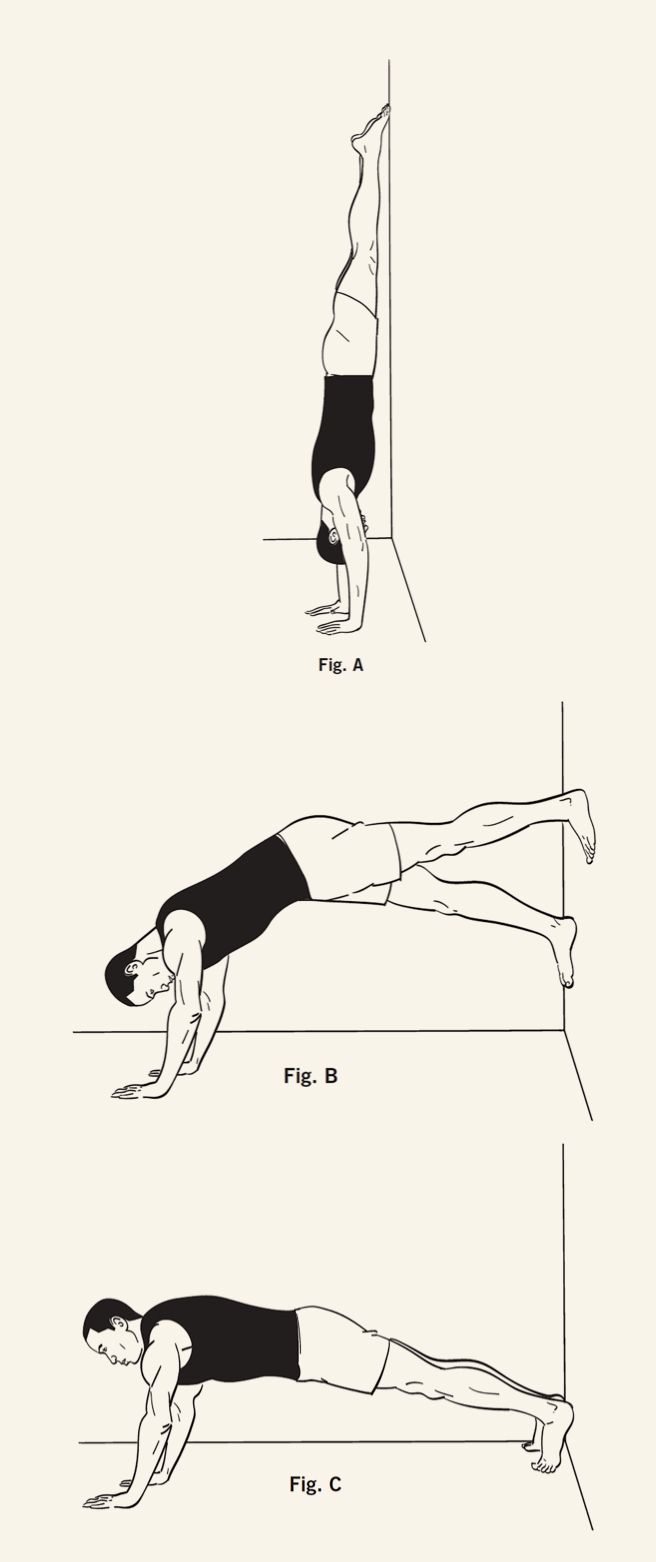
Get into a handstand position against a wall, nose facing toward the wall. (fig. A)
Keeping your body in one line, slowly walk your hands out and your feet down the wall simultaneously. (fig. B) Keep your knees straight and walk with your ankles. The steps should be small.
Reach the bottom with your feet on the floor in a push-up position. (fig. C) Correct your form to be maximally hollow and protracted.
Reverse and go back up the wall, returning to handstand position. That is 1 rep, my friend.
SLEEP
- A lack of sleep contributes to the following...
Impairs insulin sensitivity. Want to become diabetic overnight? Just sleep poorly. A night of poor or missed sleep can make one as insulin resistant as a type 2 diabetic… the effects of sleep deprivation on insulin sensitivity and thus glucose tolerance are profound and nearly immediate.
Increases gut permeability. Increased intestinal permeability itself impairs insulin sensitivity while increasing our reactivity to certain foods.
Increases systemic inflammation. Even with very little sleep loss we immediately see increases in C-reactive protein and the tendency of platelets to stick together (not great if you’re at risk for a stroke or heart attack). All modern degenerative diseases have a commonality of increased systemic inflammation
IMPAIRS IMMUNE FUNCTION.
Alters anabolic hormones.
Causes cravings. Sleep deprivation is a stress, and when a stress becomes chronic, one of the first adaptive mechanisms our bodies shift toward to deal with the stress is to seek out quick energy…. generally that comes in the form of highly processed foods
Lack of total sleep time suppresses your immune system and increases your risk of upper respiratory tract infections (URTI).
(Sheldon Cohen et al., “Sleep habits and susceptibility to the common cold,” Archives of Internal Medicine 169, no. 1 (2009), https://doi.org/10.1001/archinternmed.2008.505; Aric A. Prather et al., “Behaviorally assessed sleep and susceptibility to the common cold,” Sleep 38, no. 9 (2015), https://doi.org/10.5665/sleep.4968.)
- Now is the perfect time to work on improving our sleep hygiene. Start with the following tips and sleep soundly in your isolation chamber, aka room.
Go to bed at a similar time each night (even on the weekends). The body thrives on routine.
Stop using blue-lit screens (TV, Computer, or Mobile devices) 2 hours before bed. The blue light from the screen tricks your brain into thinking the sun is out, therefore suppressing melatonin — a hormone necessary for the onset of sleep.
Be sure to stop eating at least 2 hours before bedtime, as digestion can cause sleep interruptions.
If you must use a device with a screen, utilize "night mode" or blue-light blocking technology like F.lux to minimize your exposure.
Sleep in a cool, dark room. Research has shown that the best temperature to sleep at is around 68°F. And, the darker the room the better.
STRESS
- For sure we are in uncharted waters at the moment in history however that doesn't mean you have no control over the way you feel. Perception is a matter of choice. You can choose how you respond to anything. In any situation in life you have three options. You can change it, you can leave it, or you can accept it. What is not a good option is to sit around wishing you would change it but not changing it, wishing you would leave it but not, and not accepting it. Acceptance is the only way to mitigate the stress of this situation and move to make the best out of whats left.
- Something I find helpful in quieting the mind is the practice of gratefulness. Most people think you can only be grateful after something has happened, but if you are actively looking for things to appreciate you will find them. Establishing a habit of gratitude welcomes it into your consciousness, shifting awareness away from less desirable or stressful emotions. Get a journal, download an app, or simply open up a blank document on your computer. Set aside a few minutes each day and use the following prompts to ease your mind...
To be answered in the morning:
I am grateful for… 1._______ 2._______ 3.________
What would make today great? 1._______ 2._______ 3._______
Daily affirmations. I am…. 1._______ 2._______ 3.________
To be answered at night:
3 amazing things that happened today… 1._______ 2._______ 3.________
How could I have made today better? 1._______ 2._______ 3.________
ideas on what to be grateful for:
an old relationship that really helped you or that you valued highly.
an opportunity you have today
something great that happened yesterday, whether you experienced or witnessed it
something simple near you or within sight… the gratitude points shouldn’t all be “my career” and other abstract items
- Another thing that could have a positive impact is taking up Breathing Exercises or Meditation.

GUT HEALTH
- Since you have nothing else to do, think about fixing your shit, literally! 80% on your immune system lies in your gut. If you are not digesting your food optimally, your immune system may be compromised. Check out the following guide to assess your mess...

DETOXIFICATION
- The Environmental Working Group estimates that on average, each adult uses nine personal care products daily, with 126 different chemical ingredients. Women use more products than men, so the tally for women goes up to 168 chemicals from personal care products alone. Many of these products we use in, on, or around us are full of chemicals that are linked to serious health issues such as endocrine disruption or cancer. Take this time to review the ingredients of the personal care products you use — shampoo, toothpaste, cologne, perfume, make up, deodorant, lotion, etc. Enter anything you can't pronounce into the EWG's SKINDEEP rating system to see what you're being exposed to. Once you find the worst offenders, replace the item with a less toxic version when you run out.

EXTRA STUFF
- Take your ass outside in the sun and go for a walk (just avoid people). Going out in the sun is the easiest way to stay active, slim and boost immunity....
Sunlight's effect on Immunity: Vitamin D production, stimulated by exposure to the UVB portion of solar radiation, may improve immune system response, and thereby reduce risk of infections. One of the mechanisms by which this is accomplished is the production of antimicrobial peptides (AMPs), which can help to negate the effects of bacteria, fungi, and viruses. One of the most important AMPs is cathelicidin, which is under control of the vitamin D receptor (VDR), whose activity is regulated by the presence of the potent hormone form of vitamin D: 1,25-dihydroxyvitamin D (1,25(OH)2D). Research demonstrates that when disease causing microbes breach physical barriers, a class of proteins called toll-like receptors (TLRs) recognizes the invading pathogens and triggers the body's immune cells (white blood cells, such as macrophages) to respond in various ways, including the activation of the immune cell's vitamin D receptors (VDR). This response prompts the stored form of vitamin D, 25(OH)D, to be taken from the blood and hydroxylated to form 1,25(OH)2D (the potent hormone), which binds to the VDR of the immune cell. The cathelicidin gene is then activated and the human cathelicidin, LL-37, is synthesized within the immune cell in order to destroy the pathogen after the immune cell engulfs it. This reaction is totally dependent on the availability of the stored form of vitamin D. The cathelicidin also acts by destroying the integrity of the lipoprotein membranes of the pathogens, rendering them harmless. It also has a chemotactic effect, acting as a chemoattractant for immune cells in the immediate vicinity of the pathogen breach.
Can sun exposure help with body transformation?
A recent study from Northwestern Medicine demonstrates that timing and intensity of light correlate with BMI... Optimal BMI is between 18-25.
The study showed that exposure to bright morning light was directly related to BMI. After adjusting for confounders such as diet, exercise, and timing of sleep, it was determined that very early exposure to morning light correlated remarkably to lower BMI. Even when light intensity was equal at different times of the day, those who received the earliest bright light had lower BMI. In fact, for each hour later in the day when light exposure occurred, BMI increased by 1.3 units. This fact is exceptional, since a person who has a BMI of 25 (upper ideal range) could approach 30 (basically obese), over time, simply by the habit of receiving sun exposure later in the day, e.g. 10:00AM rather than 7:00AM.
The authors suggested that the mechanisms by which early light exposure could influence weight control could be the following: (1) resetting the circadian rhythm, (2) the greater quantity of blue light in the morning sun and (3) effects on melatonin production. Whatever the mechanisms, we now know that early-morning sun is important to weight control. It may also be important to other health issues. But before we begin to think sun exposure is the cure-all for obesity, we must address poor nutritional and exercise habits. Nevertheless, in these times of limited access to gyms, it is a simple addition to any routine.
ref: Reid KJ, Santostasi G, Baron KF, WIlson J, Kang J, Zee PC. Timing and intensity of light correlate with body weight in adults. PLoS One 2014;2;9(4)
Sun exposure is superior to Vitamin D supplements in prevention of weight gain.
Research conducted on mice with shaved backs were placed on a high-fat diet and then exposed to non-burning ultraviolet radiation (UVR) during a three-month experiment. The mice, without the benefit of UVR, would have been expected to gain weight rapidly on that diet, but when they were exposed to UVR, the weight gain was impressively reduced. The UVR treatment achieved a 30-40% reduction in weight gain, compared to the expected weight gain with the high-fat diet.
Other benefits included: significant reductions in glucose intolerance, insulin resistance and fasting insulin levels (all markers and predictors of diabetes), nonalcoholic fatty liver disease, and cholesterol. All of these factors, including obesity, are part of a cluster of maladies known as the metabolic syndrome which is indicative of deteriorating health and susceptibility to heart disease and diabetes.
ref: Geldenhuys S, Hart PH, Endersby R, Jacoby P, Feelisch M, Weller RB, Matthews V, Gorman S. Ultraviolet radiation suppresses obesity and symptoms of metabolic syndrome independently of vitamin D in mice fed a high-fat diet. Diabetes. 2014 Nov;63(11):3759-69
COMIC RELIEF via MEMES


Correlation Between Food and Joint Pain
Patients with autoimmune diseases such as, rheumatoid arthritis, systemic lupus erythematosus, or Sjogren’s disease are typically given protocol-driven treatments with limited success because the symptoms are treated instead of the underlying problem.
The problem with this is everyone has their own unique biochemical individuality. This is a common problem with almost all autoimmune diseases. There is endless research on intestinal permeability, aka leaky gut. The gastrointestinal tract is 80% of our immune system. When inflammation is present, the tight junctions and intestinal mucosa can become damaged, causing gaps or “pores” in the lining of intestinal mucosa. Toxic byproducts in the digestive tract are then absorbed into the bloodstream and transported on to the liver. The molecules of food and toxins are “leaked” through the GI lining and then eventually affect systems throughout the body, causing inflammation in our joints and expressing toxins in autoimmune conditions and food sensitivities.
Patients with rheumatoid arthritis (RA) often have an association between food intake and rheumatoid disease severity. In 2008, in looking at this immunological link between gut immunity and RA, food IgG, IgA and IgM antibodies were measured. In the intestinal fluid of many RA patients, all three immunoglobulin classes showed increased food specific activities, including gliadin antibodies.
There are some tests to consider for those with an autoimmune disease, as great strides have been made in regards to what labs can test for today. There are labs that assess food sensitivities, which is different than the IgE RAST test performed by traditional allergists. There is also a lab that can test for intestinal permeability. Through the serum they are able to detect antibodies to LPS, occludin/zonulin and the actomyosin network to identify the breakdown of a healthy intestinal barrier. In addition, a comprehensive digestive stool analysis is essential for healing the gut.
It is also very important to check vitamin D levels and to test for gluten-associated antibodies and cross-reactive foods since they play a large role in inflammatory and autoimmune processes.