These articles explore the body, the mind, the environment, and the systems that shape human health. Each piece is written to make complex ideas easier to understand, whether the topic is training, nutrition, sleep, stress, digestion, symptoms, physiology, disease, or the way modern life affects how we feel and function.
Strength, Health, & the Art of Living Well
7 Pillars of Health: Improving Health in The modern environment
The default in nature is health, so why are we fat, sick and broken? It is because our environment has change, our bodies have not. We share 99.7% of the same genetics as our relatively disease free hunter-gatherer ancestors yet eat worse, move less, sleep worse, encounter more stress and toxins, and wonder what the cause is of chronic disease. It's really not that hard! Take control of your health with the 7 Pillars of Health.

The default in nature is health, so why are we fat, sick and broken?
It is because our environment has changed, our bodies have not.
Looking back 10,000 years when we lived as hunter-gatherers people ate nutritious foods, got significant amounts of “exercise” outside in the sun as they carried out their daily activities. This was followed by an equal amount of downtime that provided for adequate rest and the development of remarkable social connections which literally extended from the cradle to the grave. Although running from the occasional tiger and lack of wi-fi made it far from an idyllic paradise, there is little evidence of obesity or chronic disease.
This is in stark contrast to our modern environment where there is an epidemic of poor health (diabetes, depression, cancer, obesity, heart disease etc.), yet we continue to wear our constant stress, long hours in the office, sleep deprivation and ability to eat like a garbage disposal as a badge of honor. Perhaps with the fact that we share 99.7% of the same genetics as our hunter-gatherer ancestors we can further understand that the problem is not us, but within the environment we live.
So, how can we affect change? Unfortunately, there is no magic pill, but there are pillars (seven to be exact!) that were created to serve as a guide to promote better health in our current environment. The follow is a brief overview of what will be covered in 7 Pillars of Health class:
Nutrition
Food is energy and we use the calories it contains along with the vitamins and minerals to carry out specific tasks like digestion, regeneration and repair (sleep), detoxification as well as managing our stress.
Questions to think about regarding Nutrition:
- What will it do to my blood sugar?
- Does it contain quality protein?
- What kind of dietary fat does it supply?
- What is our food’s nutritional status?
Movement
Movement is more than just exercise, it is the ability to demonstrate strength and ease throughout an entire range of motion. Movement is a dynamic process not a single event. Your day should be comprised of movement — squat, hinge, lunge, hang, climb, press, pull, carry — as opposed to separating it into a single hour of the day.
Questions to think about regarding Movement:
- What happens when we don’t move?
- How can we improve movement?
- Is one type of movement better than another?
Digestive Health
The health of the gut determines what nutrients are absorbed and it is often said that we are what we eat, but it is more accurate to say, we are what we absorb. Therefore, digestive health should be defined as the optimal digestion, absorption and assimilation of the food.
Questions to think about regarding Digestion:
- How is the digestive system supposed to work?
- How can your gut affect your overall health?
- What are common issues and how do we get them?
- How can we improve digestive health?
Sleep
Sleep is not the absence of wakefulness. Sleep acts as a barrier between the individual and the environment that allows the body to regenerate physically and recalibrate mentally. This is accomplished best with 8-9 hours of uninterrupted sleep, where it is as easy to fall asleep as it is to wake up at your scheduled time without the need for an alarm or stimulants.
Questions to think about regarding Sleep:
- Why is sleep important to our body and brain?
- How can we fix sleeping issues?
Stress
Stress is the response to any stressor in our internal or external environment that acts as a threat to knock our body out of balance. The purpose of stress is to help our body cope with stressors and survive. Your resiliency, energy, endurance and life all depend on the proper functioning of the stress response.
Questions to think about regarding Stress:
- What constitutes as stress?
- What happens when our homeostatic balance is threatened?
- What happens when we are faced with chronic stress?
- How can we alleviate stress?
Detoxification
Detoxification is an ongoing physiological process which involves the mobilization, transformation and elimination of toxins from external and internal sources.
Questions to think about regarding Detoxification:
- What is a toxin and how is it processed?
- Why is detoxification important?
- How can we lessen our toxin burden?
Community
A community is a shared environment with like-minded people in pursuance of similar goals where individuals included provide positive support system that allows for trust in one another and the freedom to express themselves freely.
Questions to think about regarding Community:
- Do you share similar values and goals with those around you?
- Do those around you provide a positive support system?
It is important to understand that no Pillar is more important than another. Instead, achieving optimal health is about proper balance between all Pillars. The sooner we can incorporate the lesson’s the 7 Pillars offer into our life's the better we will be able to live and thrive. When stress, sleep disruptors and environmental and emotional toxins are removed and replaced with balance, purpose, nutrient density, nontoxic products, rest, exercise and healthy relationship, the body becomes incredibly resilient. Our medical system has spent billions of dollars researching health, yet it's going to be hard to come up with a better health recommendation than the sum of what the 7 Pillars offer; eat whole, unprocessed foods, move frequently (preferably outside in the sun), avoid stress so you can sleep like you are on vacation and surround yourself with loving relationships. While we cannot (and probably would not) go back in time and sleep in caves again, we can begin to focus on resurrecting dietary and lifestyle approaches that are more in keeping with our genetics and our ancient metabolic systems, that have become disturbed by the environment we find ourselves in in modern life. It is the purpose of the 7 Pillars of Health to teach you how these disruptions are the cause of our poor health and how each of us can rectify it.
For class information please contact us!
The Liver & Detoxification (Part 1)
By Graeme Bradshaw
Did you ever want to know about how to look after your liver?
This is part of a detailed series of articles explaining liver metabolism related to detoxification. You will learn how and what to do to maintain optimal liver health.
Where is the liver?
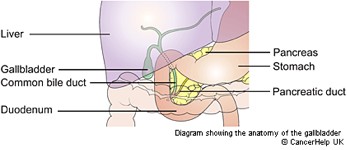
The Liver’s location is on the right side, at base of the ribs, shown in lilac color. The Gall Bladder sits under the liver.

Expanded view of the gall bladder ducts - the gall bladder is under the liver
The next diagram gives a better idea of the actual appearance of the liver, as well as how the blood flows into it from the intestines. It is the first place blood that having picked nutrients, like fats, amino acids, phyto-chemicals, vitamins and minerals and any wastes from the intestines and bowels. One of the liver's primary functions is filtering the blood. Almost 4 liters of blood pass through the liver every minute for detoxification. The blood then passes out to the heart.
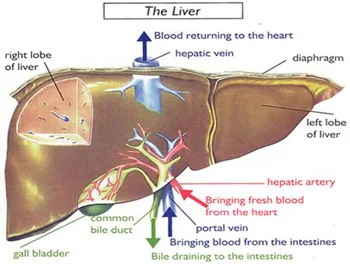
Bile from the liver is both a waste product, and it helps digesting and absorbing the fats and oils form food. Bile is especially released by fatty meals. Bile is necessary for bowel peristalsis, that is constipation may be caused by lack of bile.

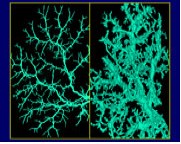
Green colors above indicate the “biliary tree”, which are the bile ducts draining the liver into the gall bladder. These may be blocked with fatty cholesterol-laden plaque, bilirubin and bile salts, as depicted on the picture on the right side. The gall bladder may become congested with this plaque if it is not released as well and is prone to crystallize into gall stones by mid-life if the diet is incorrect. Read on for how to prevent this.
What are the functions of the liver?
- It is responsible for the production of bile that is stored in the gallbladder and released when required for the digestion of fats
- The liver stores glucose in the form of glycogen that is converted back to glucose again when needed for energy
- It also plays an important role in the metabolism of protein and fats.
- It stores the vitamins A, D, K, B12 and folate and synthesizes blood clotting factors.
- Another important role is as a detoxifier, breaking down or transforming substances like ammonia, metabolic waste, drugs, alcohol and chemicals, so that they can be excreted. These may also be referred to as "xenobiotic" chemicals.
Filtering the Blood
The liver plays a key role in most metabolic processes, especially detoxification. The liver is a filter designed to remove toxic matter such as dead cells, microorganisms, chemicals, drugs and particulate debris from the bloodstream. The liver filter is called the sinusoidal system, and contains specialized cells known as Kupffer cells that are part of the white blood cell immune function. They make up 10% of liver weight, and function to ingest and break down toxic matter.
Filtration of toxins is absolutely critical as the blood from the intestines contains high levels of bacterial waste, (endotoxins from the bowels), antigen-antibody complexes, and various toxic pollutants. When working properly, the liver clears 99% of the bacterial toxins during the first pass. However, when the liver is damaged, such as in alcoholics, the passage of toxins increases by over a factor of 10. This is similar if your intestines are too permeable, a condition known as “leaky gut”. Allergies (especially to gluten) and parasites may cause this.
The liver neutralizes a wide range of toxic chemicals, both those produced internally and those coming from the environment. The normal metabolic processes produce a wide range of chemicals and hormones for which the liver has evolved efficient neutralizing mechanisms. However, the level and type of internally produced toxins increases greatly when metabolic processes go awry, typically as a result of nutritional deficiencies, pesticide laden foods, low fiber diets and high red meat or alcohol intake.
Many of the toxic chemicals the liver must detoxify come from the environment: the content of the bowels and the food, water, and air. The polycyclic hydrocarbons (DDT, dioxin, 2,4,5-T, 2,3-D, PCB, and PCP), which are components of various herbicides and pesticides, are on example of chemicals that are now found in virtually all fatty tissues of the body, including the brain. Even those eating unprocessed organic foods need an effective detoxification system because all foods contain naturally occurring toxic constituents, and bacterial or fungal activity in the bowel may produce more.
So far we’ve learned that liver plays several roles in detoxification: it filters the blood to remove large toxins, synthesizes and secretes bile full of cholesterol and other fat-soluble toxins, and now we move on to how it enzymatically disassembles unwanted chemicals. This enzymatic process usually occurs in two steps referred to as phase I and phase II. Phase I either directly neutralizes a toxin, or modifies the toxic chemical to form activated intermediates that are then neutralized by one of more of the several phase II enzyme systems.
Proper functioning of the liver's detoxification systems is especially important for the prevention of cancer, since phase II detoxification deactivates carcinogens. Around 70% of all cancers are thought to be due to the effects of environmental carcinogens, such as those in pesticides, trans and burned fats in food, plastics and other sources of environmental estrogens, as well as air pollutants, cigarette smoke, etcetera. Our own hormones that are poorly detoxified may be cancer inducing, notably some forms of estrogens, and we are especially at risk if there is insufficient liver detoxification and bowel elimination. When combined with deficiencies of the nutrients the body needs for proper functioning of the detoxification and immune systems this issue gets worse. The level of exposure to environmental carcinogens varies widely, as does the efficiency of the detoxification enzymes, particularly phase II. High levels of exposure to carcinogens coupled with slow phase II detoxification enzymes significantly increases susceptibility to cancer.
Bile Excretion
The liver's second detoxification process involves the synthesis and secretion of bile. Each day the liver manufactures approximately 2 liters of bile, which serves as a carrier in which many toxic substances are dumped into the intestines. In the intestines, the bile and its toxic load are absorbed by fiber (if there is any in the diet) and then excreted. However, a diet low in fiber results in inadequate binding and reabsorption of the toxins back from the intestines into the liver. This low fiber diet (especially soluble fiber like oats and flax seed lignans) is a major cause of gall stones. This problem is magnified when bacteria in the intestine modify these toxins to more damaging forms.
The Gall Bladder : What does it do?
The gallbladder's main purpose is to concentrate and store your bile. Bile is a fluid made in the liver that helps you to digest fats in your small intestine. It is made from cholesterol, water, bilirubin and bile salts.
Bilirubin is what gives bile its greenish colour – the color turns darker brown the longer it is in the intestines. Bilirubin comes from the breakdown of used red blood cells.
When you eat fatty foods, the fats are broken down (digested) in your stomach and intestines. To get the bile to the food in your gut, your body either:
- Releases it from the liver and down the bile ducts, straight into your small intestine
- Stores it first in your gallbladder, which releases bile into your common bile duct as you need it
- Fats and oils in the diet stimulate the release of bile following a meal
- Fiber, especially soluble fibre such as from oats causes more bile to be released from the bowel, reducing gall stone formation. A low fiber diet increases gall stone risks, especially if no breakfast is eaten.
Factors causing most gallstone formation:
- A low fiber diet. Low fiber from too few vegetables, fruits, and whole-grain foods and whole grains such as oats or flax seeds. Do you eat 5 serves of fruit and vegetables a day or have a high fiber cereal breakfast? If not add oats and flax seeds which have high lignan content that is a soluble fiber.
- Too much red meat, cheese, and other dairy, bacon, sausages and gravies which are all high in saturated fat, that increase triglycerides (TG’s) and cholesterol, affecting the liver and gall (makes more concentrated bile).
- Omega 3 oil deficiency makes the TG’s and cholesterol go higher as well. Omega-3 oil, found in fish or flax seed oil, blocks cholesterol formation in bile.
- Sugar (and lack of exercise) increases triglyceride (TG’s) levels in the blood – high TG’s create less soluble bile. High sugar intake increases insulin levels that increase cholesterol saturation in bile (a bad effect).
- Irregular meals, skipping breakfast (“coffee breakfast”) and crash dieting contribute.
- Estrogens (the pill and oral contraceptives, and pregnancy increase frequency of gall stones – hence women more common sufferers). Women with a family history of gallstones are best to avoid oral contraceptive pills.
- Some gastrointestinal diseases – including Crohns disease.
- Some cholesterol lowering drugs (fibric acid derivatives e.g. Cliofibrate).
- Incidence of liver fluke is able to precipitate a particular type of pigmented gallstone and is relatively common in Asia (common especially if raw fish is regularly eaten).
- Food allergies are another trigger factor for gall related symptoms – if the gall is partly blocked consumption of food allergens trigger symptoms. The most common offenders are: egg, pork, onions/garlic, chicken, chocolate, dairy products chili, coffee, oranges, wheat, corn, beans and nuts in descending order. The high fat dairy products and pork are not recommended whether you have allergy/intolerance to them or not because of their saturated fat content.
- Coffee contracts the gall bladder – even if de-caffeinated – so if you have gallstones coffee may cause pain.
- Finally an odd one - sun-burning increases risk of gallstones.
Helpful Supplements and Nutritional Measures:
- Drink two large glasses of water on rising, and midmorning and mid afternoon to maintain the water content of the bile. Sliced un-peeled lemon in hot water is a bile stimulant too, and a healthy way to start the day. Add honey and some turmeric powder for anti-inflammatory benefits
- Take 2 fruits and 3 - 4 vegetable serves daily, especially including the cabbage family. This is for the fiber and important anti-oxidant content. (Carrots, beets, prunes, cabbage, broccoli, brussels sprouts, kiwi, papaya, apples are all very useful).
Lose excess weight (low animal fats and/or low sugar/sweets diet)
- Take extra mg vitamin C and 200 of vitamin E daily - improves bile solubility (Innate Response Antioxidant is our best antioxidant supplement)
- Fish oil ideally as 3 or 4 Krill Oil capsules daily (providing 750 - 1000mg of EPA and contains fat mobilizing phosphatidyl choline). We recommend this also for Fatty Liver. Oily fish include salmon, sardine, halibut herring, trout – twice or more weekly.
- Initially you need herbal bile stimulating herbs: Artichoke Extract is best and simplest for this, slightly lowering cholesterol and helping bowel movement along.
- Milk thistle can be used alternatively, having more benefits on detoxification and liver protection. A product giving Milk Thistle, Globe Artichoke and further nutrients as well (choline, methionine) called Liver Support – is often given for optimal liver-gall function.
- Exercising three times per week reduces gall stone formation.
- Take a probiotic - Lactobacilus bowel flora. These stimulate excretion of bile from the intestine, as well as binding these as well as other intestinal toxins and removing them.
Dangers of NOT Detoxing
One of the world´s leading health and fitness experts, Charles Poliquin talks to Ninka-Bernadette Mauritson, founder of www.thedetoxtribe.com about the dangers of NOT doing a detox. Every year.