These articles explore the body, the mind, the environment, and the systems that shape human health. Each piece is written to make complex ideas easier to understand, whether the topic is training, nutrition, sleep, stress, digestion, symptoms, physiology, disease, or the way modern life affects how we feel and function.
Strength, Health, & the Art of Living Well
Improving Pressing Strength

Photo by Alora Griffiths on Unsplash
Few other exercises share the same level of popularity as the bench press, yet the majority of the time a proper diagnosis is necessary to keep improving the poundages.
The following is based on Charles Poliquin’s structural balance teachings .
Monday is international Bench Press day and thousands of meatheads pour into the gym to get their fix. Yet, despite its popularity, it continues to carry a reputation as being responsible for a number of pec tears and shoulder injuries.
However, whether you’re a bodybuilder, an athlete, or a weekend warrior who just wants to look better naked, the bench press can part in your routine. The focus of this article is to help you find your best assistance exercise to boost your performance in the bench press.
First, You Must Find the Weak Muscles
Louie Simmons, of Westside Barbell, along with Charles share an idea that sticking points in large compound lifts are due to one or more weak muscles in the chain that makes up that lift. If you want to get better at any give exercise and lift more? You must find the weak muscle first, then strengthen it using a few choice assistance exercises that recruit the most motor units.
To be fair, this knowledge is more applicable to the advanced lifter/athlete. For instance, if you only bench press at least 1½ times their body weight. You aren’t going to find a lot of value in the following information.
Let’s look at the most common pressing styles and their sticking points…
| Pressing Style | Sticking Point | Target Muscle |
|---|---|---|
| Close Grip/Wide Grip | Start/Mid-Range | Serratus Anterior |
| Both | Start | Anterior Deltoid |
| Wide Grip | Start | Pectoralis Major, Clavicular portion; Subcapularis |
| Close Grip | Start | Pectoralis Major, Sternal portion |
| Wide Grip | Mid Range | Biceps Brachii, Long Head Coracobrachialis |
| Both | Lockout | Triceps |
Target the Weak Link With the Right Exercises
The next step is to choose what exercises will be right for your unique issue. Don’t be a Chihuahua who does an exercise just for the fun or the change of pace. Real gains come from purposeful application of exercise selection. Now is the time for serious lifting with exercises that will recruit the largest motor unit pools possible to increase strength in the right muscles.
Have a look at table 2 to determine which exercises are right for you.
| Target Muscle | Assistance Exercises |
|---|---|
| Serratus Anterior |
Incline Front Cable Raises |
| Anterior Deltoid | Seated Press Behind the Neck |
Pectoralis Major, Clavicular portion; | Wide-Grip Bench Press to Collarbone |
| Pectoralis Major, Sternal portion | Parallel Bar Dips |
| Biceps Brachii, Long Head | Barbell Curls |
| Triceps | Triceps Extensions to Neck Parallel Bar Dips Skull Crushers Lockouts in the Rack Close-Grip Bench Press Reverse Grip Bench Press Board Presses |
Putting it Together
One thing that makes a major different in gaining strength or overcoming plateaus is knowing how to prioritize the exercises in a workout to make it more efficient at reaching a given goal. In this case, always start with the pressing exercise, and then do serratus/anterior delt work, followed by triceps and finally biceps. This will ensure that your nervous system is able to recruit the most motor units in each muscle group so you will get the most bang for your training buck.

The Importance of Strength Training in Combat Sports
Strength is an attribute that cannot be significantly improved through the practice of participating in Combat Sports, therefore it makes strength training a wise investment, particularly if you want to win. The purpose of increasing strength is to develop physical capacities necessary to handle the unpredictable nature and stressors of the sport. Athletes need to be prepared for all aspects of physical combat including punching, kicking, takedowns, takedown defense, arm bars, guillotine, grappling, and clinching, not to mention proper conditioning and muscle endurance. A simpler way to say it would be, to achieve victory an athlete needs to be faster, more explosive and last longer than their opponent. Also, let me make it clear before I go any further, strength does not replace technique — wrestlers should prioritize wrestling, just as martial artists should ultimately work to perfect their discipline — but improving strength will transfer to better technical performance (e.g., technique) on the mat or in the cage.

As a Strength Coach I look at strength training as a way to improve performance by increasing strength, whereas those who participate in Combat Sports look to improve performance through perfecting technique. Classically, there has been little crossover combining the two disciplines — with the exception of people like Bruce Lee, who found technique more useful in concert with strength — however, as Combat Sports like Wrestling and Mixed Martial Arts (MMA) continue to grow in popularity, attracting ever more skilled fighters, the sole focus on advancing technique without increasing strength is misguided. There will plenty of people who disagree, yet for those, I challenge you to find one detriment that comes with being stronger. I couldn’t find any, which is why I believe that strength is the mother of all qualities.
“Helen Maroulis defeated Saori Yoshia to win a gold medal in Women’s Wrestling at the 2016 Olympics in Rio after incorporating strength training into her regimen. Yoshia hadn’t lost in 10 years prior to her match with Maroulis; upon walking off the mat after her loss, she was overheard as saying “[Helen] is too strong for me.” Only six months prior, Maroulis was unable to do something as fundamental as a pull-up. Despite advancing to the highest level in her sport — US Olympic Wrestling Team — her technical skill lacked the expression of strength, which was her literal weakness and the one thing holding her back from success on the world’s highest stage.”
Strength is an attribute that cannot be significantly improved through the practice of participating in Combat Sports, therefore it makes strength training a wise investment, particularly if you want to win. The purpose of increasing strength is to develop physical capacities necessary to handle the unpredictable nature and stressors of the sport. Athletes need to be prepared for all aspects of physical combat including punching, kicking, takedowns, takedown defense, arm bars, guillotine, grappling, and clinching, not to mention proper conditioning and muscle endurance. A simpler way to say it would be, to achieve victory an athlete needs to be faster, more explosive and last longer than their opponent. Also, let me make it clear before I go any further, strength does not replace technique — wrestlers should prioritize wrestling, just as martial artists should ultimately work to perfect their discipline — but improving strength will transfer to better technical performance (e.g., technique) on the mat or in the cage.
Traditionally, combat sport athletes have defined their approach to strength training through one of the following misplaced excuses:
“I don’t want to lift weights because I will get too big and bulky, it will make me slow”
Avoiding the weightroom for fear of it making you big, bulky and slow, fly’s in the face of basic physiology. This misguided idea has lead to a heavy reliance on bodyweight exercises or kettlebell circuit training as their primary methods of physical preparation. This style of training works primarily against strength and power development by prioritizing slow-twitch/endurance based muscle fibers at the expense of fast-twitch/explosive muscle fiber development which would provide the power to deliver a knockout or the explosiveness to execute a takedown.
“I don’t want to lift weights because I only need to prioritize my cardio”
Improving strength makes all imposed demands easier, this includes those placed upon the cardiovascular system. Simply put, having stronger muscles allows the athlete to complete any task with less effort (i.e., less energy) and therefore have more reserve. More specifically, when developing the cardiovascular system it is necessary to understand that energy systems are optimized given the demands of the sport. Prioritizing only one energy system with long-slow distance running works against high threshold muscle fibers making explosive movements more taxing and decreases the ability to withstand a blow to the head due to losses in strength. Furthermore, the over-reliance on easy work generally comes with a sacrificing of quality for quantity, further increasing injury risk. A study on American Boxers published in 1990 concluded that an association could be made between lower body overuse injuries and the jogging and rope jumping the boxer did for preparation.
“I don’t want to lift weights because it will decrease my flexibility”
Flexibility is passive, what difference does it make if you’re athlete can stretch themselves in to a position. What really matters is that an athlete is able to demonstrate strength throughout the entire range of motion. You can spend hours doing static stretching or you can perform full range of motion exercises during your strength training. With proper range of motion and antagonistic muscle group training an athlete can optimize range of motion throughout a joint as there is equal balance between muscle groups.
“I don’t want to lift weights because I can get hurt”

Guess what, you’re in a full contact sport! Seriously though, many sport-related injuries stem from muscular imbalances — discrepancies in strength between opposing muscle groups — due to the repetitive stress of consistently overloading the same patterns without addressing the importance of structural balance. There is an optimal balance of strength between muscle groups that control a joint, but if the muscles on one side of the joint are disproportionately stronger than muscle on the opposing side, injury risk can increase. For more on structural balance, check out: Importance of Structural Balance for Injury Prevention.
“I don’t want to lift weights because it is not sport’s specific”
Many people get into trouble by thinking traditional strength training exercises and methods don’t translate well into improving performance because they don’t use the same movements that are part of an athletes technique and skill. Somewhere along the line “functional training” became interchangeable with “specificity” or “sport’s specific training” which tries to replicate the specific motor patterns and skill from the sport and add some component of resistance or instability to it. They argue that such efforts are necessary to make an exercise more transferable to on the mat performance. While goodhearted, this is a misguided attempt. For example Boxing Strength Coach Moritz Klatten had the following to say about using bands to simulate punching movements…
it is a terrible idea because the bands provide the most tension at the end of the movement, and as such they will negatively impact coordination patterns by decelerating the arms toward the end of the movement rather than the biceps. When the fighter goes back to punching without bands, they often decelerate too early or late — deceleration too late causes harmful hyperextension of the elbow, and too early reduces punching power.
The last thing you want to do as a Strength Coach is to work against the progress of your athlete or increase risk of injury. The same logic can be applied to the flawed theories behind unstable surface training or the belief that ladder drills will make an athlete more agile (see Ladder Drills Do Not Increase Sport Performance).
We need to get away from the idea that “sport specific” exercises are necessary for Combat Sport training — or most sports, for that matter — because the only sports where specific exercises directly translate to performance are Olympic Weightlifting (Snatch and Clean & Jerk), Gymnastics (Pull-Ups and Dips) and Powerlifting (Squat, Bench and Deadlift). It is important to understand that while slight variabilities in origin or insertions may exist from person to person, muscles function fundamentally the same across all populations, whether you are an elite UFC fighter or an office worker. Therefore, improving a combat athlete’s performance with strength training is not a matter of finding the best “functional” exercise to replicate a “sport’s specific movement,” but instead it is developing a proper understanding of biomechanics and applying that knowledge towards a strength training program that selects exercises to train muscles in the best way possible… for this fundamentals work best.
Push. Pull. Hinge. Extend. Rotate. Carry. Sprint.
While wrestling requires greater isometric strength because of the holds, Judo requires greater eccentric strength to complete throws and Boxing/MMA requires powerful concentric contractions for striking, the fundamentals are undeniably the best place to start. The following are a fundamental list of exercises that will better prepare the Combat Sport athlete for their next competition:
Push: Incline Press
The Incline Press is key to building strength in the chest and elbow extensors. Pressing motions are necessary for the development of punching power as they are powerful internal rotators of the Humerus (as well as the Lats!). and assisting with defense movements.
Primary muscle groups worked: Chest Musculature, Elbow Extensors, Deltoids
Pull: Pull-Up
The Pull-Up is one of the best upper body exercises to develop strength. Pulling motions are important when trying to controlling an opponent as Lats are used in pulling to pass guard.
Primary Muscles groups worked: Latissimus Dorsi, Biceps Brachii (long head, short head), Brachioradialis, Forearm Flexors
Hinge: Conventional Deadlift
The Conventional Deadlift is the best bang for your buck exercise as it trains the most muscles in the body out of all exercises. It preferentially works the muscles of the Posterior Chain — Hamstrings, Spinal Erectors, Lats, Traps — which is where power is derived from. Traps are used in the shrugging of your shoulders to defend against a rear naked choke.
Primary muscle groups worked: Hamstrings, Gluteal musculature, Spinal Erectors, Latissimus Dorsi, Rhomboids, Trapezius (upper and mid fibers), Core Musculature (Transversus abdominis, Multifidus, Internal and External obliques, Rectus abdominis), Forearm Flexors
Extend: Back Squat
The Back Squat trains the entirely of the legs, hips as well as the low back and core. Anytime you extend your hips or knees, you are using some percentage of what you can squat – Hips extend to apply force on the elbow in an arm bar.
Primary muscle groups worked: Quadriceps, Adductors, Gluteal Musculature, Spinal Erectors, Core Musculature (Transversus abdominis, Multifidus, Internal and External obliques, Rectus abdominis), Gastrocnemius, Soleus
Rotate: External Rotation
The External Rotation exercise is often overlooked but necessary for optimal Structural Balance of the shoulder. Optimal ratios of strength across musculature can improve punching power and the isometric contraction of a clinch.
Primary muscles works: Infraspinatus and Teres Minor
Carry: Heavy Carry
The Heavy Carry challenges the body to move under load. Remaining upright under a heavy load forces strength adaptations in the lower back and core musculature that translate to holding your position on the mat or in the cage. Additionally, grip strength is developed from carrying the weight enabling an athlete to easily establish wrist control.
Primary muscle groups worked: Trapezius (upper and mid fibers), Core Musculature (Transversus abdominis, Multifidus, Internal and External obliques, Rectus abdominis), Spinal Erectors, Forearm Flexors, Gluteal Musculature
Sprint
The Sprint helps to build explosive power through repeated effort. Combat sports revolve around the ability to execute a powerful movement, followed by a brief “rest” usually under an isometric contraction, they deliver another quick movement. While endurance is necessary for this exchange, long-slow distance is not the way to optimally train for such an event. Sprints of long, medium and short distance should be utilized in 400m, 200m, 60m respective.
Primary Energy Systems used: ATP-PC and Lactic
Whether it be pushing, pulling, or extending from a standing position to the same biomechanical patterns from a laying position, combat sport athletes cannot have any weak muscle groups. The stronger athlete with better technique and stamina will win. Therefore, the future of combat sports is not going to be dictated by past practices of bodyweight exercises or distance running, but by those who seek to optimize power and performance as well as injury prevention through structural balancing by adopting a strength training program that allows them to elevate the expression of their technical expertise in a way the competition isn’t ready for… Besides no one ever lost because they said they were “too strong.”
Success Stories

Kristy Wolterbeek - Amateur MMA Fighter

Wantuir Spenciere - PanAm World Champion & Amateaure MMA Figther

Herica Tibrucio - Pro Invicta Fighter
Fixing the Flaws: A Look at the Ten Most Common Biomechanical Weak Links in Athletes
Written on January 31, 2008, by Eric Cressey
Even the best athletes are limited by their most significant weaknesses. For some athletes, weaknesses may be mental barriers along the lines of fear of playing in front of large crowds, or getting too fired up before a big contest. Others may find that the chink in their armor rests with some sport-specific technique, such as shooting free throws. While these two realms can best be handled by the athletes’ head coaches and are therefore largely outside of the control of a strength and conditioning coach, there are several categories of weak links over which a strength and conditioning specialist can have profound impacts. These impacts can favorably influence athletes’ performance while reducing the risk of injury. With that in mind, what follows is far from an exhaustive list of the weaknesses that strength and conditioning professionals may observe, especially given the wide variety of sports one encounters and the fact that the list does not delve into neural, hormonal, or metabolic factors. Nonetheless, in my experience, these are the ten most common biomechanical weak links in athletes:
1. Poor Frontal Plane Stability at the Hips: Frontal plane stability in the lower body is dependent on the interaction of several muscle groups, most notably the three gluteals, tensor fascia latae (TFL), adductors, and quadratus lumborum (QL). This weakness is particularly evident when an athlete performs a single-leg excursion and the knee falls excessively inward or (less commonly) outward. Generally speaking, weakness of the hip abductors – most notably the gluteus medius and minimus – is the primary culprit when it comes to the knee falling medially, as the adductors, QL, and TFL tend to be overactive. However, lateral deviation of the femur and knee is quite common in skating athletes, as they tend to be very abductor dominant and more susceptible to adductor strains as a result. In both cases, closed-chain exercises to stress the hip abductors or adductors are warranted; in other words, keep your athletes off those sissy obstetrician machines, as they lead to a host of dysfunction that’s far worse that the weakness the athlete already demonstrates! For the abductors, I prefer mini-band sidesteps and body weight box squats with the mini-band wrapped around the knees. For the adductors, you’ll have a hard time topping lunges to different angles, sumo deadlifts, wide-stance pull-throughs, and Bulgarian squats.
2. Weak Posterior Chain: Big, fluffy bodybuilder quads might be all well and good if you’re into getting all oiled up and “competing” in posing trunks, but the fact of the matter is that the quadriceps take a back seat to the posterior chain (hip and lumbar extensors) when it comes to athletic performance. Compared to the quads, the glutes and hamstrings are more powerful muscles with a higher proportion of fast-twitch fibers. Nonetheless, I’m constantly amazed at how many coaches and athletes fail to tap into this strength and power potential; they seem perfectly content with just banging away with quad-dominant squats, all the while reinforcing muscular imbalances at both the knee and hip joints. The muscles of the posterior chain are not only capable of significantly improving an athlete’s performance, but also of decelerating knee and hip flexion. You mustn’t look any further than a coaches’ athletes’ history of hamstring and hip flexor strains, non-contact knee injuries, and chronic lower back pain to recognize that he probably doesn’t appreciate the value of posterior chain training. Or, he may appreciate it, but have no idea how to integrate it optimally. The best remedies for this problem are deadlift variations, Olympic lifts, good mornings, glute-ham raises, reverse hypers, back extensions, and hip-dominant lunges and step-ups. Some quad work is still important, as these muscles aren’t completely “all show and no go,” but considering most athletes are quad-dominant in the first place, you can usually devote at least 75% of your lower body training to the aforementioned exercises (including Olympic lifts and single-leg work, which have appreciable overlap).
Regarding the optimal integration of posterior chain work, I’m referring to the fact that many athletes have altered firing patterns within the posterior chain due to lower crossed syndrome. In this scenario, the hip flexors are overactive and therefore reciprocally inhibit the gluteus maximus. Without contribution of the gluteus maximus to hip extension, the hamstrings and lumbar erector spinae muscles must work overtime (synergistic dominance). There is marked anterior tilt of the pelvis and an accentuated lordotic curve at the lumbar spine. Moreover, the rectus abdominus is inhibited by the overactive erector spinae. With the gluteus maximus and rectus abdominus both at a mechanical disadvantage, one cannot optimally posteriorly tilt the pelvis (important to the completion of hip extension), so there is lumbar extension to compensate for a lack of complete hip extension. You can see this quite commonly in those who hit sticking points in their deadlifts at lockout and simply lean back to lock out the weight instead of pushing the hips forward simultaneously. Rather than firing in the order hams-glutes- contralateral erectors-ipsilateral erectors, athletes will simply jump right over the glutes in cases of lower crossed syndrome. Corrective strategies should focus on glute activation, rectus abdominus strengthening, and flexibility work for the hip flexors, hamstrings, and lumbar erector spinae.
3. Lack of Overall Core Development: If you think I’m referring to how many sit-ups an athlete can do, you should give up on the field of performance enhancement and take up Candyland. The “core” essentially consists of the interaction among all the muscles between your shoulders and your knees; if one muscle isn’t doing its job, force cannot be efficiently transferred from the lower to the upper body (and vice versa). In addition to “indirectly” hammering on the core musculature with the traditional compound, multi-joint lifts, it’s ideal to also include specific weighted movements for trunk rotation (e.g. Russian twists, cable woodchops, sledgehammer work), flexion (e.g. pulldown abs, Janda sit-ups, ab wheel/bar rollouts), lateral flexion (e.g. barbell and dumbbell side bends, overhead dumbbell side bends), stabilization (e.g. weighted prone and side bridges, heavy barbell walkouts), and hip flexion (e.g. hanging leg raises, dragon flags). Most athletes have deficiencies in strength and/or flexibility in one or more of these specific realms of core development; these deficiencies lead to compensation further up or down the kinetic chain, inefficient movement, and potentially injury.
4. Unilateral Discrepancies: These discrepancies are highly prevalent in sports where athletes are repetitively utilizing musculature on one side but not on the contralateral side; obvious examples include throwing and kicking sports, but you might even be surprised to find these issues in seemingly “symmetrical” sports such as swimming (breathing on one side only) and powerlifting (not varying the pronated/supinated positions when using an alternate grip on deadlifts). Obviously, excessive reliance on a single movement without any attention to the counter-movement is a significant predisposition to strength discrepancies and, in turn, injuries. While it’s not a great idea from an efficiency or motor learning standpoint to attempt to exactly oppose the movement in question (e.g. having a pitcher throw with his non-dominant arm), coaches can make specific programming adjustments based on their knowledge of sport-specific biomechanics. For instance, in the aforementioned baseball pitcher example, one would be wise to implement extra work for the non-throwing arm as well as additional volume on single-leg exercises where the regular plant-leg is the limb doing the excursion (i.e. right-handed pitchers who normally land on their left foot would be lunging onto their right foot). Obviously, these modifications are just the tip of the iceberg, but simply watching the motion and “thinking in reverse” with your programming can do wonders for athletes with unilateral discrepancies.
5. Weak Grip: – Grip strength encompasses pinch, crushing, and supportive grip and, to some extent, wrist strength; each sport will have its own unique gripping demands. It’s important to assess these needs before randomly prescribing grip-specific exercises, as there’s very little overlap among the three types of grip. For instance, as a powerlifter, I have significantly developed my crushing and supportive grip not only for deadlifts, but also for some favorable effects on my squat and bench press. Conversely, I rarely train my pinch grip, as it’s not all that important to the demands on my sport. A strong grip is the key to transferring power from the lower body, core, torso, and limbs to implements such as rackets and hockey sticks, as well as grappling maneuvers and holds in mixed martial arts. The beauty of grip training is that it allows you to improve performance while having a lot of fun; training the grip lends itself nicely to non-traditional, improvisational exercises. Score some raw materials from a Home Depot, construction site, junkyard, or quarry, and you’ve got dozens of exercises with hundreds of variations to improve the three realms of grip strength. Three outstanding resources for grip training information are Mastery of Hand Strength by John Brookfield, Grip Training for Strength and Power Sports by accomplished Strongman John Sullivan, and www.DieselCrew.com.
6. Weak Vastus Medialis Oblique (VMO): The VMO is important not only in contributing to knee extension (specifically, terminal knee extension), but also enhancing stability via its role in preventing excessive lateral tracking of the patella. The vast majority of patellar tracking problems are related to tight iliotibial bands and lateral retinaculum and a weak VMO. While considerable research has been devoted to finding a good “isolation” exercise for the VMO (at the expense of the overactive vastus lateralis), there has been little success on this front. However, anecdotally, many performance enhancement coaches have found that performing squats through a full range of motion will enhance knee stability, potentially through contributions from the VMO related to the position of greater knee flexion and increased involvement of the adductor magnus, a hip extensor (you can read a more detailed analysis from me here. Increased activation of the posterior chain may also be a contributing factor to this reduction in knee pain, as stronger hip musculature can take some of the load off of the knee stabilizers. As such, I make a point of including a significant amount of full range of motion squats and single-leg closed chain exercises (e.g. lunges, step-ups) year-round, and prioritize these movements even more in the early off-season for athletes (e.g. runners, hockey players) who do not get a large amount of knee-flexion in the closed-chain position in their regular sport participation.
7 & 8. Weak Rotator Cuff and/or Scapular Stabilizers: I group these two together simply because they are intimately related in terms of shoulder health and performance.
Although each of the four muscles of the rotator cuff contributes to humeral motion, their primary function is stabilization of the humeral head in the glenoid fossa of the scapula during this humeral motion. Ligaments provide the static restraints to excessive movement, while the rotator cuff provides the dynamic restraint. It’s important to note, however, that even if your rotator cuff is completely healthy and functioning optimally, you may experience scapular dyskinesis, shoulder, upper back, and neck problems because of inadequate strength and poor tonus of the muscles that stabilize the scapula. After all, how can the rotator cuff be effective at stabilizing the humeral head when its foundation (the scapula) isn’t stable itself? Therefore, if you’re looking to eliminate weak links at the shoulder girdle, your best bet is to perform both rotator cuff and scapular stabilizer specific work. In my experience, the ideal means of ensuring long-term rotator cuff health is to incorporate two external rotation movements per week to strengthen the infraspinatus and teres minor (and the posterior deltoid, another external rotator that isn’t a part of the rotator cuff). On one movement, the humerus should be abducted (e.g. elbow supported DB external rotations, Cuban presses) and on the other, the humerus should be adducted (e.g. low pulley external rotations, side-lying external rotations). Granted, these movements are quite basic, but they’ll do the job if injury prevention is all you seek. Then again, I like to integrate the movements into more complex schemes (some of which are based on PNF patterns) to keep things interesting and get a little more sport-specific by involving more of the kinetic chain (i.e. leg, hip, and trunk movement). On this front, reverse cable crossovers (single-arm, usually) and dumbbell swings are good choices. Lastly, for some individuals, direct internal rotation training for the subscapularis is warranted, as it’s a commonly injured muscle in bench press fanatics. Over time, the subscapularis will often become dormant – and therefore less effective as a stabilizer of the humeral head – due to all the abuse it takes.
For the scapular stabilizers, most individuals fall into the classic anteriorly tilted, winged scapulae posture (hunchback); this is commonly seen with the rounded shoulders that result from having tight internal rotators and weak external rotators. To correct the hunchback look, you need to do extra work for the scapular retractors and depressors; good choices include horizontal pulling variations (especially seated rows) and prone middle and lower trap raises. The serratus anterior is also a very important muscle in facilitating scapular posterior tilt, a must for healthy overhead humeral activity. Supine and standing single-arm dumbbell protractions are good bets for dynamically training this small yet important muscle; scap pushups, scap dips, and scap pullups in which the athlete is instructed to keep the scapulae tight to the rib cage are effective isometric challenges to the serratus anterior.
Concurrently, athletes with the classic postural problems should focus on loosening up the levator scapulae, upper traps, pecs, lats, and anterior delts. One must also consider if these postural distortions are compensatory for kinetic chain dysfunction at the lumbar spine, pelvis, or lower extremities. My colleague Mike Robertson and I have written extensively on this topic here. Keep in mind that all of this advice won’t make a bit of difference if you have terrible posture throughout the day, so pay as much attention to what you do outside the weight room as you do to what goes on inside it.
9. Weak Dorsiflexors: It’s extremely common for athletes to perform all their movements with externally rotated feet. This positioning is a means of compensating for a lack of dorsiflexion range of motion – usually due to tight plantarflexors – during closed-chain knee flexion movements. In addition to flexibility initiatives for the calves, one should incorporate specific work for the dorsiflexors; this work may include seated dumbbell dorsiflexions, DARD work, and single-leg standing barbell dorsiflexions. These exercises will improve dynamic postural stability at the ankle joint and reduce the risk of overuse conditions such as shin splints and plantar fasciitis.
10. Weak Neck Musculature: The neck is especially important in contact sports such as football and rugby, where neck strength in all planes is highly valuable in preventing injuries that may result from collisions and violent jerking of the neck. Neck harnesses, manual resistance, and even four-way neck machines are all good bets along these lines, as training the neck can be somewhat awkward. From a postural standpoint, specific work for the neck flexors is an effective means of correcting forward head posture when paired with stretches for the levator scapulae and upper traps as well as specific interventions to reduce postural abnormalities at the scapulae, humeri, and thoracic spine. In this regard, unweighted chin tucks for high reps throughout the day are all that one really needs. This is a small training price to pay when you consider that forward head posture has been linked with chronic headaches.
Closing Thoughts
A good coach recognizes that although the goals of improving performance and reducing the risk of injury are always the same, there are always different means to these ends. In my experience, one or more of the aforementioned ten biomechanical weak links is present in almost all athletes you encounter. Identifying biomechanical weak links is an important prerequisite to choosing one’s means to these ends. This information warrants consideration alongside neural, hormonal, and metabolic factors as one designs a comprehensive program that is suited to each athlete’s unique needs.
Importance of Structural Balance for Injury Prevention
What is the Science Behind Structural Balance Assessments?
The concept of structural balance is that a muscle’s ability to develop force is a function of the strength of the opposing muscle group and its stabilizers. Many training and sports-related injuries are often the result of muscular imbalances – strength discrepancies between opposing and synergist muscle groups or even between limbs. These structural imbalances are often caused by a combination of the repetitive motions involved in many sports and/or a lack of exercise variety in training.
A Structural Balance Analogy:
Another way to understand structural balance to imagine you are building a house. In construction, the term “footing” describes the concrete support that the foundation is built upon. The footing also spreads the weight of the structure evenly over a wider area. The walls of the house are then built on the foundation. However, if the footing is poorly developed it compromises the stability of the foundation, which in turn, compromises the structural integrity of the entire house.
Each of the body’s joints are similar to the above analogy in that the joint is the house and the muscles and tendons controlling that joint are the foundation and footing. Viewed as a whole, if the stability of one joint is compromised it will affect the structural integrity of the entire body.
This is the proverbial “only as strong as the weakest link” axiom.
A joint is controlled by two primary sets of opposing muscle groups; one set of muscles flexes the joint and the other extends it. Synergistic muscles help the respective primary muscle perform its action. While one primary muscle group and its synergists are moving the joint, the opposing muscle group and it synergists are stabilizing it from the opposite side.
There is an optimal balance of strength between these muscle groups that control a joint, but if the muscles on one side of the joint are disproportionately stronger than the muscles on the opposing side it creates joint instability, which increases the risk of injury to that joint.
The take away point here is balance is important and vital to injury prevention.
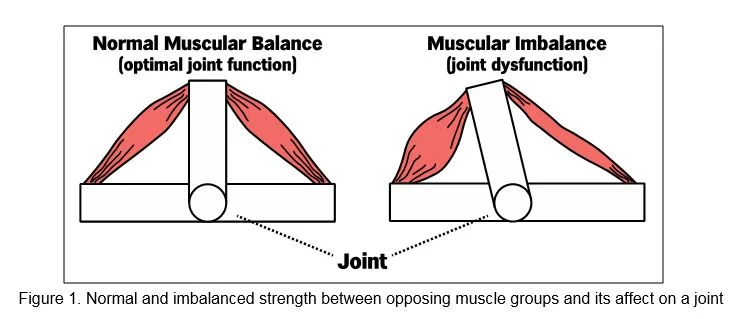
Figure 1: Notice the difference between normal and imbalanced strength and its impact on a joint.
When the central nervous system senses joint instability, it reduces the ability to continue strengthening the muscles that are already too strong. This an effective safety mechanism the body utilizes to protect itself from injury.
However, this safety mechanism can be “overridden” by attempting to force the already too strong muscles to get even stronger — many injuries occur under these conditions. If you place more strain on the weakest link than it can tolerate, the chain breaks.
While unpredictable accidents will still occur, a thorough structural balance assessment can:
- Identify muscle weaknesses that leave a joint vulnerable to injury and compromise performance;
- Faulty movement patterns that cause misalignment of the body, which results in distorted movement;
- Muscle tightness that can result in strained or torn muscles, and;
- Provide the blueprint from which your initial training program is developed.
A structural balance assessment also provides a starting point for your training. Your initial training program is developed based on the results of your assessment and aimed at correcting your weaknesses, faulty movement patterns, and tight muscles through a progression of corrective and remedial exercises. This approach expedites your results and helps ensure continuous progress.
A thorough structural assessment should be the first step of anyone’s training program whether you are a competitive athlete from any level of competition, an avid CrossFitter, or someone who wants to look better and improve your health.